Resources / Study / Innovation for Court ADR

Just Court ADR

The blog of Resolution Systems Institute

Posts Tagged ‘mediation’

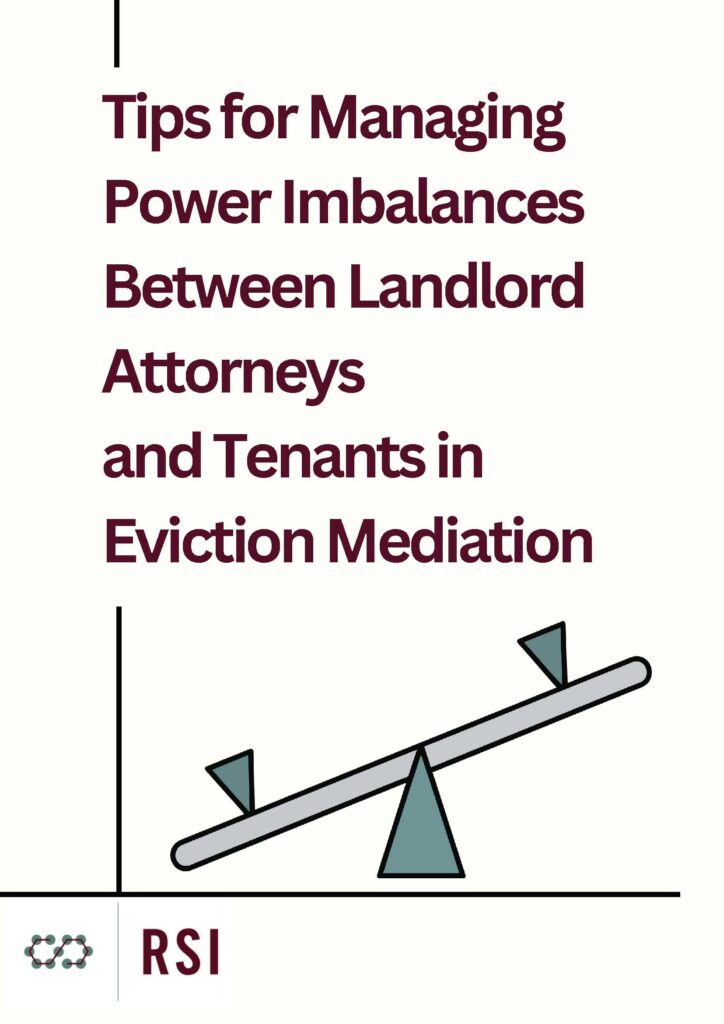
New Toolkit Helps Mediators Manage Power Imbalances Within Eviction Cases

Victoria Wang, February 11th, 2026

What happens when one party is an experienced attorney ready to negotiate, while the other is a self-represented tenant who is unsure of what to say or what the terms in the agreement really mean? This scenario is common in eviction mediations, where differences in legal knowledge, resources and confidence can create a stark imbalance in disputes between landlords and tenants. These imbalances are not always obvious, but they can quietly shape the course of the discussion and the fairness of the outcome. For mediators, navigating these dynamics is one of the toughest challenges of eviction cases. How does a mediator balance power without going too far in assisting the tenant? 

To better support mediators in this critical work, Resolution Systems Institute (RSI) has developed a Power Imbalance Toolkit. This resource draws on direct observation of eviction mediations, review of academic literature, and feedback from practitioners to identify the most common imbalance issues and provide practical strategies for mediators to address them. The toolkit is designed to be both accessible and actionable: Mediators can use it for training, preparation or even a quick reference during a session.

Why a Toolkit on Power Imbalance?

Since 2021, as an aspect of fulfilling its mission to enhance court alternative dispute resolution (ADR) systems, RSI has administered an eviction mediation program in Kane County, Illinois. As part of this work, RSI observes eviction mediations from time to time to identify what is working well and where additional support for mediators might be needed.

In the summer of 2025, our research team focused specifically on how power imbalance plays out in these sessions. In reviewing these mediations, we noticed recurring patterns: Tenants frequently came to mediation not understanding the court process, and they struggled with legal terms and procedures; mediators grew familiar with attorneys from past mediations; and some tenants became silent or disengaged under the stress of the situation.

Academic research confirms that power imbalances can erode mediation’s intended benefits. Research points out that while mediation has the potential to give tenants a voice and produce fairer outcomes than litigation, these benefits can be undermined when mediators lack clear strategies for addressing imbalance. Moreover, consistent with RSI’s observations, scholars highlight the persistent and layered power disparities in landlord-tenant relationships, from differences in financial resources and legal knowledge to broader structural inequalities such as poverty disparities. A review of the related literature finds a gap: Much has been written about structural reforms and ethical questions, but less attention has been paid to the micro-level conduct of mediators and the practical steps they can take during sessions to account for power imbalances.

We saw during our observations that mediators sometimes responded well to these challenges, but at other times they lacked specific tools or awareness to recognize and respond to power imbalances in real time. For example, in some sessions, tenants asked about legal terms, but mediators hesitated to provide an explanation, noting that they had not received clear guidance on how to handle such requests. This is not uncommon among mediators in general, and it is not surprising. Most mediation training covers neutrality, communication and facilitation skills in a comprehensive way, but power imbalance in eviction cases raises a distinct set of issues that may not be directly addressed in standard training. In addition, many mediators are also mindful of maintaining clear distinctions between providing legal information and providing legal advice.

We developed the Power Imbalance Toolkit to help bridge this gap, offering mediators concrete, context-specific strategies to recognize and respond to the challenges of eviction mediation in real time.

What’s Inside the Toolkit?

The toolkit is organized into nine sections, each focused on a particular imbalance that mediators are likely to encounter in eviction sessions:

  1. Technological Issues — When parties join remotely, particularly via mobile phone, and struggle with Zoom functions, electronic document signing, etc.
  2. Mediator Mediated with the Attorney Before — When mediators have mediated with the attorney before and have a level of familiarity with them, which tenants may see as an indicator of bias 
  3. One Party’s Dominance — When one party controls the conversation, sidelining the other party
  4. One Party’s Silence or Passivity — When one party remains quiet, making it possible to mistake silence for consent
  5. One Party’s Emotional Stress and Fear — When parties’ anxiety or fear inhibits participation
  6. Parties’ Unfamiliarity with Court Procedures and Legal Terms — When parties, usually tenants, do not understand legal terms like “seal the case” or “dismissed without prejudice”
  7. Complex Proposals — When attorneys suggest intricate settlement terms that may be hard for tenants to grasp
  8. Drafting Agreements — When agreements are written in legalese or terms are dictated by attorneys without tenant input
  9. Scope of the Discussion — When attorneys limit the scope of the conversation and do not address issues like unpaid rent after a tenant moves out

Each section of the toolkit follows the same structure to make it easy for mediators to use. It begins with “What is the issue and what should I watch for?,” which describes the specific imbalance and highlights common warning signs that might appear during a session. The second part, “What should I do?,” provides concrete approaches that mediators can take, including sample questions and prompts to encourage fuller participation or check for understanding. Finally, each section ends with “Quick Tips for Your Toolbox,” a concise summary that mediators can consult at a glance, whether as preparation just before a mediation or as a quick refresher.

The toolkit also includes a plain-language glossary of legal terms that commonly arise in eviction mediation. Terms like “sealing the case” and “dismissed without prejudice” can be intimidating to tenants who are unfamiliar with court processes. The glossary gives mediators simple, accessible definitions they can use to ensure tenants understand what is being discussed.

How Mediators Can Use the Toolkit

The Power Imbalance Toolkit is meant to be flexible. Mediators can:

  • Prepare before sessions by reviewing the common issues and reminding themselves of strategies to address those issues
  • Reference it quickly during sessions for language prompts or quick tips
  • Incorporate it into training for new mediators who are just beginning to work on eviction cases

RSI sees the toolkit not as a static document, but as a living resource. We encourage mediators to share their feedback and experiences, which will help refine and expand the strategies over time.

Looking Ahead

Addressing power imbalances in mediation is essential to ensuring fairness and accessibility. While mediators cannot eliminate the structural disparities that exist outside the mediation room, they can take meaningful steps to create a process where all parties feel heard and where agreements reflect informed consent.

The Power Imbalance Toolkit is part of RSI’s broader mission to strengthen mediation practice and improve access to justice. We hope mediators will find it useful in their day-to-day work and that it sparks conversation about how to best support tenants and landlords navigating the difficult realities of eviction.

You can read and download the full Power Imbalance Toolkit on our website. We welcome your feedback and ideas for future updates. Together, we can continue building mediation practices that are fair, effective and responsive to the communities they serve.

Survey Comments Highlight What Tenants, Landlords Think About Mediation Program

Jasmine Henry, September 16th, 2024

Since 2021, Resolution Systems Institute has administered the Kane County (Illinois) Eviction Mediation Program. Our team works with the 16th Judicial Circuit Court and community services to mitigate the negative effects of eviction filings. We conduct intake, schedule mediations, provide guidance for parties going through eviction mediation, manage the mediator roster, and provide assistance to the mediators as needed. After parties participate in mediation, we ask them to complete a survey about their experience, including answering multiple open-response questions.

Kane County Eviction Mediation Program Survey Comments

Landlord and tenant comments on the program and their mediations illuminate what they value and what falls short for them. We have seen how the process makes parties feel respected and listened to, and what that means for them. We have also learned of issues that arise with power imbalances and with mediators who repeatedly facilitate cases involving the same attorney.

Mediation as a ‘Life Preserver’

Comments from the past year make clear that many parties have been profoundly affected by their experience with our program and their mediation. This is perhaps best exemplified by this comment from a tenant: “Everyone has their own reasons for difficulties. I got a chance to say how this happened and also how I can prevent it from happening in the future. I’m thankful for everyone who has helped me through this and being treated fairly and with respect. This program is a life preserver to a drowning person. Thank you.”

Another tenant shared a similar sentiment, saying, “When people go through a difficult time, this program gives them a chance.”

Mediator Role is Key

As with so many mediation programs, mediators are central to parties’ positive experience in the Kane County program, survey responses show. In fact, the presence of a knowledgeable, impartial mediator is one of the most appreciated aspects of the program. One participant noted that the mediator “listened to both sides of the story.” Another commented: “I really appreciated . . . the way the mediator helped to point out the facts of the situation and allow both parties to express themselves. As a tenant without a lawyer who’s been through a major financial crisis, it gave me the opportunity to be listened to and to get my head above water.”

Many survey respondents praised their mediators’ ability to help parties find compromise. As one tenant put it, “They really try to meet in the middle and make everyone happy in the end. It gives so much clarity and security.” Another tenant succinctly stated, “It gave a compromise to a no win situation.”

Participants noted that both the skills of the mediators and the structured nature of the mediation process ensure that all parties have a chance to contribute to the conversation. A tenant shared: “Both sides were given the opportunity to speak uninterrupted. Everything was explained clearly and the mediator was very pleasant to work with. I came in feeling anxious not knowing what to expect but was pleasantly surprised by the whole experience and outcome.” A landlord shared that it was “good to talk to the other party in the presence of some responsible people.”

“The meeting was not at all stressful once the call was started. Each party received ample time to discuss any offer, explanations of situation, possible resolutions to ensure both parties benefited.”

Tenants in particular mentioned the importance of feeling listened to. When asked what they liked about the mediation, tenants described mediators who “listened to my doubts and questions,” were “helpful and caring and want to hear what you have to say,” or gave all parties “the opportunity to discuss their thoughts and concerns.” A landlord added that their mediator “listened and asked good questions.”

Additionally, mediators were often commended for their patience and thoroughness, as exemplified by this comment: “The [mediator] was very respectful and kind and listened to all my doubts and questions. The [mediator] helped a lot and explained everything in very good detail.” Another participant described their experience this way: “The meeting was not at all stressful once the call was started. Each party received ample time to discuss any offer, explanations of situation, possible resolutions to ensure both parties benefited.”

These comments underscore the program’s success in creating an environment where both tenants and landlords feel they can speak openly, are listened to and are treated equitably.

Resources for Vulnerable Individuals

Several survey responses highlighted the program’s value for vulnerable individuals. For example, a number of comments mentioned the importance of the resources beyond mediation that the program can connect parties with. One tenant wrote that the program “was there to help me [with court paperwork] when they really didn’t have to.” Multiple commenters emphasized that they had applied to the court-based rental assistance program — which the mediation program directed many parties to, and which parties were able to access until funds ran out in June 2024. When asked if they would recommend eviction mediation to a friend, a tenant shared that they would (even though they didn’t settle their case in mediation) because “sometimes tenants are unaware of the resources available due to lack of communication or shame.”

Others expressed more general appreciation for being able to participate in the program as someone in a challenging situation: “Just every single mother that actually works and tries 100% for her and children deserves this opportunity.” Another shared: “I think it is an excellent program for families who are going through difficulties, personally I felt supported and confident in the ability of this incredible program to help.”

Perceptions of Mediator as Biased

Some survey respondents indicated that their mediators worked to minimize the usual power imbalance between tenants and landlords. For example, one commented: “My mediator was a rockstar ! The attorney tried to bully us and was interrupting them but they kept their calm and brought up my rights.”

However, some tenants expressed concerns about potential bias in the mediation process, with one tenant stating, “They are there to mostly help the landlord … It doesn’t help the tenant. At all … The mediator is on the landlord side to help them evicted you.”

“I felt because the lawyer and the mediator were familiar with one another they may have been more partial to the landlord.”

Similarly, a tenant shared, “Not only was I not informed what mediation was going to be like, but also the mediator didn’t take everything I said and just went with what the landlord [said].” And one tenant went so far as to say, “I feel like I was gaslit by the Lawyer, and [the lawyer], as well as the mediator didn’t want to hear my side.”

Some comments about pro-landlord bias reflected a tenant’s understanding that the mediator already knew or had worked with the landlord’s attorney in the past, with one tenant writing: “I felt because the lawyer and the mediator were familiar with one another they may have been more partial to the landlord.”

Another explained: “[I]t’s like the mediator and the landlord and the landlord Lawyer have some kind of friendship already[,] so that kind of singles you out when they’re cracking jokes and laughing with each other[. A]nd then [the mediator is] only hearing [the landlord’s] side and telling you [that] you have to take your side to court.”

Other criticisms related to feeling unduly pressured to reach an agreement. One tenant explained how they felt both unheard and pressured: “I feel as if, regardless what was disclosed, my landlord and his attorney pushed too hard at a hard no to mediation, not giving me a chance, and the mediator seemed to take what I had to say about the situation with a grain of salt.” Another tenant stated, “My concerns were not fully addressed, felt bullied into settling.” One expressed their frustration, saying: “The mediator didn’t listen to my needs and disregarded any of my opinions[. The mediator] listened to every word the lawyer said and also wrote anything they wanted word for word.”

How RSI Uses Feedback

RSI uses party responses to our post-mediation surveys both to evaluate and improve our program, as well as to tell the full story of the eviction mediation process. These firsthand accounts allow us to go beyond statistics to better understand how eviction mediation programs affect real people in our communities. Furthermore, these comments provide invaluable evidence of the program’s tangible benefits. By thoughtfully analyzing and presenting these comments, we strengthen our partnerships, justify program funding and, ultimately, improve our ability to effectively serve the Kane County community.

RSI takes party criticisms of our mediators and program very seriously. Every quarter, we evaluate the participant post-mediation survey responses to determine what is or is not working. Every month, we hold meetings with our program staff to review our findings. We also use our research to train mediators on how to cultivate better party experiences. When necessary, we provide further training and support to mediators with recurring issues. Occasionally, if feedback was provided but no improvement made, we remove underperforming mediators from our roster.

Negative party perceptions, even if not reflective of actual bias, indicate a need to ensure and communicate impartiality more effectively. While it can be demoralizing to read party comments complaining that a mediator was biased, these comments help us to understand the impact that such perceptions have on party experience. Mediation is meant to be a level playing field for all parties — landlords and tenants, unrepresented parties and those with attorneys.

New Board Member Nancy Welsh Discusses Fairness, Self-Determination in ADR

Just Court ADR, May 10th, 2024

In February, Resolution Systems Institute welcomed two new Board of Directors members to their first RSI board meeting. Recently we wrote a blog introducing you to one of them, University of Denver Law Professor Oladeji M. Tiamiyu. For this edition, we spoke with the other, Texas A&M Law Professor Nancy A. Welsh

Nancy Welsh is a member of the Board of Directors of Resolution Systems Institute

Nancy Welsh is the Frank W. Elliott, Jr. University Professor, Professor of Law and Director of the Dispute Resolution Program at Texas A&M University School of Law. She is a leading scholar and teacher of dispute resolution and procedural law. Prof. Welsh examines negotiation, mediation, arbitration, judicial settlement and dispute resolution in US and international contexts, focusing on self-determination, procedural justice, due process and institutionalization dynamics. Read more about Prof. Welsh’s background and find links to her work in her RSI bio.

When/where were you first introduced to alternative dispute resolution?

I first learned about alternative dispute resolution when I was in law school. Frank Sander — one of the founders of the ADR movement (including the contemporary mediation movement) — was one of my law professors. He taught a course that I believe was called Alternatives to Litigation. That was where I first learned about mediation. I’m sure we also covered arbitration, but negotiation principles and mediation are what I remember best. I actually enjoyed the exam in that course — an unusual experience! — because we needed to think about what the parties wanted and what their underlying interests likely were. We also needed to think practically when different alternatives existed that might be responsive to their underlying interests. I found the problem-solving aspect of the course to be really exciting.

I also had the opportunity to take a mediation training when I was in law school and then to mediate in a small claims court.

What are some of the big questions related to ADR that interest you or that you are currently focusing on?

I’ve always been interested in the intersection between negotiation, mediation, arbitration and the courts, which, of course, is where RSI largely is located. I have been a big advocate of negotiation, mediation and arbitration when the parties have actually selected these processes, and when the processes have been managed in a manner that helps to ensure that people really have the opportunity to think and share what they care about, to think about what options might exist for resolution, to be fully informed, and to freely make their choices.

One thing that really excited me about negotiation and mediation was that it seemed as though — especially once you started asking about and looking at underlying interests — a whole new path to resolution opened up. I had gotten to a point where it seemed to me that when we were talking about the law, there was no path; there were only positions and legal arguments.

So when people are choosing negotiation or mediation, when they really have the opportunity to be informed and to explore what other options exist that can be responsive to their needs, I am entirely in favor of these processes.

When the mediation process is one in which mediators or lawyers decide that the parties are never going to be in direct contact with each other — putting them in separate rooms and with the mediator just shuttling back and forth — and when the focus of mediation is primarily on getting the parties to be more realistic in the way that the mediators and lawyers want them to be, I am less enthusiastic about the processes. Some reality-testing is almost inevitable, but the mediation process also should provide the opportunity for the parties to express what is really important to them, to be heard in a dignified setting, and to explore options that meet their needs. I care a lot about procedural justice and self-determination and have written extensively on both.

Importantly, we really don’t know what happens in most mediations. The courts don’t regularly collect or publish such data. Again, this is a world in which RSI operates; RSI has been involved in much more research and evaluation than a lot of organizations and encourages court-connected programs to evaluate and collect data. That is really important. How can you know what is going on if you don’t have any information?

Meanwhile, I know that a lot of the data we do have indicates that people are satisfied with the mediation process. So that’s important. I just think the process can be one that enables people to fully exercise self-determination consistent with the American ideal of democracy, that each of us is a thinking human being who can be educated and make good decisions. And then, of course, we also need data regarding the other dispute resolution processes.

What in your current academic work, if anything, relates to the work of RSI?

My academic work relates to RSI’s work because RSI does so much with data and evaluation, and a lot of my writing has been about mediation and court-connected processes, which are obviously core areas for RSI.

I wrote a series of articles (one of which is “But Is it Good: The Need to Measure, Assess, and Report on Court-Connected ADR”) that focus largely on the need for more data, for regular reporting by the courts regarding their use of dispute resolution processes. How many cases were eligible? How many cases actually went to these dispute resolution processes? Did they settle? On what terms? What were parties’ perceptions of the procedures and outcomes? And then I also have urged that courts have some responsibility to ensure substantive fairness in the aggregate, or at least some responsibility to ensure that there is not a systemic pattern of unfairness in outcomes.

What attracted you to/made you want to join the RSI board?

I have thought for a long time that RSI is a really wonderful organization and it’s doing important work. When I identify who is out there focusing on court-connected dispute resolution, helping to ensure that research is being done and that courts are getting the kind of assistance they need to provide good court-connected dispute resolution processes, RSI has been at the center of it. Jen Shack is a wonder. Susan Yates is a wonder.

What are you most looking forward to during your time on the RSI board?  

I think there are amazing people who are involved with RSI, so I’m looking forward to getting to know the staff and the board. I’m excited to be working with people on the board — some of whom I’ve known and respected for a long time, and others whom I’ve known by reputation but have never before met. It’s an honor to join them.

Better Forms Can Help Reduce Fear and Confusion for Self-Represented Parties

Christina Wright, February 21st, 2024

In an eviction courtroom filled mostly with self-represented defendants, the confusion and fear can be palpable: fear over what the future holds, and confusion about the process and the parties’ options.

But some of this anxiety can be mitigated. Represented or not, parties should always have access to the information they need to understand what is happening in their court case. One way to help reduce the confusion and fear is to provide easily accessible court forms with instructions in plain language.

A small group of individuals is working toward precisely this goal, and recently I began volunteering with them.

Hands hold a pen and a nondescript form.

When forms are understood and completed correctly, the court process is smoother, time is used more efficiently, and there is less risk of legal errors that might compromise a case on behalf of self-represented litigants.

In 2012, the Illinois Supreme Court created the Illinois Supreme Court Commission on Access to Justice (Commission) to “promote, facilitate and enhance equal access to justice with an emphasis on access to the Illinois civil courts and administrative agencies for all people, particularly the poor and vulnerable.” The same year, the court adopted an administrative order spelling out how the Commission and the Administrative Office of the Illinois Courts (AOIC) would be tasked with developing, reviewing and approving standardized court forms for the entire state. 

The Forms Committee currently has 13 drafting subcommittees, which consist of judges, attorneys, clerks and other court stakeholders — such as RSI and me — who help create new forms when needed and update existing forms in an annual process, according to Lillie Schneyer, Forms Program Coordinator with the AOIC.

“Annual review is an important process to ensure that the forms are up to date with the latest court processes, are as user-friendly and effective as possible, and remain legally sufficient,” Schneyer explains.

Over the past few months, I have been working with the Eviction Subcommittee to revamp the forms provided to people involved in eviction cases. We are reviewing current documents, such as the Eviction Order, Appearance and Agreed Order forms, that have received comments and suggestions from members of the public or that members of the subcommittee have comments or questions about. (Draft forms are posted for public comment on this page of the Illinois courts site.)

We work together as a small group to adjust language, instructions, spacing, and any other minute detail that has been brought to our attention. Our overarching goal is to make the forms as simple and accessible as possible, with the hope that any self-represented party can maneuver them, while also ensuring that the language used is legally responsible and applicable.

We work together as a small group to adjust language, instructions, spacing, and any other minute detail that has been brought to our attention as in need of revamping. We analyze the law in reference to the language to be used on the forms and the implications of the changes we are making. Our overarching goal is to make the forms as simple and accessible as possible, with the hope that any self-represented party can maneuver them, while also ensuring that the language used is legally responsible and applicable.

The process can be tedious, but having seen eviction cases play out in my role with RSI, I recognize how important it is for all parties to fully grasp what they can expect from the court, what is expected of them, and the options in front of them so they can make informed choices. The forms guide and educate litigants in their options and legal responsibilities. When forms are understood and completed correctly, the court process is smoother, time is used more efficiently, and there is less risk of legal errors that might compromise a case on behalf of self-represented litigants. All in all, having accessible Supreme Court forms benefits both the self-represented litigants and the court itself.

When our work is complete, the revised forms will be published in the Court Forms Hub of the Illinois Courts website.

Verified by ExactMetrics