RSI is developing a tool for use by any court — and potentially others — with a mediation program: a brief animated video explaining the mediation process to parties in an easy-to-follow format. Topics will include: the purpose of mediation, the mediator’s role, confidentiality and exceptions to confidentiality, and what happens if parties reach an agreement. Because the video will focus on the general mediation process itself (instead of the topics discussed in mediation), it will be useful across multiple civil case types (such as child protection, eviction, foreclosure and small claims).
We will create the video in accordance with the findings from user testing in our ODR Party Engagement (OPEN) Project. Our user testing demonstrated that a short, illustrated video that uses plain language and an easy-to-follow narrative was effective at helping people understand the online dispute resolution (ODR) process in ways that other materials had not been. Testers not only understood ODR well, but they gave our model explainer video an average rating of 4.75 out of 5 for ease of understanding. One tester noted that the video was “to the point and easy to follow” without being “overly animated.” Others noted additional positive aspects: One tester appreciated the human voice, saying “it felt like there was somebody there, kind of explaining,” and another liked the shorter video, saying “it was very distinct and to the point and quick; I liked it.” Another tester shared that they felt the video would be “helpful for people that don’t do well … with reading or comprehending.”
Our new video will follow the same format and style as our OPEN video: It will be relatively short and will use animation, including illustrated characters reflecting the diversity of mediation participants. The video will provide viewers with necessary information to meaningfully participate in mediation, but not overwhelm them with information. Our research has shown that taking the “legalese” out of the conversation is likely to help participants understand and feel comfortable with the video.
RSI is excited to take this opportunity to help more courts around the country readily and easily prepare participants, particularly self-represented litigants, to participate in and get the most out of mediation. Be sure to follow RSI’s Court ADR Connection newsletter and Just Court ADR blog for the rollout of the video later this year.
Recently, we looked back at the past five years of RSI’s Kane County Eviction Mediation Program. When we launched the program during the COVID-19 pandemic, an eviction moratorium was in place and the prospect of mass evictions loomed. Families feared losing their homes, landlords contended with uncertainty over managing property costs, and courts were concerned about their capacity to handle the anticipated volume of eviction cases.
Stock Photo by Nicola Barts via Pexels
The program’s primary goal has been to provide mediation as an opportunity for tenants and landlords to avoid eviction and pursue alternative solutions. One of the key ways we support this work is to connect parties to resources that may help them navigate their situation, including legal aid and information, financial counseling and, crucially, rental assistance. During the pandemic, the Emergency Rental Assistance (ERA) program helped renters who fell behind on payments. In the years since, our staff has continued to reach out to state and local programs to determine what assistance is available and to share this information with parties.
In this article, I discuss the program’s role in sharing resources with parties and how the availability of rental assistance supports positive mediation outcomes. I also discuss recently published research by Eviction Lab analyzing the ERA’s impact across the country.
Sharing Resources with Parties
Most eviction cases that enter our program involve nonpayment of past due rent due to financial hardship. Rental assistance programs provide emergency relief in such cases; funds can cover back rent or a set amount of future rent for eligible applicants. Rental assistance benefits both tenants and landlords. It ensures landlords get the rent they are owed and helps tenants maintain their housing and avoid having an eviction on their record.
However, tenants and landlords often do not know how to access these funds or how to determine their eligibility. Sometimes these programs are also paused as states or localities determine their budgets. These factors may prevent interested parties from knowing about or accessing critical resources to ease their situation.
This is where the Eviction Mediation Program steps in. As Program Manager Christina Wright shared, “Our program has the opportunity to keep the court and parties informed of these programs, increasing the likelihood of use with or without mediation. Rent assistance is a lifeline for both landlords and tenants and often plays a role in resolving said cases.” Our program staff regularly refers tenants and landlords to rental assistance programs, particularly the Illinois Court-Based Rental Assistance Program (CBRAP), which provides up to $10,000 to cover past due rent and/or funds to cover two months of future rent.
Rental assistance is especially time sensitive because application approval and disbursement of funds cannot happen immediately. At this early stage of the case, self-represented tenants and landlords are often overwhelmed by the amount of information they receive and feel unsure about what they need to do. This is where the mediation program’s intervention can make a meaningful difference. Ensuring parties can effectively and capably access the resources they need remains a core part of the work we do.
Rental Assistance Benefits to Mediation
RSI connects tenants and landlords to resources at various points of the mediation process. Beyond the direct benefits they provide, these resources also help parties better prepare to participate in mediation. As a result, parties are able to develop agreement terms that are practicable.
Without rental assistance resources, the scope of possible solutions narrows. Financial issues may remain unresolved if tenants feel unsure about what they can pay or are pressured to agree to payment plans that they later cannot meet. “We see fewer opportunities for parties to settle with a ‘pay and stay’ agreement,” shares Wright. RSI’s evaluation of New Hampshire’s Eviction Diversion Program found a similar trend. When the state’s rental assistance funding ended, overall agreement rates held, but the proportion of agreements to stay dropped (from 62% before rental assistance ended to 31% afterward).
Research on other eviction mediation programs finds that the availability of rental relief contributes to positive mediation outcomes. For example, an evaluation of Hawai’i’s Act 57 mediation program, established to anticipate the end of the state’s eviction moratorium in August 2021, found that 66% of agreements that involved the repayment of back rent noted the use of rental assistance[1]. Mediators and attorneys interviewed for the study agreed that rent relief helped parties to resolve their disputes[2].
A similar evaluation of an Eviction Diversion Program in Philadelphia found that cases were less likely to result in a subsequent eviction filing if parties received rental assistance (7.4% filing rate) than if they did not (42.2% filing rate). The researchers also note that provision of rental assistance made a meaningful impact in lowering court filing rates whether or not parties mediated or reached an agreement. The lowest rates were among those who received assistance, mediated and reached an agreement (4.2%) and those who received assistance, did not mediate but reached an agreement (1.8%).
When RSI launched our eviction mediation program, ERA was the largest source of rental assistance funds. Eviction Lab recently conducted a study on whether ERA was successful at reaching those who needed assistance most and what patterns emerged in how states distributed funding. Overall, their data suggests that ERA spending was significantly higher in high-risk neighborhoods —where eviction cases were most concentrated before the pandemic. They found that ERA also reached the demographics most at risk for eviction, including renters in majority-Black and majority-Hispanic neighborhoods. Additionally, households with children and those with higher unemployment rates received higher rates of funding than those without children or with lower unemployment rates. States varied in how they distributed funds, but Eviction Lab’s data suggests that these variations had little effect on national patterns: “the distribution of aid matched the geography of housing insecurity.”
Conclusion
These findings point to the benefit of having external support programs such as rental assistance to promote mediation program objectives and help tenants and landlords avoid eviction. Reaching parties who may not know what resources are available or how to access them remains a challenge. This is where effective communications — such as those we identified in our OPEN Project — can make a meaningful difference. The RSI research team is currently working with the eviction mediation program team to update our program materials to ensure parties can effectively learn about the program and access the resources they need. Stay tuned for updates on this project.
[1] The researchers note that it is unclear whether the remaining 33% of cases did not involve rental assistance or if the mediator did not make reference to it in the settlement agreements.
[2] The researchers note that while rent relief availability is an important factor to ensuring housing stability, it alone does not ensure such an outcome. They note that combining rent relief with a robust pre-litigation mediation process strengthens mediation outcomes.
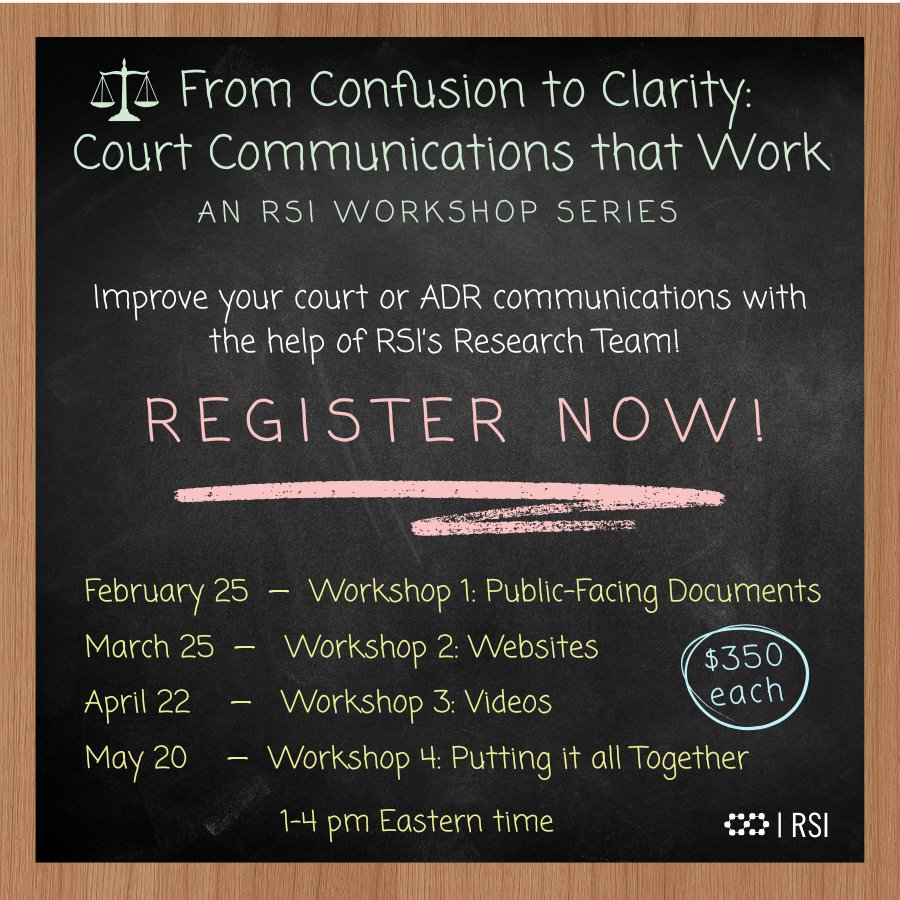
RSI is offering a series of online workshops to help courts and organizations enhance their ADR program communication materials. During these workshops — From Confusion to Clarity: Court Communications that Work — RSI’s researchers will work with participants to review and improve their communication materials, including notices, webpages and videos. Participants will walk away with new or updated materials and the strategies to ensure future communications can effectively serve their communities, including self-represented litigants (SRLs).
Improving Court Experience Remains a Priority
Courts continue to face diminished public trust and a lack of confidence among those who go through the legal system. The 2025 State of the State Courts report by the National Center for State Courts found that poor communications are a major driver of access to justice issues. People find court forms and paperwork confusing or hard to understand, and they lack information about what to expect from court processes, the report notes. In line with these findings, a recent Pew study on perceptions of state and local courts found that US adults want courts to be easier to navigate, to work for all users and to be more user-friendly.
According to the Pew study, one-third of people who have had a court experience emerged with diminished confidence in the courts. More than half of those with court experience found it difficult to understand how to fill out court forms and to understand the steps of their cases. The latter finding held true across demographic groups, including age, education level and income level, and regardless of whether the respondent was a plaintiff or defendant.
Most people also said courts should focus on making processes easier to navigate rather than making them faster. The same Pew study found that 71% of survey respondents with court experience and 68% of survey respondents without court experience said courts should make it easier for people to navigate the system rather than diverting their resources to speed up cases and reduce costs.
Why We Designed the Workshops
RSI’s OPEN research demonstrates that simple and easy-to-understand communications can meaningfully address some of the biggest challenges facing court users. Through usability testing, we found that our accessibly designed OPEN communication models boosted people’s confidence in navigating their case and enabled them to more capably follow the steps required to participate in ADR programs.
Easy-to-understand court communications are especially important for SRLs, people with low literacy and people with low digital literacy. Courts can make important inroads to improving court experience and building trust by addressing barriers in their communication materials. Our OPEN research also highlights scaffolding as an effective strategy for making the steps within court programs easy to follow.
Yet RSI recognizes that courts may not have sufficient resources for a full consultation to improve their materials. We developed these workshops to be low-cost opportunities for court staff to begin addressing these issues. By participating in our workshops, participants can take the first step to improving their existing communication materials or creating new materials that better serve their communities.
What the Workshops Will Cover
We are offering four workshops over the next few months. Each workshop will be 3 hours long and cost $350.Each will take place 12-3 pm Central/1-4 pm Eastern,via Zoom. Below are descriptions of each workshop:
Wednesday, February 25 — Workshop 1: Public-Facing Documents. Bring the documents you would like to modify or thoughts on what you want to create. You will leave with documents that are written and formatted so that SRLs will understand and act on any instructions. Register & pay now for Workshop 1, or Register & receive an invoice for Workshop 1. Please register by February 18.
Wednesday, April 22 —Workshop 3: Videos. We will help you take your ideas for a video and turn them into a storyboard to provide your communications department or consultant, or ready for you to create your own video. Register & pay now for Workshop 3, or Register & receive an invoice for Workshop 3. Please register by April 15.
Wednesday, May 20 —Workshop 4: Putting it All Together. Learn how to take your different communication methods and turn them into a workflow that enhances SRL trust and confidence in navigating an unfamiliar process. Register & pay now for Workshop 4, or Register & receive an invoice for Workshop 4. Please register by May 13.
We are excited to use what we have learned through the OPEN Project to help you with your communication needs. Please reach out to research@aboutrsi.org for any questions you may have about the workshops.
Do you know the best ways to communicate with self-represented litigants (SRLs)? That’s the question we asked our newsletter readers and social media followers over the last two months through a short (four-question) quiz. Our initial answer is in: Most quiz takers have some understanding of how best to share information with SRLs, but they also have the space to learn more.
Webinar 1: Enhancing Understanding While Reducing Stress Wednesday, October 15, Noon-1 p.m. CT Register for Webinar 1
Webinar 2: Creating Trust and Addressing the Tech Gap Wednesday, November 12, Noon-1 p.m. CT Register for Webinar 2
Our four questions — meant to be fun, engaging and educational — were based on the findings of our ODR Party Engagement (OPEN) Project. In prior research, RSI had observed the struggles SRLs can have navigating court processes, and we knew that court communications are not geared toward the 57% of the population that cannot read proficiently. So we set out to find out what SRLs need and want from court communications.
With funding from the American Arbitration Association-International Centre for Dispute Resolution Foundation, we conducted focus groups across the U.S. to learn how to improve communications for SRLs. Using what we learned, we worked with an inclusive designer and an accessibility expert to create model communication materials. We conducted usability tests around the U.S. to get feedback on these new materials. Users gave our new Notice, website and video an average 4.8/5 rating for ease of understanding.
Now, we are committed to helping courts and other organizations better communicate with SRLs. Our quiz helps us achieve this goal by providing quiz takers with the best answers and explaining why they are the most effective options. If you would like to learn more about our findings, resources, guide and toolkit, check out the website we created (odr.aboutRSI.org) to share our knowledge with courts.
As of the time of this writing, 33 people had responded to our quiz. Their average score was 42%. Though that’s a score that might feel demoralizing for some, we view it as an opportunity for quiz takers to gain essential knowledge about how to communicate with SRLs.
What we can learn from our hardest questions.
Two quiz questions stood out as particularly difficult, with less than half of the takers answering either question correctly. The questions focused on the best types of illustrations to use in documents and the best method for providing information on a webpage, respectively.
Best type of illustration to use
We asked quiz takers what type of illustration should accompany text about signing an agreement. We gave them four options, as seen in the table below. The response options included two photos and two illustrations. Despite photos making up half of the answer options, only 18% of quiz takers chose a photo as the best option. This suggests that court professionals might understand that photos are typically too complex to be used in instructive text. However, most quiz takers selected the complex illustration as the best option to accompany instructive text. Just over a quarter of quiz takers selected the correct answer: the simple illustration.
Quiz Question: What is the best visual to accompany text about signing an agreement?
Answer Choices
Percentage of Quiz Takers Selecting Answer
A. A complex illustration
55%
B. A simple photo
6%
C. A complex photo
12%
D. A simple illustration
27%
Any visuals used in communication materials for SRLs should highlight major concepts and draw the reader’s attention to them. They should not contain additional visual details that are not important to the core of your message, because excessive features can become distractions that pull your user’s focus from the relevant content.
Best method for providing information on a webpage
The question on webpage formatting got 32 responses. Quiz takers were asked if any of the following were good methods for providing information on a webpage. We gave them four options, as reflected in the table below, plus a “none of the above” option. While there was no majority agreement on this question, the largest segment of quiz takers indicated that it is a good idea to place many links on one page, and the smallest segment answered that it is best to fill both the left and right sides of the page with helpful information. A little under 20% of the quiz takers answered this question correctly, selecting “none of the above.”
Quiz Question: Which of the following is a good method for providing information on webpages?
Answer Choices
Percentage of Quiz Takers Selecting Answer
A. Place a list of links on one page, so that users can see all the resources available in one place
44%
B. Have a user-entered search box where SRLs are directed to find information
22%
C. Fill both the right and left sides of the page with helpful information
6%
D. Provide information to users via downloadable PDFs
9%
E. None of the above
19%
While any of these answers might sound like a good tip, you will want to avoid all of them. Unfortunately, it is not helpful to provide a long list of links because that can lead to “link-surfing,” where users jump around on your webpage without actually reading and absorbing any information. It is also not recommended to have a user-entered search box because sometimes users do not know the terminology for the help they seek; or, if they do know the term, they may have difficulty spelling it accurately.
Moreover, filling the whole page with information can lead your user to feel overwhelmed; instead, it is best to create white space on your webpage and keep the most important information to one side of your screen. It is also important to remember that many users are approaching your webpage via their phone or a borrowed computer and may not have access to a PDF reader, digital storage device or free printer. Thus, it is important to embed all important information within the text of your webpage itself so it is easily accessed by all your users.
Want to learn more?
This fall, RSI will present two free webinars for courts, ADR professionals and others. In our series — From Confusion to Clarity: Court Communications that Work — we will offer insights into barriers to program communication and participation and how you can address those barriers. We will provide practicable “good” and “bad” examples and actionable tips on making court communications that your users will understand, trust and use.