RSI is developing a tool for use by any court — and potentially others — with a mediation program: a brief animated video explaining the mediation process to parties in an easy-to-follow format. Topics will include: the purpose of mediation, the mediator’s role, confidentiality and exceptions to confidentiality, and what happens if parties reach an agreement. Because the video will focus on the general mediation process itself (instead of the topics discussed in mediation), it will be useful across multiple civil case types (such as child protection, eviction, foreclosure and small claims).
We will create the video in accordance with the findings from user testing in our ODR Party Engagement (OPEN) Project. Our user testing demonstrated that a short, illustrated video that uses plain language and an easy-to-follow narrative was effective at helping people understand the online dispute resolution (ODR) process in ways that other materials had not been. Testers not only understood ODR well, but they gave our model explainer video an average rating of 4.75 out of 5 for ease of understanding. One tester noted that the video was “to the point and easy to follow” without being “overly animated.” Others noted additional positive aspects: One tester appreciated the human voice, saying “it felt like there was somebody there, kind of explaining,” and another liked the shorter video, saying “it was very distinct and to the point and quick; I liked it.” Another tester shared that they felt the video would be “helpful for people that don’t do well … with reading or comprehending.”
Our new video will follow the same format and style as our OPEN video: It will be relatively short and will use animation, including illustrated characters reflecting the diversity of mediation participants. The video will provide viewers with necessary information to meaningfully participate in mediation, but not overwhelm them with information. Our research has shown that taking the “legalese” out of the conversation is likely to help participants understand and feel comfortable with the video.
RSI is excited to take this opportunity to help more courts around the country readily and easily prepare participants, particularly self-represented litigants, to participate in and get the most out of mediation. Be sure to follow RSI’s Court ADR Connection newsletter and Just Court ADR blog for the rollout of the video later this year.
Last year, a few ADR staff from courts around the US approached RSI to help with a need that was no longer being met elsewhere. Court ADR administrators needed a safe space to be honest and open when discussing the challenges they face as ADR administrators. Other options couldn’t provide a closed, confidential opportunity to learn and exchange ideas. The ADR staff asked RSI to provide that safe space for them. We agreed — who else would be better suited to take on the role of convening a network of court ADR administrators than RSI?
So, in November 2025, the Court ADR Network was launched. With dozens of members signed up, we held our first meeting to figure out what members wanted from the network. We decided to have RSI host quarterly meetings at which an expert — who could be a member — would present on a topic of interest, followed by a group discussion of that topic, or anything else. We also voted on the topics that would be the focus of each of the next three meetings.
The network is open to both state and federal court administrators, from trial to appellate level, and from single courts to statewide offices. It is also open to allied staff, such as in-house researchers and staff mediators. If you fit those categories and would like to join the Court ADR Network, please reach out to jshack@aboutrsi.org.
Our next meeting in February focused on how to work with self-represented litigants, from referral through mediation. I presented on the needs of self-represented litigants, including the importance of effective communication and issues presented by power imbalances when one side has an attorney and the other does not. That was followed by a lively discussion of the role of technology and AI as avenues for access to justice.
The topic of our third meeting, held this month, was mediator recruitment and retention. Josh Pando, the New Mexico Statewide ADR Senior Program Manager, talked about his successful recruitment and retention strategies. Discussion ranged from where to find new recruits, to ways programs engage and educate mediators, to what programs require of volunteer mediators. In August, we will be talking about the use of technology and AI.
The meetings have also provided members with an opportunity to get to network and learn about what different programs are doing. In emails, members have expressed their appreciation for the network, including a new member who recently wrote, “I absolutely loved yesterday’s meeting.” In addition to the meetings, RSI periodically lets members know about resources and learning opportunities.
The network is open to both state and federal court administrators, from trial to appellate level, and from single courts to statewide offices. It is also open to allied staff, such as in-house researchers and staff mediators. If you fit those categories and would like to join the Court ADR Network, please reach out to me at jshack@aboutrsi.org.
A recent report on remote mediation and disability by Nick White, Research and Evaluation Director for the Maryland Judiciary’s Mediation and Conflict Resolution Office (MACRO), sheds light on how remote mediations might improve access to justice for people with disabilities. The RSI team has found the report’s findings helpful in assessing how our own eviction mediation program serves this population.
Photo by Gustavo Fring via Pexels
White’s research team recruited 23 mediators and 62 people with disabilities to participate in simulations of remote mediations. The research focused on participants with visual, hearing and physical disabilities. Researchers used interviews and focus groups to gain insight about participants’ and mediators’ experiences before and after the simulated mediation. Participants also completed surveys before and after the simulated mediation.
Participant Experiences vs. Expectations
In many instances, the simulated mediation seems to have met or exceeded participants’ expectations in terms of barriers. Before their simulated mediation, participants were asked what concerns they had and what potential benefits they anticipated. While most participants reported expecting technology challenges or problems communicating online, the participants’ responses after the simulated mediation indicated that most experienced fewer barriers than expected.
When asked after their simulated mediation whether it “reduced any barriers … that [they] expected to face,” 85.5% of 54 participants responded “yes.” Additionally, when participants were asked if remote mediation “created any barriers … that [they] were not expecting,” 74.5% answered “no.” This is in line with the participants’ overall comments, 73.5% of which focused on potential benefits to using remote mediation, and 26.5% of which focused on potential barriers.
Although the participants’ responses were largely positive, some barriers, discussed below, did affect the simulated mediations.
Technology Challenges
Unsurprisingly, technology issues were among the challenges. Both participants and mediators mentioned having connectivity issues during their simulated mediation. Complications also occurred with the use of assistive technology. For example, during one simulated mediation, the mediator was unable to work their closed caption software, despite having practiced using the tool prior to the session. Further, a participant noted that closed captions are not always accurate.
Participants and mediators in White’s study seemed to agree that the best solution for any potential technology challenge is to ensure everyone is fully prepared for the session. When asked what advice or info they would give someone with a disability who is considering remote mediation, a party stated: “Always communicate your needs before the mediation to make the process comfortable for you.” When asked what worked well in their session, a mediator said: “Understanding ahead of time how the participants wanted to engage in the mediation, what technology they were using, and checking in ahead of time regarding any needed accommodations or supports.”
A good intake protocol, such as the one provided in the appendix of White’s report, is important for being fully prepared. As RSI works to improve our eviction mediation program’s intake process to better serve parties with disabilities, we plan to adopt some of the report’s guidance, including adding the intake question: “Do you have any accessibility needs that we should be aware of to ensure your full participation in the remote mediation process?”
Online vs. In-Person Mediation
Participants in the simulated mediations also voiced concerns about potential disadvantages to online versus in-person mediation. A central concern was the potential loss of nonverbal communication and the possibility that the mediator might miss subtle cues like body language or tone.
Such disadvantages are exacerbated when parties are either unable or choose not to turn on their cameras. The question of whether participants should be required to keep cameras on is tricky, and not just for mediations involving people with disabilities. Having video provides mediators with nonverbal cues that can help them better recognize party emotions and engagement. It also allows everyone in the mediation to more easily see if others are in the room with a participant. Additionally, using videos for mediations can provide participants with more context; for example, a deaf participant noted that they find lip reading helpful and recommended that camera use be mandatory. However, some participants may not be able to navigate the necessary technology to turn their videos on for a remote mediation, and some may prefer to keep their cameras off, for reasons that may or may not be connected to their disability.
RSI’s mediation program typically requires that both parties’ cameras be turned on, with case-by-case exceptions. When those exceptions occur, we recommend that our mediators tell both parties to keep their cameras off, as a way to address potential power imbalances created when only one party has their camera on. (See our Power Imbalance Toolkit for more on this.)
Concerns About Discrimination
Another concern named by parties in the research was the potential for the mediator to misunderstand or discriminate against them because of their disability. Participant comments noted that discrimination sometimes occurs when the mediator does not fully understand the parties’ needs, with one participant’s post-mediation comment calling on mediators to “make sure they are sensitive to people with [disabilities].” Another research participant shared the following post-mediation feedback: “you are thinking that one size fits all disabilities — this will not be true,” and another shared, after the mediation, that “[the mediator] can check their ableist attitudes.”
The report recommends ways for mediators to accommodate parties. For example, for participants with visual disabilities, mediators can take specific care to describe any documents, graphics or photos shared on the screen. For participants with auditory disabilities, mediators should ensure they are able to use closed captioning; and, once closed captioning is enabled, they should remain vigilant to ensure it is accurate. Above all, the research emphasized that mediators should remember to treat parties with empathy and patience, regardless of their status.
Conclusions
Overall, the report found that remote mediation opened access to people with disabilities who may otherwise have a hard time participating in mediation. Further, research participants were highly positive about their experience. The report’s findings indicate that courts should take careful consideration when providing remote mediation to parties with disabilities. Deliberate planning, mediator training and a good intake protocol are all essential aspects of a fair, effective and efficient service.
RSI’s mediation program works to address several of the issues named in the report in our mediator meet-ups, which occur monthly. These meet-ups are geared toward helping our mediators better provide services to all parties who enter our program. Reports such as this are essential to helping our mediators improve.
What happens when one party is an experienced attorney ready to negotiate, while the other is a self-represented tenant who is unsure of what to say or what the terms in the agreement really mean? This scenario is common in eviction mediations, where differences in legal knowledge, resources and confidence can create a stark imbalance in disputes between landlords and tenants. These imbalances are not always obvious, but they can quietly shape the course of the discussion and the fairness of the outcome. For mediators, navigating these dynamics is one of the toughest challenges of eviction cases. How does a mediator balance power without going too far in assisting the tenant?
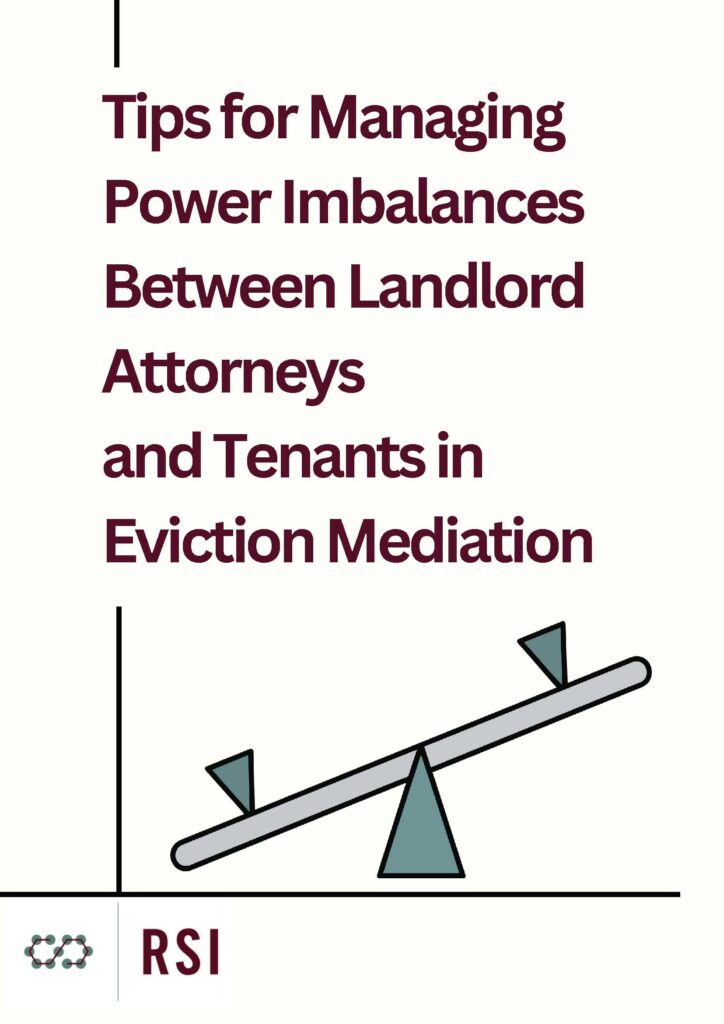
To better support mediators in this critical work, Resolution Systems Institute (RSI) has developed a Power Imbalance Toolkit. This resource draws on direct observation of eviction mediations, review of academic literature, and feedback from practitioners to identify the most common imbalance issues and provide practical strategies for mediators to address them. The toolkit is designed to be both accessible and actionable: Mediators can use it for training, preparation or even a quick reference during a session.
Why a Toolkit on Power Imbalance?
Since 2021, as an aspect of fulfilling its mission to enhance court alternative dispute resolution (ADR) systems, RSI has administered an eviction mediation program in Kane County, Illinois. As part of this work, RSI observes eviction mediations from time to time to identify what is working well and where additional support for mediators might be needed.
In the summer of 2025, our research team focused specifically on how power imbalance plays out in these sessions. In reviewing these mediations, we noticed recurring patterns: Tenants frequently came to mediation not understanding the court process, and they struggled with legal terms and procedures; mediators grew familiar with attorneys from past mediations; and some tenants became silent or disengaged under the stress of the situation.
Academic research confirms that power imbalances can erode mediation’s intended benefits. Research points out that while mediation has the potential to give tenants a voice and produce fairer outcomes than litigation, these benefits can be undermined when mediators lack clear strategies for addressing imbalance. Moreover, consistent with RSI’s observations, scholars highlight the persistent and layered power disparities in landlord-tenant relationships, from differences in financial resources and legal knowledge to broader structural inequalities such as poverty disparities. A review of the related literature finds a gap: Much has been written about structural reforms and ethical questions, but less attention has been paid to the micro-level conduct of mediators and the practical steps they can take during sessions to account for power imbalances.
We saw during our observations that mediators sometimes responded well to these challenges, but at other times they lacked specific tools or awareness to recognize and respond to power imbalances in real time. For example, in some sessions, tenants asked about legal terms, but mediators hesitated to provide an explanation, noting that they had not received clear guidance on how to handle such requests. This is not uncommon among mediators in general, and it is not surprising. Most mediation training covers neutrality, communication and facilitation skills in a comprehensive way, but power imbalance in eviction cases raises a distinct set of issues that may not be directly addressed in standard training. In addition, many mediators are also mindful of maintaining clear distinctions between providing legal information and providing legal advice.
We developed the Power Imbalance Toolkit to help bridge this gap, offering mediators concrete, context-specific strategies to recognize and respond to the challenges of eviction mediation in real time.
What’s Inside the Toolkit?
The toolkit is organized into nine sections, each focused on a particular imbalance that mediators are likely to encounter in eviction sessions:
Technological Issues — When parties join remotely, particularly via mobile phone, and struggle with Zoom functions, electronic document signing, etc.
Mediator Mediated with the Attorney Before — When mediators have mediated with the attorney before and have a level of familiarity with them, which tenants may see as an indicator of bias
One Party’s Dominance — When one party controls the conversation, sidelining the other party
One Party’s Silence or Passivity — When one party remains quiet, making it possible to mistake silence for consent
One Party’s Emotional Stress and Fear — When parties’ anxiety or fear inhibits participation
Parties’ Unfamiliarity with Court Procedures and Legal Terms — When parties, usually tenants, do not understand legal terms like “seal the case” or “dismissed without prejudice”
Complex Proposals — When attorneys suggest intricate settlement terms that may be hard for tenants to grasp
Drafting Agreements — When agreements are written in legalese or terms are dictated by attorneys without tenant input
Scope of the Discussion — When attorneys limit the scope of the conversation and do not address issues like unpaid rent after a tenant moves out
Each section of the toolkit follows the same structure to make it easy for mediators to use. It begins with “What is the issue and what should I watch for?,” which describes the specific imbalance and highlights common warning signs that might appear during a session. The second part, “What should I do?,” provides concrete approaches that mediators can take, including sample questions and prompts to encourage fuller participation or check for understanding. Finally, each section ends with “Quick Tips for Your Toolbox,” a concise summary that mediators can consult at a glance, whether as preparation just before a mediation or as a quick refresher.
The toolkit also includes a plain-language glossary of legal terms that commonly arise in eviction mediation. Terms like “sealing the case” and “dismissed without prejudice” can be intimidating to tenants who are unfamiliar with court processes. The glossary gives mediators simple, accessible definitions they can use to ensure tenants understand what is being discussed.
How Mediators Can Use the Toolkit
The Power Imbalance Toolkit is meant to be flexible. Mediators can:
Prepare before sessions by reviewing the common issues and reminding themselves of strategies to address those issues
Reference it quickly during sessions for language prompts or quick tips
Incorporate it into training for new mediators who are just beginning to work on eviction cases
RSI sees the toolkit not as a static document, but as a living resource. We encourage mediators to share their feedback and experiences, which will help refine and expand the strategies over time.
Looking Ahead
Addressing power imbalances in mediation is essential to ensuring fairness and accessibility. While mediators cannot eliminate the structural disparities that exist outside the mediation room, they can take meaningful steps to create a process where all parties feel heard and where agreements reflect informed consent.
The Power Imbalance Toolkit is part of RSI’s broader mission to strengthen mediation practice and improve access to justice. We hope mediators will find it useful in their day-to-day work and that it sparks conversation about how to best support tenants and landlords navigating the difficult realities of eviction.
You can read and download the full Power Imbalance Toolkit on our website. We welcome your feedback and ideas for future updates. Together, we can continue building mediation practices that are fair, effective and responsive to the communities they serve.