Resources / Study / Innovation for Court ADR

Just Court ADR

The blog of Resolution Systems Institute

Posts Tagged ‘Kane County Eviction Mediation’

COVID’s ERA and Beyond: How Rental Assistance Affects Eviction Mediation

Stephen Sullivan, June 18th, 2026

Recently, we looked back at the past five years of RSI’s Kane County Eviction Mediation Program. When we launched the program during the COVID-19 pandemic, an eviction moratorium was in place and the prospect of mass evictions loomed. Families feared losing their homes, landlords contended with uncertainty over managing property costs, and courts were concerned about their capacity to handle the anticipated volume of eviction cases.

Stock Photo by Nicola Barts via Pexels

The program’s primary goal has been to provide mediation as an opportunity for tenants and landlords to avoid eviction and pursue alternative solutions. One of the key ways we support this work is to connect parties to resources that may help them navigate their situation, including legal aid and information, financial counseling and, crucially, rental assistance. During the pandemic, the Emergency Rental Assistance (ERA) program helped renters who fell behind on payments. In the years since, our staff has continued to reach out to state and local programs to determine what assistance is available and to share this information with parties.

In this article, I discuss the program’s role in sharing resources with parties and how the availability of rental assistance supports positive mediation outcomes. I also discuss recently published research by Eviction Lab analyzing the ERA’s impact across the country.

Sharing Resources with Parties

Most eviction cases that enter our program involve nonpayment of past due rent due to financial hardship. Rental assistance programs provide emergency relief in such cases; funds can cover back rent or a set amount of future rent for eligible applicants. Rental assistance benefits both tenants and landlords. It ensures landlords get the rent they are owed and helps tenants maintain their housing and avoid having an eviction on their record.

However, tenants and landlords often do not know how to access these funds or how to determine their eligibility. Sometimes these programs are also paused as states or localities determine their budgets. These factors may prevent interested parties from knowing about or accessing critical resources to ease their situation. 

This is where the Eviction Mediation Program steps in. As Program Manager Christina Wright shared, “Our program has the opportunity to keep the court and parties informed of these programs, increasing the likelihood of use with or without mediation. Rent assistance is a lifeline for both landlords and tenants and often plays a role in resolving said cases.” Our program staff regularly refers tenants and landlords to rental assistance programs, particularly the Illinois Court-Based Rental Assistance Program (CBRAP), which provides up to $10,000 to cover past due rent and/or funds to cover two months of future rent.

Rental assistance is especially time sensitive because application approval and disbursement of funds cannot happen immediately. At this early stage of the case, self-represented tenants and landlords are often overwhelmed by the amount of information they receive and feel unsure about what they need to do. This is where the mediation program’s intervention can make a meaningful difference. Ensuring parties can effectively and capably access the resources they need remains a core part of the work we do.

Rental Assistance Benefits to Mediation

RSI connects tenants and landlords to resources at various points of the mediation process. Beyond the direct benefits they provide, these resources also help parties better prepare to participate in mediation. As a result, parties are able to develop agreement terms that are practicable.

Without rental assistance resources, the scope of possible solutions narrows. Financial issues may remain unresolved if tenants feel unsure about what they can pay or are pressured to agree to payment plans that they later cannot meet. “We see fewer opportunities for parties to settle with a ‘pay and stay’ agreement,” shares Wright. RSI’s evaluation of New Hampshire’s Eviction Diversion Program found a similar trend. When the state’s rental assistance funding ended, overall agreement rates held, but the proportion of agreements to stay dropped (from 62% before rental assistance ended to 31% afterward).

Research on other eviction mediation programs finds that the availability of rental relief contributes to positive mediation outcomes. For example, an evaluation of Hawai’i’s Act 57 mediation program, established to anticipate the end of the state’s eviction moratorium in August 2021, found that 66% of agreements that involved the repayment of back rent noted the use of rental assistance[1]. Mediators and attorneys interviewed for the study agreed that rent relief helped parties to resolve their disputes[2].

A similar evaluation of an Eviction Diversion Program in Philadelphia found that cases were less likely to result in a subsequent eviction filing if parties received rental assistance (7.4% filing rate) than if they did not (42.2% filing rate). The researchers also note that provision of rental assistance made a meaningful impact in lowering court filing rates whether or not parties mediated or reached an agreement. The lowest rates were among those who received assistance, mediated and reached an agreement (4.2%) and those who received assistance, did not mediate but reached an agreement (1.8%).

When RSI launched our eviction mediation program, ERA was the largest source of rental assistance funds. Eviction Lab recently conducted a study on whether ERA was successful at reaching those who needed assistance most and what patterns emerged in how states distributed funding. Overall, their data suggests that ERA spending was significantly higher in high-risk neighborhoods —where eviction cases were most concentrated before the pandemic. They found that ERA also reached the demographics most at risk for eviction, including renters in majority-Black and majority-Hispanic neighborhoods. Additionally, households with children and those with higher unemployment rates received higher rates of funding than those without children or with lower unemployment rates. States varied in how they distributed funds, but Eviction Lab’s data suggests that these variations had little effect on national patterns: “the distribution of aid matched the geography of housing insecurity.”

Conclusion

These findings point to the benefit of having external support programs such as rental assistance to promote mediation program objectives and help tenants and landlords avoid eviction. Reaching parties who may not know what resources are available or how to access them remains a challenge. This is where effective communications — such as those we identified in our OPEN Project — can make a meaningful difference. The RSI research team is currently working with the eviction mediation program team to update our program materials to ensure parties can effectively learn about the program and access the resources they need. Stay tuned for updates on this project.

[1] The researchers note that it is unclear whether the remaining 33% of cases did not involve rental assistance or if the mediator did not make reference to it in the settlement agreements.

[2] The researchers note that while rent relief availability is an important factor to ensuring housing stability, it alone does not ensure such an outcome. They note that combining rent relief with a robust pre-litigation mediation process strengthens mediation outcomes.

A Look Back at Nearly Five Years of RSI’s Kane County Eviction Mediation Program

Sandy Wiegand, April 22nd, 2026

When RSI launched the Kane County Eviction Mediation Program in May 2021, the Chicago collar county was facing the prospect of an onslaught of evictions as it became evident that pandemic-related eviction moratoria could soon wind down. Having cost so many lives and livelihoods, COVID-19 was also threatening people’s homes.

Today, as the eviction mediation program nears the milestone of five years in operation, we are taking the time to reflect on its goals and share some of its outcomes, including observations from some of the folks involved. Stay tuned in the coming weeks, too, for a more detailed and rigorous report from our Research Team, evaluating the program’s performance in 2025.

Stock photo by Kamaji Ogino via Pexels

Goals and Opportunities

RSI and Illinois’ 16th Judicial Circuit developed the Kane County Eviction Mediation Program together because we saw its potential to help families avoid sheriff’s eviction, as well as to help the court — which had only one eviction judge — manage the “tsunami” of evictions some feared would overtake it when the state’s eviction moratorium ended. Supporters also recognized that the grant-funded mediation program, which was free to participants, could benefit landlords by being cost-effective and potentially helping them to avoid empty units.

One of the program’s early, vital proponents was Judge John Dalton, who presided over Kane County Eviction Court from the program’s inception through December 2023. Judicial support has been key to the success of the program, as a 2022 RSI report stated: “The program can only function if the judges support it both by educating the parties about the resources available to them and by either strongly encouraging or requiring the parties to attend mediation. When tenants and landlords are educated about the benefits of mediation, they are more likely to want to participate.”

Noting that Kane County had been the first in Illinois to launch an eviction mediation program, Judge Dalton commented in 2023: “We have been overwhelmingly pleased with the outcomes. It has been successful in assisting landlords and tenants in reaching mutually beneficial agreements.”

Those with ADR experience, including RSI, foresaw another set of benefits from the eviction mediation program. One was the opportunity for parties to experience procedural justice, elements of which include feeling able to express oneself in mediation, finding the mediation process fair, and feeling satisfied with the process. We also knew that mediation carried the possibility of parties finding creative solutions in a way that was unlikely to occur in court.

Furthermore, because mediation was conducted online, and because the program did not charge parties any fee, it could increase access to justice. 

“(B)eing able to participate in mediation remotely via Zoom has been a huge benefit to all parties,” RSI Eviction Mediation Program Assistant Cathy McCoy noted. “Attending mediation and court in person in Kane County can be difficult without access to transportation, given the layout of the county.”

Mediations, Agreements and Avoided Evictions

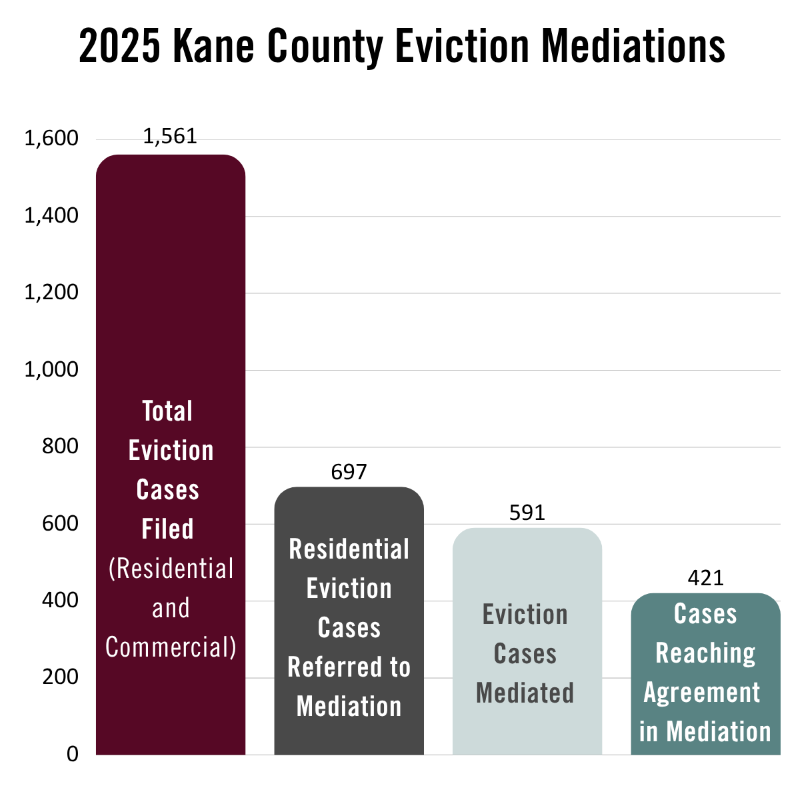
Over the course of its existence, the Kane County Eviction Mediation Program has mediated almost 3,000 cases, which led to more than 2,100 agreements that helped parties avoid eviction. RSI program staff has also connected thousands of parties to support such as financial and housing counseling, legal aid, utility assistance and rental assistance.

Cathy, who joined RSI’s staff in 2025, has also been a paid mediator for RSI since the program’s beginning. In 2024, her dedication to providing a supportive process for eviction mediation parties led her to begin volunteering in person at the Kane County Courthouse in Geneva, Illinois, as well. (Although parties can attend mediation and court online, some still choose to attend in person.)

“Eviction mediation can benefit both tenants and landlords, both by shortening the time it takes to resolve their case and by reducing the stress level so that parties can focus on the future and make difficult decisions,” Cathy told us in 2024. “Most importantly, mediation can help avoid evictions and provide a bit of stability during challenging times.”

Tenants in eviction cases are overwhelmingly self-represented, and they often feel overwhelmed and powerless trying to navigate their case. Access to mediators and other support personnel can reduce their barriers to justice. “I often work with pro se parties that express gratitude that RSI mediators help them understand the process and empower them to make decisions, when the expense of an attorney would be a financial burden,” Cathy explained.

Sophie Rexrode is an Illinois Justice Corps fellow who has worked alongside Cathy at the courthouse, providing parties with information about the eviction court process, mediation and rental assistance. Sophie points to the program as a means to improve access to justice, while also noting that promoting dialogue can have additional, less obvious impacts.

“(B)uilding out parallel and alternative ways of resolving issues is tremendously important if we are interested in having a justice system that works for everyone, and the eviction mediation program is a significant step in that direction,” Sophie said recently of the program. “I also think that opening doors for dialogue in the community is critical, and the benefits from that ripple outward even if an individual case doesn’t get resolved.”

Judge and Party Feedback

In 2024, a new presiding judge was assigned to the Kane County Eviction Court and its eviction mediation program. Judge Elizabeth Flood oversaw the mediation program from January 2024 through December 2025. “I think the program was effective in facilitating communication between the parties and giving tenants the possibility of keeping their housing or negotiating more favorable terms to move or decrease debt,” she told RSI recently.

Many on the other side of the bench seemed to agree with this assessment. RSI’s Research Team regularly surveys Kane County Eviction Mediation Program participants as one way to evaluate the program’s effectiveness. Although feedback on the program has not been universally favorable (read full reports on the program’s survey responses on RSI’s website), the great majority of comments have been positive. Here are a few: 

“When people go through a difficult time, this program gives them a chance.”

“This program is a life preserver to a drowning person. Thank you.”

“This process gave me hope that I could get through a difficult time in my life, without having to further upset my life via eviction! I am very grateful!”

And apart from the surveys, just this month, a landlord emailed program staff to say:

“I truly have nothing but incredibly positive things to say so far in the mediation process and [staff member] was beyond helpful.”

The same week, an attorney sent staff the note:

“I generally have nothing but positive things to say about the mediation program. It has helped me resolve [many] cases over the past few years. … I appreciate that the program is available to facilitate resolution.”

Procedural Justice

RSI’s post-mediation surveys of Kane County Eviction Mediation Program participants focus in particular on measures of procedural justice, or the degree to which people feel they have been treated fairly during the process. In addition to being a useful gauge of participant satisfaction, procedural justice is important to the effectiveness of mediation. When people leave mediation with a sense of having been treated fairly, they tend to be more likely to abide by the agreement reached.

RSI’s survey asks questions about voice, fairness, trust in the mediator, respectful treatment by the mediator and more. Throughout the lifetime of the Kane County program, survey respondents have consistently given it high marks for procedural justice. For example, parties who responded to RSI’s surveys after participating in the program in 2025 gave an average rating above 4 on a five-point scale for each of the five procedural justice questions.

Comments from parties often reflect their appreciation for having a voice in the process and feeling respected. For example, tenant comments from surveys on mediations held in 2025 included the following:

“[Staff member] and [mediator] … made me feel important, I was heard, I was treated fairly and it made a stressful situation very comfortable …”

“[Mediator] did a great job at making sure both myself and my landlord were ‘heard.’”

“The mediator was fair with both sides which is all anyone could ask.”

Likewise, landlord’s attorneys who took surveys provided the following comments regarding 2025 mediations:

“Mediator was fair to both sides and not overly pushy toward settlement. Mediator was incredibly inquisitive, prompting both sides to be more honest or consider things they had not considered. Mediator was patient and thorough, made sure the case was settled and worked through tech issues with the tenant.”

“The resolution took into account the requests and needs of both sides.”

Asked about the program’s impact on parties, Judge Flood summarized: “I believe most parties felt they had a greater opportunity to express themselves and be heard than in a busy courtroom.”

Benefits to the Court

Both Judge Dalton and Judge Flood also credit the Kane County Eviction Mediation Program with helping the court run smoothly.

“Around 70% of the cases referred to mediation were resolved with a settlement agreement,” Judge Flood noted, “which streamlined the court process, led to quicker resolutions, and alleviated the need for trial settings on the majority of the cases.”

“Thanks to this program, the court has been able to run efficiently during an eviction surge,” Judge Dalton said.

RSI is grateful to the funders of this program over the years, including the American Arbitration Association – International Center for Dispute Resolution Foundation and the Illinois Equal Justice Foundation.

We hope to see the program continue for many years to come.

Hon. Elizabeth Flood

Illinois JusticeCorps Volunteer Helps People Seek Rental Support, Navigate Court

Just Court ADR, January 26th, 2026

Since spring of 2025, RSI’s Kane County Eviction Mediation Program has benefited from the support of Illinois JusticeCorps to help it run smoothly: Illinois JusticeCorps fellow Sophie Rexrode has worked alongside RSI in the courthouse, providing parties information about the eviction court process, mediation and rental assistance. Sophie was kind enough to sit down recently and answer a few questions for us about her work. We’re so grateful to Sophie for all she does to help the program serve the Kane County community! Please note that the views expressed below do not represent those of Illinois JusticeCorps, AmeriCorps or the Kane County Law Library.

Can you tell us a bit about the Illinois JusticeCorps program? When did you join?

Sophie Rexrode

I joined Illinois JusticeCorps in the fall of 2024, because I knew I was interested in (and frustrated with!) the legal system and wanted to devote time to serving people impacted by it.

Illinois JusticeCorps is an AmeriCorps program that places volunteers in courthouses across the state to help people who don’t have lawyers navigate the legal system. We field all kinds of questions, from “Where is the courtroom?” to “How do I file an employment discrimination complaint?” to “I was just served with divorce papers, and I don’t know what that means or how to proceed.”

JusticeCorps members aren’t lawyers, and we can’t give legal advice, but we can provide legal information like forms and guides, and explain how court processes work. The court system is incredibly stressful and confusing, so we’re here to listen, share resources and hopefully make people’s experiences a little bit easier.

What led you to join Illinois JusticeCorps, and how did you get connected with RSI?

I’d always been interested in law, but I didn’t have any background in it before joining Illinois JusticeCorps — I studied cognitive science and theater in college. But in my time as a JusticeCorps member I expressed a strong interest in housing and eviction issues, so when my supervisor, Hallē Eichert (the Director of the Law Library), heard that there was a need for help with Court-Based Rental Assistance Program (CBRAP) applications, she put me in contact with (RSI Eviction Mediation Program Manager) Christina Wright and RSI.

What does your JusticeCorps work at eviction court entail?

I’ve been assisting with CBRAP applications and tabling with RSI outside eviction court since spring 2025. I table with (RSI Eviction Mediation Program Assistant) Cathy McCoy each week to provide information on the court process, mediation and rental assistance. 

Much of my work is helping tenants fill out the rental assistance application. You can only apply for CBRAP on a website, so if people want to apply but don’t have access to/aren’t comfortable with computers, I’ll help them through the process of scanning and uploading documents. Because transportation poses a hardship for many tenants in eviction proceedings, I travel all over the county to meet people at public libraries near where they live and help them in person.

Outside of evictions, most of my work is at the Kane County Law Library & Self Help Legal Center in St. Charles, where I work alongside the fantastic staff there to provide legal navigation. I also assist with the Lawyer in the Library programs (bringing free legal advice to local public libraries) and help to redesign signage and resources to make court processes easier to understand.

How many hours a week do you generally spend on JusticeCorps work?

It really depends on how many people I’m working with! I’d estimate I spend anywhere from 2–8 hours per week, including time at eviction court and helping people with applications. I know I’ve volunteered over 95 hours in the time I’ve been doing this.

Do you live in Kane County?

I do! I’m originally from the East Coast but moved here to work with Illinois JusticeCorps. I’ve really enjoyed getting to know the community here and exploring up and down the river and through all the parks!

What is your favorite part about your Illinois JusticeCorps work?

My favorite part about tabling and assisting with CBRAP is the people. The meetings I have with tenants can be stressful and difficult, but they are also full of real connection and (surprisingly) laughter. Even while navigating one of the hardest things in life, the tenants are kind, generous, and funny. It’s a privilege to get to work with them.

What do you find challenging about your work with the eviction mediation program?

I find the limitations on resources available and the services we can provide to be frustrating at times. It’s wonderful that mediation exists as an opportunity, but it can still be an inequitable arena for tenants going up against their landlord’s attorney without any representation, especially for those who aren’t comfortable with computers or have other accessibility or access needs. Similarly, while the CBRAP program is fantastic, far too many people still fall through eligibility gaps and are blocked by procedural obstacles.

Do you have future career plans/goals that relate to this work?

Yes! I’m currently starting the law school application process, with the hopes of pursuing legal aid work specifically around housing and evictions.

Do you do other volunteer work? 

I volunteer lots of places! Some of my volunteering relates directly to housing: I take shifts at the Aurora Overnight Warming Shelter and help build houses with Habitat for Humanity. I’ve also done volunteering with local forest preserves, local food pantries/banks and community fridges, and as a “snow angel” (shoveling driveways for neighbors).

Working in an environment where eviction is on the table can be stressful. What do you like to do for fun/to relieve stress?

I love trail running, and try to get outside whenever possible. I doodle in the margins of notebooks and like to write letters to friends and family.

How do you think the Kane County Eviction Mediation Program is important to the community it serves?

I think building out parallel and alternative ways of resolving issues is tremendously important if we are interested in having a justice system that works for everyone, and the eviction mediation program is a significant step in that direction. I also think that opening doors for dialogue in the community is critical, and the benefits from that ripple outward even if an individual case doesn’t get resolved.

Is there anything else you’d like to talk about that might be interesting/relevant to RSI’s readers?

I just want to emphasize how serious evictions are, and the gap that exists in legal services for low-income people. 96% of tenants don’t have lawyers but are stuck navigating a process that was built by and for attorneys. Almost all landlords are represented by attorneys, many of whom specialize in evicting tenants. Court processes are challenging at the best of times, but they become impossibly confusing in the chaos that ensues when someone is threatened with being removed from their home. Evictions are catastrophically destabilizing events, jeopardizing tenants’ jobs, families, communities, and health, yet there are few support systems for people thrown into this process. Against this backdrop, I am grateful to be able to provide the small assistance I can to tenants, but there is such a tremendous need.

Grant Helps RSI’s Eviction Mediation Program Better Serve Domestic Violence Victims

Jasmine Henry, July 30th, 2025

Housing insecurity and domestic violence are deeply intertwined. In fact, according to research cited by the American Bar Association’s Commission on Domestic and Sexual Violence, 38% of domestic violence victims experience homelessness, and over 90% of homeless women have experienced severe physical or sexual abuse at some point in their lives. Recognizing this correlation, RSI sought to improve our eviction mediation program and better serve participants who have been affected by domestic violence.

Late last year, RSI applied for funding from the Illinois Equal Justice Foundation (IEJF) to support training our mediators on how domestic violence can affect victims and enable us to develop a more robust screening process to better identify any potential mediation cases involving domestic violence. Since receiving funding in January, we screened approximately 500 eviction mediation cases for instances of domestic violence. Of those cases, 13 were identified as involving domestic violence or intimate partner violence, and victims were referred to a variety of resources. Nine of those cases had mediation process adjustments as a result of domestic violence, such as only using separate Zoom breakout rooms or being assigned the specific gender of mediator requested.

What We Needed

Since the inception of the Kane County Eviction Mediation Program in 2021, RSI’s staff has been committed to creating safe mediation spaces for all parties involved. Designing respectful and responsive spaces for our program participants helps us effect our mission of strengthening access to justice by enhancing court alternative dispute resolution (ADR) systems.

Over the last few years, our program routinely noted instances of domestic violence affecting the parties in our eviction cases. While our staff and mediators tried to remain sensitive to our participants’ emotions and how their experiences might affect the mediation, none of our mediators had domestic violence training, so they were not as well prepared to adjust the mediations to ensure the safety of parties with a history of domestic violence. Additionally, it was difficult for our program and mediators to understand the scope of the issue without a proper screening process. Thus, in November 2024 when an opportunity became available, RSI’s Kane County Eviction Mediation Program applied for grant funding from IEJF to assist survivors of domestic and intimate partner violence through civil legal services and legal information. 

What We Developed

With funding secured, we designed a system to screen for domestic violence prior to eviction mediations and to modify mediations when domestic violence has been present to promote the safety of the parties involved. To screen for domestic violence, we added three questions to our intake process for all parties. These questions asked if anyone who currently lived with them, anyone they were in a relationship with, or the other party in their case had made them afraid, controlled them, hit them or contacted them in unwanted ways. We also asked if they had a current order of protection.

If warranted based on a party’s response to those questions, a staff member then went through the MASIC-S questionnaire with the party to determine what types of modifications were needed. (The MASIC-S is a research-validated screening tool to help mediators identify the types and severity of domestic violence involved. Depending on the party’s responses, it recommends modifications to the mediation process to maintain participant safety.)

While updating our intake process, we also worked to better train our staff and mediators on how to handle domestic violence issues. We held three separate trainings — hosted by the Community Crisis Center in Elgin, Illinois; RSI; and the Center for Conflict Resolution in Chicago. These domestic violence trainings focused on awareness of victim impacts and needs, how to have compassionate discussions about abuse disclosures and trauma-informed practices. Sixteen mediators on our program roster attended all three trainings and became eligible to mediate eviction cases that included a party who had experienced domestic violence.

In June, we decided to eliminate the more intensive MASIC-S step because the full screening took over an hour to complete and the advice provided after the party responded was essentially the same as what our program would have done without using the MASIC-S. There was also a sense among staff that the MASIC-S step may have been retraumatizing for the involved party, and we could not always provide immediate supportive resources to address these reopened wounds.

Who We Helped

Of the 500 defendants screened for domestic violence, 13 defendants were flagged and referred to outside services. All 13 were referred to legal advocacy, rent assistance and housing counseling services. We also gave 29 additional support service referrals to these tenants, including referrals to disability support services, immigration support services, victim support services, food assistance, utilities assistance and homelessness prevention services. Three of the defendants we referred to legal services ended up being represented by a pro bono attorney.

We held mediations for 11 of the 13 cases involving domestic violence. One was dismissed, and another has yet to take place. Based on our screening, we made safety- and security-related process adjustments for nine of the mediations. The process adjustments included keeping the parties in separate Zoom rooms in six of the mediations, holding an early caucus for one case, allowing a support person to attend with the involved party in one case, and providing a female mediator in one case. Eight mediations ended with an agreement. Seven of these agreements were for the tenant to move out; another was an agreed dismissal order, since the tenant had already moved out. These agreements gave tenants the opportunity to avoid the financial and emotional impacts of eviction while also affording them more time to move out.

While it can be difficult to understand the human impact of our program modifications purely based on the number of cases, referrals and process adjustments, the specific instances of domestic violence that participants shared with our staff left a lasting effect.

In a particularly disheartening case, a female tenant reported being sexually assaulted, verbally abused and intimidated by her male landlord over the course of about five months. As a result of her background, she was wary of the police, and she disclosed to our staff that her landlord actively worked to reinforce those fears. She was terrified that divulging his exploitations would hurt her family. Yet as a result of the abuse, she told us, she was forced to go to the hospital for prescription treatment. Shortly after getting medical care, she reported the abuse to the police but did not find their response helpful. Upon returning home, she found that her abuser had locked her out of her unit.

Soon after, the landlord filed an eviction case; he also continued to threaten and intimidate her throughout the court process, she said. When the eviction case was referred to our mediation program, RSI staff referred her to pro bono legal, immigration and victim advocacy assistance. Throughout the mediation process, our program worked with the tenant to get her into a safe living space. In the end, the woman was able to move out prior to mediation. Her landlord dismissed the eviction case without seeking money and without entering a formal eviction onto the tenant’s record.

In another case, a tenant’s past violent relationship was impacting her current livelihood. Several years ago, this tenant was locked out of her partner’s house during a domestic violence incident. This forced the tenant to get an apartment by herself for the first time. She enrolled in a housing assistance program at a nearby domestic violence support organization. After this assistance ran out, the tenant became distressed and ultimately depressed; she could not maintain employment and, by the time she came into contact with our eviction program, she was several months behind on rent. Additionally, as a result of a previous domestic violence incident with her abuser, she could not obtain free legal aid to help with her eviction case.

Our program adapted to the tenant’s unique needs and pivoted from our traditional referrals. We provided services to a different local domestic violence resource, as well as resources for a local hospital that treats depression. We also referred her to rental assistance and a homeless shelter with additional resources.

The mediation resulted in a moveout order and a payment plan. The tenant avoided eviction, had a plan to pay off her debt, and was given support in finding affordable housing. In this way, we were able to help the tenant stem the damage from her past domestic violence experiences. Moreover, the landlord was made whole financially, and the unit was ultimately returned to their possession.

In yet another instance, the program helped a defendant who was living with her abusive boyfriend during an eviction case. During the intake process, the tenant disclosed her physically and emotionally abusive living circumstances. First, our program staff worked with the tenant to create a safety plan while she was still living with her abuser. Then, we supported moving her and her ten children out of their current living situation. Additionally, our program connected the tenant to a variety of resources, including an agency that could help with both domestic violence and housing counseling, a rental assistance program and our legal aid partner.

What We Learned

In six short months, RSI’s eviction mediation team was able to improve its screening techniques and better assist domestic violence victims involved with our program. Whereas previously we only learned of domestic violence if a party happened to bring it up, we now have a clear system in place to sort the cases and help prepare mediators and parties to make appropriate adjustments. Because we are screening every case, we have the opportunity to provide parties access to support resources prior to their mediation if they seek it; in some cases, this resulted in a faster and smoother resolution for both the landlord and the tenant.

Verified by ExactMetrics