
More than 1 in 4 eviction cases filed in Kane County, Illinois, in 2025 were resolved through RSI’s eviction mediation program, and most participants were satisfied with their mediation and the process. Participating tenants and self-represented landlords were consistently referred to additional resources such as legal and rental assistance. These are among the findings in a new report coming out in September on the Kane County Eviction Mediation Program’s performance in 2025.
Background
RSI, the Illinois’ 16th Judicial Circuit Court and other partners established the Kane County Eviction Mediation Program in spring 2021. RSI administers and continually evaluates the program with funding from Eviction Help Illinois, administered by the Illinois Equal Justice Foundation (IEJF). All residential eviction cases in Kane County are eligible for the program. Most referrals to mediation occur at the judge’s prompting during the parties’ first court hearing. Mediations typically occur over Zoom. After mediation, all parties are sent a survey about their experience.
Participation and Agreement Rates
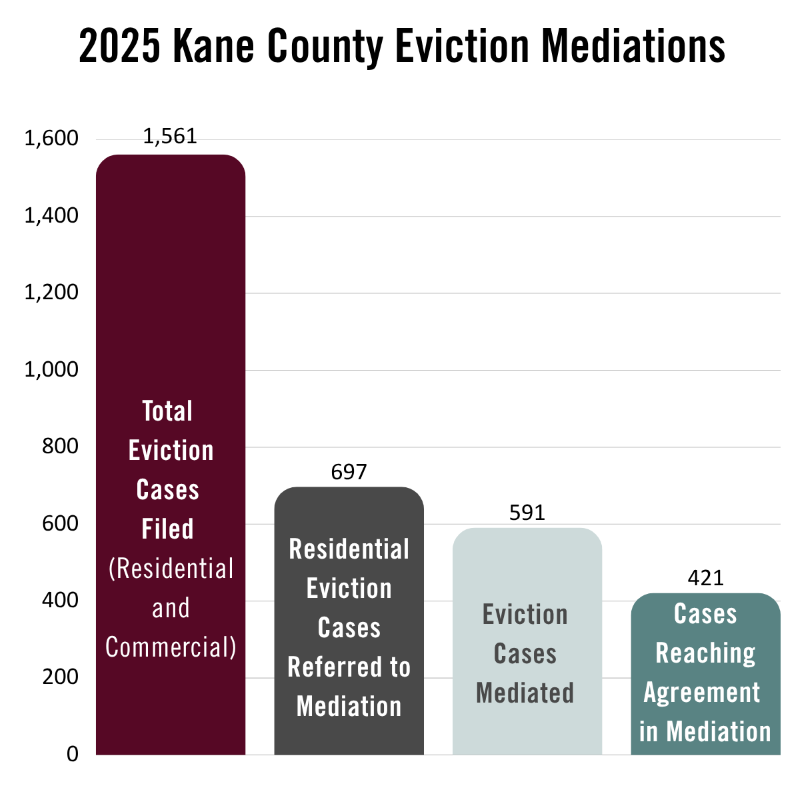
In 2025, 1,561 eviction cases, including both residential and commercial eviction cases, were filed in Kane County. RSI only has access to data that doesn’t differentiate between residential and commercial filings, but we know that 697 residential eviction cases (or 45% of all eviction cases) were referred to mediation and that 591 cases (85% of referred cases and 38% of all eviction cases filed) were mediated. (Note that because of the data limitations, the above numbers actually underrepresent the share of residential cases referred to mediation and mediated.) At 85%, the rate of referrals that led to mediation is the highest in the program’s history, tied with 2023, indicating the program continues its high level of service.
Parties reached agreement in 71% of the cases mediated (421 of 591). This represents 27% of all eviction cases filed in Kane County in 2025 (including commercial cases, which are not mediated). Although agreements can enable tenants to remain in their units (with Illinois Court-Based Rental Assistance, for example), or stipulate that they move out by a certain date, all mediated agreements enable the tenants to avoid an eviction order, which would negatively affect their housing and legal record.
Satisfaction with Mediation
RSI sent approximately 1,172 post-mediation surveys in 2025 and received 117 responses, for a response rate of 10%. Of these, 55 were from tenants, three were from tenants’ attorneys, 10 were from landlords, and 49 were from landlords’ attorneys. Some survey questions ask participants to rate their experiences on a five-point scale, and others ask for write-in responses. Five ratings questions explore participants’ experience of procedural justice, including aspects of respect, voice, trust and fairness.
Participants in all three groups — tenants, landlords and attorneys — generally gave high ratings for all five procedural justice questions, with an average above 4 on a five-point scale for each. However, attorneys and landlords were more likely than tenants to rate their experiences highly.
Respect. Almost all participants felt the mediator treated them with “very much” respect. Of the 117 who responded to this question, 108 (92%) gave a rating of 5, indicating the mediator treated them with very much respect. In all, 112, or 96%, of respondents gave ratings of a 4 or 5.
Few respondents made comments referring to respect; all were positive. One tenant commented that “the mediator was respectful while keeping us on point and making sure both sides understood what was discussed.” A landlord attorney wrote “the moderator made absolutely sure everyone was heard and respected.”
Voice. 8 in 10 participants felt they could talk about what was important to them. Of the 117 people who responded to this question, 93 (79%) indicated they could talk about the issues most important to them, giving a rating of 4 or 5. Only 15 (13%) felt they were not able to express what was important to them. Tenants were less likely than landlords and attorneys to feel they were able to talk about the issues important to them, with 62% (34 of 55) rating their ability to do so at 4 or 5, compared with 94% of attorneys (49 of 52) and all landlords.
In comments, ten tenants talked about feeling heard in mediation, with eight making positive comments. For two tenants, being heard led to a good resolution. One said, “The mediator asked both sides questions and I was able to explain I didn’t contest the eviction, I just needed a little more time to get out of the house, and the landlords [sic] lawyer gave me more time.” The other stated, “I was allowed to communicate what was important to me and ultimately come to an agreement without feeling ignored or unheard.” Two landlords reflected this same appreciation for feeling heard, saying “[The mediator] gave both sides adequate time to explain each side” and that they felt “heard and understood.”
Trust. Most respondents indicated they trusted their mediator. This question received 115 responses, with 92% of attorneys (47 of 51), 90% of landlords (9 of 10) and 83% of tenants (45 of 54) rating their trust in the mediator as high or very high. Three (6% of) attorneys and three (6% of) tenants responded that they trusted their mediator somewhat. However, one attorney and six tenants (11%) indicated they only trusted their mediator a little bit or not at all.
One tenant who indicated trusting their mediator only somewhat (a rating of 3) also shared this comment: “Sometimes during the moderation session, I felt the moderator and the plaintiff attorney knew each other just a little bit too much in my opinion. Overall, I felt the moderator was trustworthy, but had a pervious [sic] relationship with the lawyer that was or could be considered Bias.”
Fairness. Most participants felt the mediator treated them very fairly. The participants in general had very positive assessments of how fairly the mediator treated them. Of the 116 participants responding to this question, 105 (91%) gave a rating of 4 or 5, and 95 (82%) indicated their mediator treated them “extremely fairly,” with a rating of 5. Only four participants (3%) did not feel fairly treated, responding with a 2 (a little fairly) or 1 (not at all fairly). There was little difference between tenants, landlords and attorneys as to whether they perceived their mediator to be fair, with 85% of tenants, 90% of landlords and 96% of attorneys giving ratings of 4 or 5. However, they differed in the strength of their rating, with 70% of tenants, 80% of landlords and 94% of attorneys giving a rating of 5.
Most participants — 8 in 10 — felt their mediation process was fair. Of the 111 participants who responded to this question, 90 (81%) rated the fairness highly, with a four or five; 72, or 65%, indicated their mediation was extremely fair. Only 11 participants (10%) did not find the mediation to be fair. Notably, however, seven participants who felt the mediator treated them fairly did not think the process itself was fair.
Landlords and attorneys were more likely than tenants to perceive their mediation as fair. Of the 54 tenants who responded to this question, 72% (39) rated it as a 4 or 5, compared with 84% of attorneys (43 of 51) and 100% of landlords. The difference is more apparent when looking solely at whether respondents perceived mediation as extremely fair. Fewer than half of tenants — 48% (25 of 52) — gave a rating of 5, compared with 78% of attorneys (40 of 51) and 88% of landlords (7 of 8).
When asked to explain their fairness ratings, ten tenants commented on the balance of power. One noted that mediation “gave both of us time to have discussions about the reasons and difficulties both tenants and owners are having.” Another indicated that the agreement took what they wanted into account: “We agreed to an extent on what each side wanted.” On the other hand, seven tenants gave low ratings for their experience and made comments indicating they felt they had no power or control over the outcome. Many laid blame on the other party. For example, one shared “I didn’t have a choice. It was either pay a HUGE monthly payment or lose my house. There really was no negotiation involved.”
Referrals to Other Services
The program places high importance on assisting parties holistically because people facing eviction typically have other needs. Thus, staff referred parties in almost all of the 697 cases referred to the program to additional services, including 99% to legal assistance, as well as the following:
- 98% (683 people) to housing counseling
- 19% (131 people) to utility assistance
- 15% (106 people) to food assistance
- 8% (53 people) to disability services
- 4% (27 people) to victim advocacy services
Conclusion
The program is having an impact on almost half of all people facing eviction in Kane County, with more than a quarter avoiding an eviction order. The participants who go through mediation generally have a positive experience. They feel they have voice, feel respected and believe the process is fair. There is, however, a power imbalance between tenants and landlords that can make some tenants feel the process is biased in favor of the landlords, whom they see as having all the power in determining the outcome of their mediation.
Look for the full 2025 report on RSI’s website next month to learn more about the Kane County Mediation Program, parties’ responses to additional questions about their experiences, and more.