Resources / Study / Innovation for Court ADR

Just Court ADR

The blog of Resolution Systems Institute

From Research to Program Operation, RSI Dug into the Elements of Effective ADR in ’23

Just Court ADR, April 3rd, 2024

In 2023, RSI continued to dig deep into identifying the variables that make court-related alternative dispute resolution (ADR) effective. We did this through innovative research and day-to-day program implementation.

Today, we are pleased to share a summary of that work in Resolution Systems Institute’s 2023 Annual Report, which focuses on the elements of effective ADR. We hope you’ll check it out!

RSI is fascinated and inspired by all that our work has taught us. And we are grateful to have the privilege of continuing to examine the elements of effective court-related ADR as a means of enhancing access to justice.

Thank you for your continued interest in and support of our work.

New Board Member Oladeji Tiamiyu Talks Tech, ADR and More

Just Court ADR, March 19th, 2024

Resolution Systems Institute (RSI) recently welcomed two new members to its Board of Directors! Texas A&M Law Professor Nancy A. Welsh and University of Denver Law Professor Oladeji M. Tiamiyu attended their first Board meeting in February, and RSI is so grateful for their service. We’d like to help you get to know them, beginning this month with a Q&A with Prof. Tiamiyu.  

Professor Oladeji Tiamiyu is an RSI board member

Oladeji Tiamiyu is an Assistant Professor of Law at the University of Denver (DU) and an Expert Adviser to early-stage ventures at Harvard’s Innovation Lab. Before joining DU, he was a clinician at Harvard Law School’s Negotiation and Mediation Clinical Program. His research interests focus on the intersection of technology and dispute resolution. Read more about his background and find links to his work in his RSI bio.

When/where were you first introduced to alternative dispute resolution?

Before I went to law school, I had some degree of concern that the courts were not always the best place to resolve conflict. And I fondly remember being in my criminal law class, one of my favorite classes in law school with Professor Jeannie Suk Gersen, and thinking about alternatives to the carceral state. Shortly after then, I took a law school negotiations class that served as a gateway drug to this field. Now when I think about ADR, it is no longer about being an “alternative” in the strict sense of the word, but instead being a complement to litigation, so there’s been some personal evolution in how I think about the field.

I understand that you have a particular interest in the intersection of technology and dispute resolution. What drew you to this combination of topics?

Yes, well, I don’t know the extent my interest would have developed without Colin Rule. I had my first conversation with him in 2019, and I left essentially salivating for more ideas. From an intellectual and practical level, Colin has shaped me and hundreds of thousands of others in thinking about technology’s role with ADR.

And a few months after this conversation, there was dramatic upheaval in the legal profession. The legal tectonic plates were shifting dramatically. With the pandemic, courts were closed. Mediators and arbitrators were staying at home. It probably was the first time some of my highly social mediator friends didn’t want to meet anyone in person. And it was during this time that technology’s role became more than an esoteric idea, but instead necessary to keeping the courthouse open, albeit virtually.

Maybe we’ll talk about this later, but I found a way to work at RSI during this moment of change. So if Colin was the first to spark my interest, I am indebted to RSI, Susan Yates and Erik Slepak-Cherney for giving me space to explore technology’s role on a practical level.

What are some of the big questions related to tech and dispute resolution that interest you?

There are many. One lingering question from COVID is whether the pandemic led to a permanent change in how dispute resolution is practiced. Are mediators and arbitrators comfortable in incorporating online processes? Is there a critical mass of parties and disputes seeking out online processes? There’s some amount of data to suggest the answer to both is yes, but as we have greater psychological and temporal separation from the pandemic, there will be greater clarity.

I also share a sentiment with many other ODR scholars about whether online process increases access to justice. I’ll go a step further in inquiring whether the relationship between parties fundamentally changes when engaging in online process. That is, do parties communicate differently, problem-solve differently, trust differently and build consensus differently when in an online space?

There’s also the question of the role of artificial intelligence in these systems. Nvidia, ChatGPT, and Brazil’s VICTOR have all expanded our horizons for what could be possible with AI. I’m excited to see who will be the Jen-Hsun Huang of the dispute resolution field that develops an application with AI to fundamentally change what is possible in ADR. 

The exciting part is that RSI is at a unique position to bring clarity to these questions.

What attracted you to/made you want to join the RSI Board?

RSI as an organization. We have done such important research over the years. We have collaborated with innovative courts. I’ve also been on the other side as an employee, and I personally know the integrity of the employees.

I am particularly honored to be joining RSI at this specific time of change. Susan Yates is one of the foremost thought leaders in our field. Judges know it. Academics know it. The American Bar Association knows it. As she leaves RSI, I was intrigued at being a steward for this great organization to ensure that we continue to do the important work our organization has historically championed.

What are your ADR-related courses or other activities at the University of Denver law school?

From my lens, everything I teach has an ADR bend to it. So much of the modern-day legal profession depends on ADR skillsets. As Arthur Miller described many years ago, settlement and negotiations cannot be separated from being a lawyer. So I teach Contract Law, Family Law, and a survey of ADR course. Yet with Contract Law, my students get an introduction to simulations for negotiating contracts that advance their client’s interests, or simulations that prepare them to negotiate out-of-court settlements when there is a breach of contract.

In Family Law, my students do simulations in mediating and negotiating agreements for child custody and alimony. Much of what I try to impart in all of my classes is that ADR skillsets will help my students be better client-centered lawyers.

You were a Public Interest Law Initiative Fellow with RSI in the past. Is there something you learned or experienced in that role that will help you in your work on the RSI Board?

Yes, I have tremendous admiration for the PILI fellowship and gratitude for Sidley Austin LLP for their active engagement in public interest work in both Illinois and nationally. I hope more law graduates practicing in Illinois recognize how special of a state Illinois is for building the infrastructure for PILI. Overall, my PILI fellowship informed some of my hopes and aspirations for the ADR field. It was through PILI that I met some of the nation’s leading dispute resolution practitioners based in Chicago.

But the most valuable lesson I learned from being a PILI Fellow has less to do with ADR. Because RSI is such a collegial and accessible non-profit, my time as a PILI Fellow helped me to appreciate the impact that non-profits can have. Fulfilling lawyering can be in a non-profit office as much as in a law firm or in a courtroom.

What in your current academic work, if anything, relates to the work of RSI?

Much of my research touches on topics that are highly germane to RSI. My research shares a fundamental commitment to exploring how best to leverage dispute resolution to promote access to justice.

What are you most looking forward to during your time on the RSI Board?  

Chicago is fortunate to have RSI, but RSI can and historically has had an impact in different corners of the country. So I am excited to see how our organization grows, especially in a time when there is a fundamental change in the legal profession. There are few other organizations with as sizeable of a network with the judiciary, legal profession and dispute resolution field. I’m excited to see how we can use all of these assets to introduce greater innovation for dispute resolution.

RSI Executive Director Susan M. Yates to Receive ABA’s D’Alemberte Raven Award

Just Court ADR, March 11th, 2024

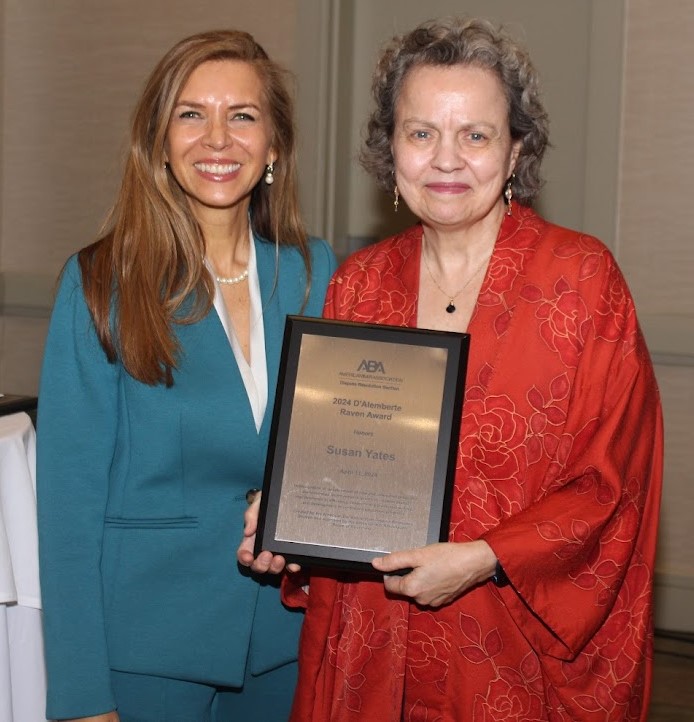
RSI is thrilled to share the news that the American Bar Association Section of Dispute Resolution (ABA DR Section) has chosen our own Susan M. Yates to receive its prestigious D’Alemberte Raven Award this year!

Resolution Systems Institute Executive Director Susan M. Yates

The ABA DR Section will present the award at its 2024 Dispute Resolution Spring Conference, taking place April 10–13 in San Diego.

The D’Alemberte Raven Award is the premier award in the field of alternative dispute resolution. It is presented to an individual or organization that has contributed significantly to the dispute resolution field through the development of new or innovative programs, improvements in service, improvements in efficiency, research and/or published writings, and/or development of continuing education programs.

As you may know, Susan has been Executive Director of RSI since 1997, when she was instrumental in its founding. She is responsible for implementing RSI’s mission of strengthening access to justice by enhancing court ADR systems.

“Susan’s astute, dedicated stewardship has made RSI the nationally respected ADR thought leader it is today,” said longtime member of the RSI Board of Directors Terry Moritz. “Because of her leadership, RSI has continued to develop landmark research and is enabling the ADR field to maintain high standards of both efficiency and ethics. Susan’s recognition by the Dispute Resolution Section of the ABA is certainly well deserved.”

Please join us in congratulating Susan on this wonderful achievement!

Better Forms Can Help Reduce Fear and Confusion for Self-Represented Parties

Christina Wright, February 21st, 2024

In an eviction courtroom filled mostly with self-represented defendants, the confusion and fear can be palpable: fear over what the future holds, and confusion about the process and the parties’ options.

But some of this anxiety can be mitigated. Represented or not, parties should always have access to the information they need to understand what is happening in their court case. One way to help reduce the confusion and fear is to provide easily accessible court forms with instructions in plain language.

A small group of individuals is working toward precisely this goal, and recently I began volunteering with them.

Hands hold a pen and a nondescript form.

When forms are understood and completed correctly, the court process is smoother, time is used more efficiently, and there is less risk of legal errors that might compromise a case on behalf of self-represented litigants.

In 2012, the Illinois Supreme Court created the Illinois Supreme Court Commission on Access to Justice (Commission) to “promote, facilitate and enhance equal access to justice with an emphasis on access to the Illinois civil courts and administrative agencies for all people, particularly the poor and vulnerable.” The same year, the court adopted an administrative order spelling out how the Commission and the Administrative Office of the Illinois Courts (AOIC) would be tasked with developing, reviewing and approving standardized court forms for the entire state. 

The Forms Committee currently has 13 drafting subcommittees, which consist of judges, attorneys, clerks and other court stakeholders — such as RSI and me — who help create new forms when needed and update existing forms in an annual process, according to Lillie Schneyer, Forms Program Coordinator with the AOIC.

“Annual review is an important process to ensure that the forms are up to date with the latest court processes, are as user-friendly and effective as possible, and remain legally sufficient,” Schneyer explains.

Over the past few months, I have been working with the Eviction Subcommittee to revamp the forms provided to people involved in eviction cases. We are reviewing current documents, such as the Eviction Order, Appearance and Agreed Order forms, that have received comments and suggestions from members of the public or that members of the subcommittee have comments or questions about. (Draft forms are posted for public comment on this page of the Illinois courts site.)

We work together as a small group to adjust language, instructions, spacing, and any other minute detail that has been brought to our attention. Our overarching goal is to make the forms as simple and accessible as possible, with the hope that any self-represented party can maneuver them, while also ensuring that the language used is legally responsible and applicable.

We work together as a small group to adjust language, instructions, spacing, and any other minute detail that has been brought to our attention as in need of revamping. We analyze the law in reference to the language to be used on the forms and the implications of the changes we are making. Our overarching goal is to make the forms as simple and accessible as possible, with the hope that any self-represented party can maneuver them, while also ensuring that the language used is legally responsible and applicable.

The process can be tedious, but having seen eviction cases play out in my role with RSI, I recognize how important it is for all parties to fully grasp what they can expect from the court, what is expected of them, and the options in front of them so they can make informed choices. The forms guide and educate litigants in their options and legal responsibilities. When forms are understood and completed correctly, the court process is smoother, time is used more efficiently, and there is less risk of legal errors that might compromise a case on behalf of self-represented litigants. All in all, having accessible Supreme Court forms benefits both the self-represented litigants and the court itself.

When our work is complete, the revised forms will be published in the Court Forms Hub of the Illinois Courts website.

Verified by ExactMetrics