Resources / Study / Innovation for Court ADR

Just Court ADR

The blog of Resolution Systems Institute

After Successful Pilot, RSI Seeks Mediator Partners for Next Phase of Trust Project

Jennifer Shack, July 17th, 2024

Last year, RSI began the pilot phase of a research project to examine how mediator behaviors might affect parties’ trust during mediation. During this exploration phase, our research team has been observing small claims and eviction mediations and marking down mediators’ communication behaviors, in a process referred to as coding, for the Trust Project. We gathered pre- and post-mediation surveys from the parties, and we interviewed the mediators involved.

From left, Rackham Foundation’s Ava Abramowitz, RSI Director of Research Jennifer Shack and Behavior Analysis Trainer Kenneth Webb gave a presentation on the early findings of RSI’s Trust Project at the American Bar Association Section of Dispute Resolution 2024 Spring Conference in April 2024.

After coding 22 mediations and completing a thorough review of our piloted data collection instruments, RSI has successfully completed our pilot phase. We are excited to share that we will soon be expanding the project and are looking for mediation organizations and/or individual mediators who would like to partner with us.

Method Adapted for Mediation

The Trust Project is based on behavior analysis (BA), a research method that codes for particular communication behaviors and connects them to desired outcomes. This method has been used successfully in negotiations and sales. BA examines the particular behaviors used as well as the sequences of behaviors that occur, to determine their effects on specific desired outcomes. In this instance, RSI is interested in changes in trust between the parties and changes in trust in the mediator. We are also interested in mediation results and participant perceptions of the mediation and the other party.

Over the course of five years, Ava Abramowitz and Ken Webb worked to modify communication behaviors used in the contexts of negotiations and sales for use in mediation — with a lot of input from mediators and researchers. Ava is a former assistant U.S. attorney, longtime mediator and secretary of the Rackham Foundation. Ken is an expert in behavior analysis, coding and training negotiators to improve their practice. He trained RSI’s researchers in behavior analysis. Thanks to generous support from the Rackham Foundation, RSI has the opportunity to conduct this innovative research into the effects of mediator behaviors on party trust.

Watch Michael Lang’s 2021
In Their Voices interview with Ava Abramowitz and Ken Webb for more insight into the idea of applying behavioral analysis to mediation — the concept behind the Trust Project!

Mediator Partners Sought

For the next phase of the Trust Project, RSI will observe mediations of small claims, family and larger civil cases, both in person and online. We are looking for partners in this endeavor. Interested organizations and mediators would work with RSI to determine how to effectively recruit parties. Mediators will be asked to complete an initial survey about their background and approach to mediation, to facilitate observations of their mediations, and to complete a survey after each observed mediation. We will preserve confidentiality of the mediations, the mediators and the parties by removing any identifying information from the data.

If you are interested in participating in this impactful research, please contact RSI Director of Research Jennifer Shack at jshack@aboutrsi.org.

8 Tips for Assisting Self-Represented Litigants

Christina Wright, June 24th, 2024

Working in the Kane County Eviction Mediation Program for the past three years, I have seen firsthand the challenges self-represented litigants may face. I have also learned a lot by reading RSI’s research on related topics, such as the ODR Party Engagement (OPEN) Project. Recently, I had a chance to speak to members of the Illinois Supreme Court Access to Justice Court Navigator Network at the Kane County Law Library in Geneva, Illinois, about tips I’ve found useful in supporting these litigants. I am sharing them below with the hope that they will be useful to others.

Photo by Edmond Dantes via Pexels

1. Speak and write in plain English.

For native speakers as well as those for whom it is a second language, English can be a difficult language to master. Many self-represented litigants don’t have the language skills to understand the legalese that is often used in the courtroom. Thus, it is important that all court-related communications be written in plain English. Additionally, court-connected mediation programs and other settings involving self-represented litigants should have a staff member accessible to answer questions regarding court/program handouts and policies.

2. Provide translation.

Any paperwork should be readily available in commonly used languages other than English. In Kane County, our primary need is Spanish, but that will vary by jurisdiction. Translation services should also be provided as needed.

3. Be clear that outcomes are not predictable.

To avoid making promises you can’t keep, be sure to use language that does not promise a particular outcome. For instance, one could say “You may apply for a court fee waiver,” rather than “You can get your court fees waived.” This important distinction can prevent confusion down the line as the individual continues to navigate the court/program.

4. Be flexible with scheduling.

Courts/programs can be difficult to access for those who live near or below the poverty line and/or who have inflexible work schedules. For self-represented litigants with little or no income, it may be impossible to physically attend court or afford the devices necessary to attend court virtually. Buses, ride-hailing services and even bicycles cost money and can be time-consuming to use. Being flexible with scheduling allows participants a greater chance of attending, and without the extra burden of costs associated with travel, childcare, calling off work, etc.

5. Be knowledgeable about available resources.

Inability to use technology is another hurdle. Whether it be because the individual lacks the skills or the finances to utilize technology, online dispute resolution (ODR) programs and virtual court may only be an option with extra assistance from the court/program. Extra assistance may come in the form of lending a device, walking the self-represented litigant through connection issues, or referring them to another agency that can help get them connected. Libraries are a great resource for technology assistance and connection.

6. Keep an open mind.

Don’t assume you know anything about any particular self-represented litigant’s life, capabilities, technology access, education, finances, etc. What may seem simple or common to you may not even be an option for them. With that said, self-represented litigants come from all different walks of life, so it is even more important not to assume they are all alike and thus all have the same needs.

7. Be persistent when reaching out to parties.

How do you reach a self-represented litigant? Keep trying! The Kane County Eviction Mediation Program uses phone, text, email and in-person conversations to gather information and assist self-represented litigants face their legal challenges. Everyone has their own preferred communication method, so it takes different forms of communication to reach different people. Attempt contact frequently and through a variety of methods if you really want to reach the individual.

8. Be trustworthy.

Finally, the OPEN Project found that trust can be a big obstacle for courts. OPEN focus group participants were wary of the communications they reviewed. Thus, it is important that all court communications look official and provide solid contact information in case the self-represented litigant needs to ask questions or contact the court/program for other reasons.

Although there can be challenges when working with self-represented litigants, the individual parties can benefit greatly from the support. Mediation and similar programs can provide clarity, control, support, legal assistance, financial resources, housing counseling and other resources to self-represented litigants. They can decrease the amount of time a case remains in court (a benefit to everyone involved) and prevent unnecessary wage losses. Self-represented litigants may need regular reinforcement and assurance, but by providing this service we increase their access to justice.

Farewell RSI: Gratefully Recalling Milestones on an Incredible Journey

Susan M. Yates, June 13th, 2024

With my last day as Executive Director at RSI — July 12, 2024 — rapidly approaching, I’m experiencing a bit of nostalgia, especially as I think back to the earliest years of RSI.

I wasn’t there at the very beginning, but as the story goes, the organization started in 1995 when a small group of lawyers and judges gathered around a fireplace in a hotel lobby after a mediation training and hatched the idea for a nonprofit entity that would assist court mediation programs. They called it the Center for Analysis of Alternative Dispute Resolution Systems (CAADRS).

I got involved soon thereafter as a consultant working on a research project. Then the executive committee of CAADRS hired me as its first full-time staff person, in 1997. One of my first tasks was to define the original mission: Collect and disseminate reliable information about court ADR.

In 1999, I hired Jennifer Shack, now RSI’s Director of Research, not knowing this would be the best decision I ever made at RSI. For me, working with Jen for these 25 years has been the greatest gift of my career.

Over the ensuing years, there have been many milestones. Here are a few that stand out to me:

  • CAADRS was an early user of the internet, launching a website to disseminate reliable resources about court ADR
  • CAADRS changed its name to Resolution Systems Institute (Whew!)
  • RSI spun off from our original home as part of the Center for Conflict Resolution, becoming an independent nonprofit
  • RSI more than doubled in size to respond to the foreclosure crisis — providing mediation services in three jurisdictions, training mediators all across Illinois, developing data collection tools and conducting two in-depth evaluations
  • RSI developed and operated more mediation programs — first in child protection cases and then in eviction cases in response to the COVID pandemic
  • More recently, RSI has decided to double down on our strengths in research and evaluation with the hiring of additional staff and taking on more projects
  • For many years now, our mission statement has been “strengthening access to justice by enhancing court ADR systems”

If I started naming the names of all those who have supported RSI and me over these years, there would be no end to this post. Suffice to say I am deeply grateful to everyone who has been part of this incredible journey. 

Fortunately, I am leaving RSI in good hands. Transitioning into the role previously held by a founding executive director is no small feat, but I know Heather Fogg is up to the challenge and will do a great job as the next RSI leader. Please join me in welcoming and supporting her!


Welcome, Heather!

I am not a gambler, but I would bet no child has ever answered the question “What do you want to be when you grow up?” with “I want to run a nonprofit that helps improve access to justice by enhancing court ADR.” Well, there are now two people who could have said that: RSI’s incoming CEO Heather Fogg, and me.

Heather’s first day at RSI will be June 17, 2024. Please join me in welcoming her!

Heather is going to do such a great job building on RSI’s past successes and taking the organization to new heights. Here are just a few of the qualities she brings to this position:

> A passion for quality ADR and the role it can play in enhancing access to justice

> Deep experience with ADR, in particular mediation and restorative justice

> Knowledge of court mediation, especially focusing on quality

> Skills in communication and a focus on excellence

> Background in and enthusiasm for the role research can play in improving court ADR

Heather’s knowledge, expertise and character should assure everyone that this next phase for RSI will be an exciting one that is full of opportunity and success. Please join me in welcoming Heather on June 17!

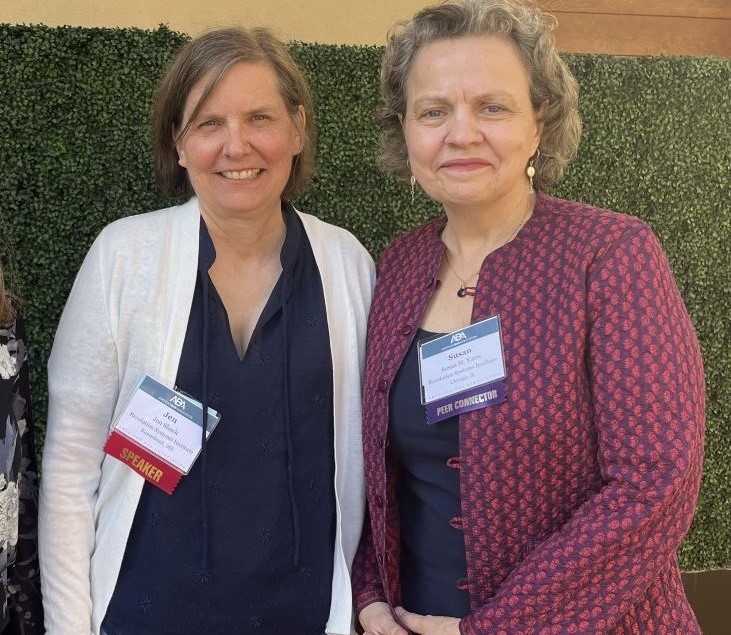
Jennifer Shack, left, and Susan Yates “then” and now.

Fogg Joining RSI as CEO on June 17; Yates Will Support Transition Through July 12

Just Court ADR, May 29th, 2024

Resolution Systems Institute is pleased to announce the appointment of Heather Fogg as our next Chief Executive Officer. Heather’s hiring follows an exhaustive nationwide search, a rigorous application and interview process, and unanimous approval by RSI’s Board of Directors. She will start on June 17.

Heather Fogg

RSI Executive Director Susan M. Yates will remain on staff through July 12 to help support a smooth leadership transition. After 27 years, Susan is stepping away from RSI to pursue other opportunities in the alternative dispute resolution (ADR) and non-profit worlds.

“The choice of Heather Fogg to take over the helm at RSI gives me great peace of mind,” Susan said. “Heather’s passion for conflict resolution, ADR experience and strategic vision are clear evidence of her commitment to improving access to justice by enhancing court-connected ADR. I am confident in her ability to help RSI maintain its position as the nation’s premier court ADR organization. Furthermore, Heather’s authenticity and enthusiasm will make it easy for RSI’s staff, board and partners to connect with her.”

Heather comes to RSI with an extensive background in court-connected ADR and research. Her expertise includes directing court mediator excellence programs; managing a state court’s ADR data collection tool; and designing and delivering restorative justice practices across a diverse range of sectors. Heather has guided the evaluation, design and data analysis of grant-funded ADR programs; coordinated workshops and training sessions for court ADR program managers, mediation trainers and mediators; and led and mentored scores of researchers and ADR practitioners. For the past three years, Heather has been a Training and Capacity Building Restorative Justice Practitioner at Restorative Justice Project Maine.

“Heather has an impressive combination of hands-on experience with court ADR, a track record of successful leadership, and dedication to ADR research and evaluation,” RSI Board President Brian Roche said. “We feel secure that Heather is the right person to lead RSI through its next phase of innovation and accomplishment.”

Heather lives in Maine’s Midcoast region and will lead the Chicago-based RSI remotely. RSI currently has staff in the Chicago area, as well as in Central Illinois, Florida, Maine and Texas.

“I feel thrilled and overjoyed to join RSI and help guide us through our next chapters,” Heather said. “RSI has an unmatched reputation of excellence in court ADR, and I am fortunate to have the opportunity to bring all of my skills to bear on serving the goal of making court-connected ADR as accessible and effective as possible for parties and courts with the least resources.”

Verified by ExactMetrics