Resolution Systems Institute is pleased to announce the appointment of Heather Fogg as our next Chief Executive Officer. Heather’s hiring follows an exhaustive nationwide search, a rigorous application and interview process, and unanimous approval by RSI’s Board of Directors. She will start on June 17.
Heather Fogg
RSI Executive Director Susan M. Yates will remain on staff through July 12 to help support a smooth leadership transition. After 27 years, Susan is stepping away from RSI to pursue other opportunities in the alternative dispute resolution (ADR) and non-profit worlds.
“The choice of Heather Fogg to take over the helm at RSI gives me great peace of mind,” Susan said. “Heather’s passion for conflict resolution, ADR experience and strategic vision are clear evidence of her commitment to improving access to justice by enhancing court-connected ADR. I am confident in her ability to help RSI maintain its position as the nation’s premier court ADR organization. Furthermore, Heather’s authenticity and enthusiasm will make it easy for RSI’s staff, board and partners to connect with her.”
Heather comes to RSI with an extensive background in court-connected ADR and research. Her expertise includes directing court mediator excellence programs; managing a state court’s ADR data collection tool; and designing and delivering restorative justice practices across a diverse range of sectors. Heather has guided the evaluation, design and data analysis of grant-funded ADR programs; coordinated workshops and training sessions for court ADR program managers, mediation trainers and mediators; and led and mentored scores of researchers and ADR practitioners. For the past three years, Heather has been a Training and Capacity Building Restorative Justice Practitioner at Restorative Justice Project Maine.
“Heather has an impressive combination of hands-on experience with court ADR, a track record of successful leadership, and dedication to ADR research and evaluation,” RSI Board President Brian Roche said. “We feel secure that Heather is the right person to lead RSI through its next phase of innovation and accomplishment.”
Heather lives in Maine’s Midcoast region and will lead the Chicago-based RSI remotely. RSI currently has staff in the Chicago area, as well as in Central Illinois, Florida, Maine and Texas.
“I feel thrilled and overjoyed to join RSI and help guide us through our next chapters,” Heather said. “RSI has an unmatched reputation of excellence in court ADR, and I am fortunate to have the opportunity to bring all of my skills to bear on serving the goal of making court-connected ADR as accessible and effective as possible for parties and courts with the least resources.”
In February, Resolution Systems Institute welcomed two new Board of Directors members to their first RSI board meeting. Recently we wrote a blog introducing you to one of them, University of Denver Law Professor Oladeji M. Tiamiyu. For this edition, we spoke with the other, Texas A&M Law Professor Nancy A. Welsh.
Nancy Welsh is the Frank W. Elliott, Jr. University Professor, Professor of Law and Director of the Dispute Resolution Program at Texas A&M University School of Law. She is a leading scholar and teacher of dispute resolution and procedural law. Prof. Welsh examines negotiation, mediation, arbitration, judicial settlement and dispute resolution in US and international contexts, focusing on self-determination, procedural justice, due process and institutionalization dynamics. Read more about Prof. Welsh’s background and find links to her work in her RSI bio.
When/where were you first introduced to alternative dispute resolution?
I first learned about alternative dispute resolution when I was in law school. Frank Sander — one of the founders of the ADR movement (including the contemporary mediation movement) — was one of my law professors. He taught a course that I believe was called Alternatives to Litigation. That was where I first learned about mediation. I’m sure we also covered arbitration, but negotiation principles and mediation are what I remember best. I actually enjoyed the exam in that course — an unusual experience! — because we needed to think about what the parties wanted and what their underlying interests likely were. We also needed to think practically when different alternatives existed that might be responsive to their underlying interests. I found the problem-solving aspect of the course to be really exciting.
I also had the opportunity to take a mediation training when I was in law school and then to mediate in a small claims court.
What are some of the big questions related to ADR that interest you or that you are currently focusing on?
I’ve always been interested in the intersection between negotiation, mediation, arbitration and the courts, which, of course, is where RSI largely is located. I have been a big advocate of negotiation, mediation and arbitration when the parties have actually selected these processes, and when the processes have been managed in a manner that helps to ensure that people really have the opportunity to think and share what they care about, to think about what options might exist for resolution, to be fully informed, and to freely make their choices.
One thing that really excited me about negotiation and mediation was that it seemed as though — especially once you started asking about and looking at underlying interests — a whole new path to resolution opened up. I had gotten to a point where it seemed to me that when we were talking about the law, there was no path; there were only positions and legal arguments.
So when people are choosing negotiation or mediation, when they really have the opportunity to be informed and to explore what other options exist that can be responsive to their needs, I am entirely in favor of these processes.
When the mediation process is one in which mediators or lawyers decide that the parties are never going to be in direct contact with each other — putting them in separate rooms and with the mediator just shuttling back and forth — and when the focus of mediation is primarily on getting the parties to be more realistic in the way that the mediators and lawyers want them to be, I am less enthusiastic about the processes. Some reality-testing is almost inevitable, but the mediation process also should provide the opportunity for the parties to express what is really important to them, to be heard in a dignified setting, and to explore options that meet their needs. I care a lot about procedural justice and self-determination and have written extensively on both.
Importantly, we really don’t know what happens in most mediations. The courts don’t regularly collect or publish such data. Again, this is a world in which RSI operates; RSI has been involved in much more research and evaluation than a lot of organizations and encourages court-connected programs to evaluate and collect data. That is really important. How can you know what is going on if you don’t have any information?
Meanwhile, I know that a lot of the data we do have indicates that people are satisfied with the mediation process. So that’s important. I just think the process can be one that enables people to fully exercise self-determination consistent with the American ideal of democracy, that each of us is a thinking human being who can be educated and make good decisions. And then, of course, we also need data regarding the other dispute resolution processes.
What in your current academic work, if anything, relates to the work of RSI?
My academic work relates to RSI’s work because RSI does so much with data and evaluation, and a lot of my writing has been about mediation and court-connected processes, which are obviously core areas for RSI.
I wrote a series of articles (one of which is “But Is it Good: The Need to Measure, Assess, and Report on Court-Connected ADR”) that focus largely on the need for more data, for regular reporting by the courts regarding their use of dispute resolution processes. How many cases were eligible? How many cases actually went to these dispute resolution processes? Did they settle? On what terms? What were parties’ perceptions of the procedures and outcomes? And then I also have urged that courts have some responsibility to ensure substantive fairness in the aggregate, or at least some responsibility to ensure that there is not a systemic pattern of unfairness in outcomes.
What attracted you to/made you want to join the RSI board?
I have thought for a long time that RSI is a really wonderful organization and it’s doing important work. When I identify who is out there focusing on court-connected dispute resolution, helping to ensure that research is being done and that courts are getting the kind of assistance they need to provide good court-connected dispute resolution processes, RSI has been at the center of it. Jen Shack is a wonder. Susan Yates is a wonder.
What are you most looking forward to during your time on the RSI board?
I think there are amazing people who are involved with RSI, so I’m looking forward to getting to know the staff and the board. I’m excited to be working with people on the board — some of whom I’ve known and respected for a long time, and others whom I’ve known by reputation but have never before met. It’s an honor to join them.
On April 11, 2024, the American Bar Association Dispute Resolution Section honored me with its D’Alemberte Raven Award. The award is given “in recognition of development of new and innovative programs, demonstrated improvements in service, demonstrated improvements in efficiency, research and published writings, and development of continuing education programs.”
The following are the remarks I made at the award ceremony.
Susan M. Yates gives a speech after being presented with the D’Alamberte Raven Award at the American Bar Association Section of Dispute Resolution 2024 Spring Conference.
Thank you.
I must say, when I first learned I was getting this award, I was stunned.
That was followed quickly by a surge of love for my friends who nominated me. Thank you, Peter, Jen, Jim, John, Kelly and Terry. I live in abject fear of leaving someone out when I publicly thank people, so I am going to stop naming names right there! But I will give a huge thank you to all my friends and colleagues, who I respect and love from the bottom of my heart.
An occasion like this was bound to lead me to reflect on my career. As I did, I thought about all the small, day-to-day actions that turned into something important for me. This evening I invite you to join me in reflecting on little things, and to keep doing those small acts because you just never know.
Here’s my first example:
It’s from the end of the ’70s. I was at Cornell’s School of Industrial and Labor Relations, studying mediation, arbitration, negotiation, etc. A representative from the Rochester (NY) Community Mediation Center (not their long-time executive director Andrew Thomas) came and spoke about community mediation. And that idea lodged in the back of my mind and deep in my heart.
So, when you are asked to speak to a class about mediation, conflict resolution, ADR, whatever … go! It is possible that when you do, you could plant a seed that will bloom for decades.
Another example:
ABA Section of Dispute Resolution Chair Ana Sambold, left, presented Susan Yates with the D’Alamberte Raven Award at the section’s spring conference. (Photo courtesy of ABA Section of Dispute Resolution)
A few years out of college, I was living in Chicago and found that there was a local community mediation center — what is now known as the Center for Conflict Resolution. I reached out; they were doing a mediator training the next two weekends and invited me to participate. That training, which came about because someone answered the phone and extended an invitation, formed the basis for the rest of my career!
So, as you are going about your day, answer the phone or an email, and make a simple offer. It might not be consequential for you, but it could be life changing for someone else.
Here’s an example from later in the ’80s,when I was executive director of that community mediation program in Chicago:
I went to a Chicago Bar Association reception and happened to meet in person a funder, Kent Lawrence, who was supporting our eviction mediation program via a third party. (Yes, eviction mediation was happening back in the ’80s.) From that chance meeting came a multiple-decade friendship and funding relationship that has enabled Resolution Systems Institute to grow into the organization it is today.
So, go to those gatherings and other events — whether in person or online. Meet new people and develop those personal and professional friendships.
Here’s another example from a few years later:
Jim Alfini — who many of you know and is the OG of the DR Section — invited me to grab coffee and talk about the ABA DR Section. He was about to chair the section and invited me to chair the Associates Committee. Well, that led to me serving on the Council for a number of years, being one of the ABA’s two representatives to the revision of the Model Standards of Conduct for Mediators and many, many, MANY other involvements — budgeting, nominating, ethics, strategic planning, conference programming — in the Section. In the Section, I found my professional home.
So, take someone to coffee. Invite them to engage with the DR Section or another organization of your choice. Help your colleagues find their professional home.
And one final example from about the same time in the ’90s:
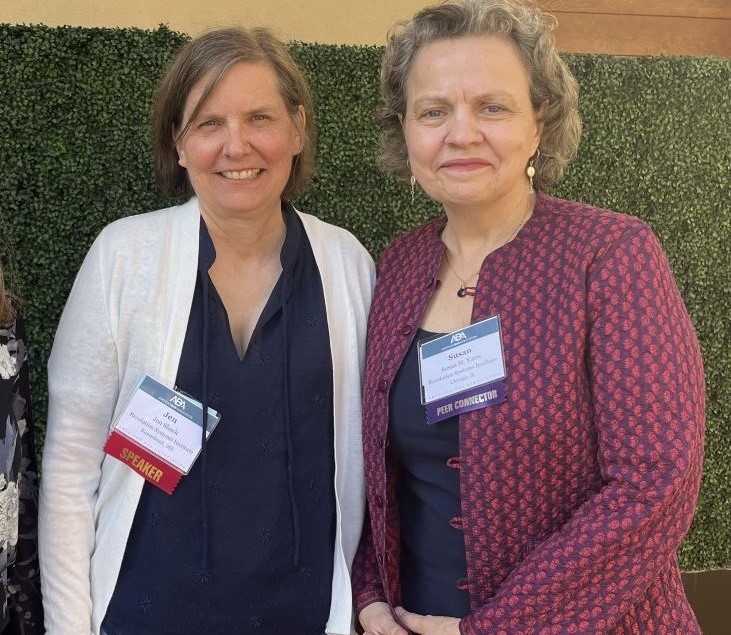
Susan Yates (right) with RSI Director of Research Jennifer Shack (center) and RSI Researcher Rachel Feinstein at the ABA Section of Dispute Resolution Conference in April 2024.
I was executive director at Resolution Systems Institute — where I still am today — and looking to hire someone to be the second RSI staff person. One person I interviewed was right for the job, but could only promise to stay for 18 months. Well, that was the magnificent Jennifer Shack, RSI’s Director of Research, with whom we recently celebrated 25 years at RSI. Were it not for her, RSI would certainly not be the organization it is today, and I would likely not be standing here in front of you.
What does this tell us? Better to hire someone good for a short amount of time. You never know where it might lead.
Each of these seemingly small actions had a huge impact on my life and ultimately led to me standing here this evening. So, I encourage us all to keep doing those small things. Speak to a class, respond to an email, meet people, invite someone to get involved, hire someone because they are good.
In closing, I will add another action: Nominate a colleague for an award. You will never know how much it means to the person who receives the award.
RSI has completed the first phase of the ODR Party Engagement (OPEN) Project! We are excited to share what we have learned from our research and to roll out new downloadable tools designed to support courts. A summary of our research, our full report and the tools can be found in a new section of our website.
The Study
For this extensive study, RSI conducted six focus groups with a total of 41 participants from three areas of the country. Our aim was to uncover barriers to using court-referred text-based ODR (online dispute resolution) and ways courts can address these barriers. More information about the study, a summary of the findings and key takeaways are available on the OPEN Project section of our website, in addition to the full report.
Tools for Courts
Informed by our research findings, RSI developed tools to help courts communicate more effectively about ODR. The two downloadable documents, “Communicating Effectively about ODR: A Guide for Courts” and a “Document Preparation Worksheet and Checklist for ODR Programs,” are both accessible on our website.
The Guide for Courts provides recommendations for developing documents, websites and video tutorials for ODR that are easy to understand and use, particularly for those who have low literacy and are self-represented.
The Document Preparation Worksheet and Checklist walks readers through each step of the document prep process, from considering the characteristics of the audience to determining the key content to include and the best way to communicate this content. Once documents are completed, the interactive checklist provides an opportunity to review the material and ensure all key recommendations were incorporated.
Next Up in Phase 2: Model Materials
RSI is very proud of what we have accomplished in Phase 1, and there is more to come! We are now starting Phase 2, in which we will work with an inclusive designer to create model court documents, a brief informational ODR video and a mockup webpage, using our findings from Phase 1 and previous research on best practices.
We will user-test these models to learn what barriers persist for people when attempting to use the models to register for ODR. After all our user-testing is complete and barriers have been addressed, courts will be able to download the final model documents, video and webpage to use as examples when developing their communications. This will provide added support to courts with limited resources, who will be able to simply replicate these models and tailor them to their specific needs and audience using instructions we will provide.
RSI is grateful for the generous support of the American Arbitration Association-International Centre for Dispute Resolution Foundation for making the OPEN Project possible.