

Resources / Study / Innovation for Court ADR

Just Court ADR

The blog of Resolution Systems Institute

Archive for the ‘Research’ Category

Use of Joint Session to Open Mediation Influenced by Lawyers and Geography

Just Court ADR, October 18th, 2022

Historically, mediations would begin with a joint introductory session with all parties discussing the case together along with the mediator, and the parties having the opportunity to discuss their issues and interests directly in a guided conversation. Mediations would either continue in joint session or move into separate caucuses, depending on the course of the conversation and the preferences of the mediator. In the last 10-20 years, however, it has become increasingly uncommon for mediations to begin jointly.

In “Joint Session or Caucus? Factors Related to How the Initial Mediation Session Begins,” by Roselle Wissler and Art Hinshaw (Ohio State Journal on Dispute Resolution, September 2022), the authors report the findings of the first study to examine the relationships between the way in which mediation opens and a wide range of factors. It found that although many mediators suggest tailoring the structure of mediation to the needs of an individual case, the likelihood of mediation beginning with a joint session is instead tied to whether the parties are represented by an attorney, whether the mediator has a law degree and where in the US the mediator resides.

Wissler and Hinshaw note that there is significant disagreement as to whether joint opening sessions are still needed. Some possible benefits of such a session include that it would provide: a chance to explain to parties the process and the issues at hand and make sure all are on the same page, a chance to open channels of communication and foster understanding between opposing parties via face-to-face communication, and a chance for the mediator to observe the dynamic between the parties and establish a rapport. There are also some who argue that the existence of mediation-informed lawyers and pre-session discussions between parties and mediators, as well as the changing landscape of mediation proceedings (which frequently includes more “impersonal” civil and commercial cases with little or no pre-existing relationship), obviate the need for these sessions.

Many mediators and lawyers, rather than advocating for or against joint opening sessions, suggest tailoring the structure of the mediation to the needs of an individual case. They indicate that joint opening sessions may be helpful in situations where litigants may not be well informed about each other’s positions and/or when there exists a continuing relationship between parties. On the other hand, joint opening sessions may not be recommended if the relationships between parties are highly contentious, or when violence or abuse is involved.

Study

To examine the factors involved in how mediations begin, Wissler and Hinshaw conducted a survey among civil and family mediators with publicly available contact information in eight states across the US. They limited participation to those who had mediated civil or family disputes (outside of small claims or probate) involving only two parties within the US in the last four months. Out of 5,510 mediators who received an email invitation, 1,065 (19.3%) responded. Respondents were asked to focus on their most recent concluded mediation in their responses. Both family and civil mediators’ cases mainly came directly from lawyers or court mediation programs/judges.

Findings

Wissler and Hinshaw found that joint opening sessions have not been replaced by pre-session communication, as there is no correlation (or in civil cases, there is a slight positive correlation between pre-mediation communication and…) between whether litigants are present in pre-session communications and whether the mediation begins in joint session. Joint opening sessions have also not been obviated by litigants being more informed (either by the mediator in pre-session communication or by their lawyers) about the mediation process and the issues at hand. In general, issues discussed in pre-session were more likely to be brought up in the mediation session proper, not less likely – so these communications are not taking the place of communication in a joint opening session.

Similarly, the findings suggest that the way mediation begins is not strongly related to dispute characteristics (such as disputants’ prior experience with litigation; the presence of non-monetary issues in the case; or the presence of abuse, harassment, or violence between disputants). Joint session was more likely when litigants had the goal of speaking face-to-face (90% vs 70% in civil cases, 92% vs. 54% in family cases) or preserving their relationship (86% vs 63% in family cases), suggesting that it is more likely to occur when litigants have goals that are in line with a desire to communicate directly with the opposing party.

Several sets of findings address the hypothesis that lawyers generally do not wish for joint opening sessions. Mediation was less likely to begin in joint session when the mediator had a legal background or a history as a neutral evaluator (59% vs 77% in civil cases), or when one (67%-82%) or both (57%-72%) of the disputants was represented by an attorney, compared with when neither disputant had an attorney (88%-95%). It was also less likely to begin in joint session in cases referred from lawyers (33%) compared with any other source, and less likely to begin in joint session when mediators said the lawyers were the parties with the most influence over how mediation began (17%).

The state in which the mediation took place had a large impact on likelihood of beginning in joint session, as did the mediator’s history in terms of how frequently they opted to begin in joint session. Out of the states surveyed, mediation is most likely to begin in joint session in Maryland, New York and Illinois and least likely to do so in Utah.

Wissler and Hinshaw note that, taken together, the findings suggest that the recommendation to determine how mediation begins on a case-by-case basis, tailored to the nature of the particular dispute and the needs of the disputant, is largely disregarded.

New Reports Describe Successes, Challenges in Launch of Eviction Mediation Programs in Illinois’ Kankakee, Winnebago Counties

Jennifer Shack, September 19th, 2022

This article is part of a series of perspectives on eviction mediation program development that is being supported by the American Arbitration Association-International Centre for Dispute Resolution Foundation. The AAA-ICDR’s grant is enabling RSI to expand our outreach to court ADR colleagues working in the fast-evolving eviction field, and we are tremendously grateful to the Foundation for their support.

In late 2021, the 17th Circuit and 21st Circuit courts of Illinois launched eviction mediation programs with RSI assistance. RSI now administers the programs remotely. I had the pleasure of interviewing the judges and program administrators involved in the planning and implementation of the programs. The purpose was to help other courts interested in starting eviction mediation programs by better understanding how the programs work and the challenges and successes they experienced during the planning phase and post-launch. The resulting reports for the 17th Circuit and 21st Circuit are now available.

Photo by eskay lim via Unsplash

Both programs started with the same program design and initially relied on the same program coordinator, who administered the programs remotely with the help of an assistant. For both programs, the program coordinator or the program assistant attended court calls remotely so that when the judge referred cases to the program, they could obtain party contact information and other case details that would help them to administer the program. Parties had access to rental assistance, and mediation was held via Zoom by paid mediators. The programs got off to a slow start but have begun to see more referrals.

17th Circuit Program

The 17th Circuit program, serving Winnebago County, launched in September 2021, but started seeing regular referrals in January. The mediation program was conceived as a partner service to rental assistance.[1] Winnebago County had the benefit of two agencies that could process rental assistance applications quickly and that could have representatives present at the court call. Because rental assistance was readily available to most tenants, the judge decided to refer cases to rental assistance first, then authorize mediation for cases in which the assistance was denied. 

Initially, the program coordinator did not have an easy way to follow up with the tenants to see if they had been approved for rental assistance and whether they wanted to mediate. Seeing an opportunity for the program to do more, the court and RSI decided to have the program coordinator help move tenants through the rental assistance application process. She now follows up with tenants to be sure they have applied for rental assistance and helps get them in contact with a rental assistance agency if not. This helps her to identify cases that need mediation and to schedule them for mediation if the tenants agree to participate.

Lessons Learned

Coordination with program partners may improve buy-in

RSI did not have the staff capacity to take on the role of coordinating program partner communications and needs during program development. According to RSI’s associate director, this resulted in more landlord resistance to the program than in another circuit whose eviction mediation program RSI helped develop. In that program, there was ongoing communication among the program partners, and their perspectives were incorporated into the program rules and process. There, attorneys for landlords and tenants, as well as representatives from the rental assistance agencies and court staff, met regularly before program launch to discuss program development and after the program launched to discuss any issues with the program and its processes.

Communication is essential

The program coordinator and the program assistant both indicated that the open communication with both rental assistance agencies is essential to the smooth running of the program and to ensuring that those who need mediation are offered the opportunity. Communication with the judge is also necessary. The judge initially referred cases to mediation based on a narrow set of criteria. The program coordinator and the program manager have been discussing with the judge the benefits of mediation in other circumstances.

Judge support is key

The judge promotes use of the program both by informing the parties of the resources available to them and strongly encouraging parties to attend mediation.

Tenants need help obtaining rental assistance

Not all tenants are capable of navigating the process of obtaining rental assistance, particularly in the short time frame required by the court’s eviction process. The program coordinator has found that she often needs to explain to tenants what they must do to apply and to follow up to be sure they do so in a timely manner. In addition, she often must explain to tenants what the status of their application is, because they do not always understand their situation.

Good program administration is important

The judge indicated that the program coordinator’s follow-up with tenants about their efforts to obtain rental assistance has helped to move parties through the application process. The program coordinator indicated that this case management has allowed her to identify cases suitable for mediation and has led to more cases being mediated.

It’s helpful to meet with landlords before program launch

The judge noted that outreach to landlords helped to assuage landlords’ fears about the program, reducing resistance to it.

The mediation program may need to evolve

The program may not work the way originally planned, or the original plan may not lead to the most effective provision of services. In this case, the judge’s desire to wait to mediate cases until after rental assistance was denied led to a need to reconfigure the program coordinator’s role.

21st Circuit Program

The 21st Circuit program, serving Kankakee County, launched in December 2021 but saw its first referrals in March 2022. In the 21st Circuit, the reasons for the slow start were complicated. The judge, who was assigned to hear evictions after the program planning phase, was supportive of mediation but had a narrow view of which cases were appropriate. Further, there was no funding for the program during the planning phase, so RSI did not have the staff to engage with stakeholders to get their input and their buy-in. This may have played a role in resistance to mediation among the plaintiff’s bar.

The mediation program was conceived as a partner service to rental assistance,[2] with parties having access to both at the same time. The judge was given the authority by local court rule to order cases to mediation, which she uses when she believes referral to mediation is warranted. Though the court and its partners did not integrate rental assistance with mediation, in practice, the judge refers cases to mediation when she determines the tenants do not know about the resources available to them. The program coordinator has thus taken on the role of helping self-represented tenants, who make up the vast majority of defendants, navigate the rental assistance process. The rental assistance agency has been less involved in the program than the agencies in the 17th Circuit, and has determined that it cannot inform the program coordinator of the status of rental assistance applications due to privacy concerns. This has made it more difficult to help tenants, and mediations often take place without knowledge of whether the tenants have been approved for rental assistance. 

Lessons Learned

Many of the lessons learned were similar to those for the 17th Circuit, but for different reasons.

Coordination with program partners may improve buy-in

Because of a lack of funding during program planning, RSI was understaffed and could not take on the role of coordinating program partner communications and needs. According to the associate director, this resulted in more landlord resistance to the program than in another judicial circuit, in which there was ongoing communication among the program partners and the incorporation of program partner perspectives into the program rules and process.

It helps to remain flexible

The mediation program went through some growing pains, and both the court and the program coordinator needed to figure out how to best work together and to best manage cases. This effort is ongoing but appears to be bearing fruit.

Communication is essential

Lack of communication with the court led to a slow rollout of the program. This has changed as communication has improved. Lack of communication with the rental assistance agency has made it more difficult to assist tenants and to reach agreements in mediation.

Judge support is key

Although the eviction judge came onto the bench after the program had been planned, and therefore needed some time to acclimate to the mediation program, she believes there is a place for mediation in eviction cases. This has led to a greater number of referrals as time has passed.

Good program administration is important

The judge relies on the program coordinator to help tenants navigate resources and to gain access to rental assistance. This has broadened the scope of the position and has required greater case management skills. 


[1] State and federal funds have been made available that provide eligible tenants up to $25,000 to pay past and future rent. The county disburses the funds, which are sent directly to the landlord.

[2] State and federal funds have been made available that provide eligible tenants up to $25,000 to pay past and future rent. The county disburses the funds, which are sent directly to the landlord.

Significant Participation, Agreement Levels Highlight Potential of ODR for Family Cases

Jennifer Shack, August 31st, 2022

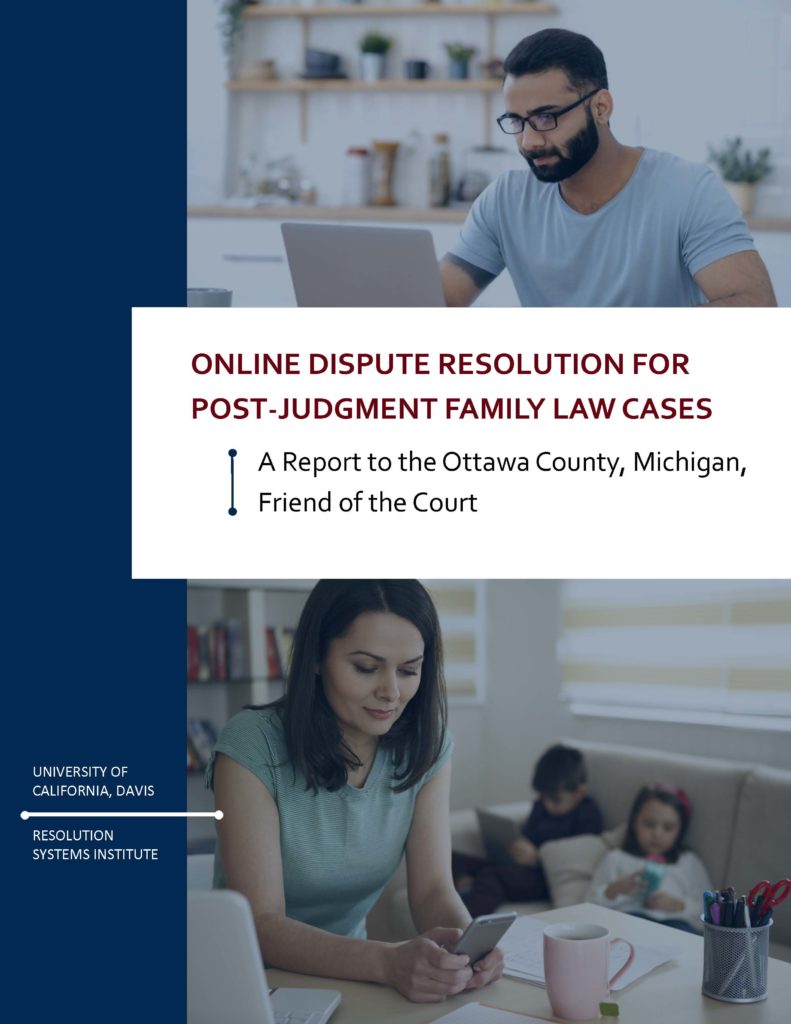
University of California, Davis, Professor Donna Shestowsky and I recently had the pleasure of conducting the first neutral evaluation of any family law court online dispute resolution (ODR) program in the United States. The program was launched by the 20th Circuit of Michigan’s Friend of the Court (FOC) in August 2020 with the goal of providing parties with post-judgment family law disputes a simpler, more convenient and cost-effective way to reach agreements related to child custody, parenting time and child support. It also aimed to increase efficiency in the disposition of these matters. By and large, we found that the program was providing the benefits the FOC hoped it would.

What We Studied

The FOC used Matterhorn’s text-based ODR platform, which allows participants to communicate with each other and their caseworker via asynchronous text messages and document exchanges. We used case data, ODR data, pre- and post-process party surveys, and staff interviews to gain insight into:

  • Parties’ expectations for the ODR process at the time it was offered to them, and their views on a video mediation alternative
  • ODR access, including the percentage of parties who participated and opted out, information about ODR available to parties, and parties’ capacity to use ODR
  • Participants’ evaluation of their experience of ODR in terms of procedural justice, satisfaction, fairness of the process, and ability to control the outcome of their matter
  • Parties’ impressions of the FOC and the other party
  • The agreement rates, hearing rates, and efficiency (time to disposition, caseworker time spent on matters) associated with ODR use
  • Direct costs and the FOC’s staff members’ perceptions of the effect of ODR on their work

Excitement and Anxiety

We found that before ODR, parties tended to be confident they could reach agreement, but the majority did not believe the other party would be truthful. They expressed high levels of excitement about using ODR, but also high levels of anxiety. Those who were planning on using it were twice as likely to report a high level of fear of the other party as those who weren’t sure they would, or who were not going to, use ODR.

Because of the platform’s technological limitations, caseworkers did not offer ODR to parties who had attorneys, those who had limited English proficiency, or to those who were blind or visually impaired. In addition, the FOC had decided that those who had a history of a high level of conflict would not benefit from ODR, and they were therefore not offered the opportunity.

Uptake Higher than for Other ODR

Almost half of the parties who were offered the chance to use ODR did so, which was high compared with other early ODR programs, which have had participation rates of 21% to 36%. In half the cases in which ODR was offered but not used, at least one of the parties simply did not register to use it despite the FOC’s intent to require its use. We noted that the emails sent to the parties informing them to register for ODR used language that could have confused the parties both about what the program was and their requirement to participate.  We also found that parties lacked an understanding of the main features of the program. This, too could have reduced program use.

A surprising finding was that almost all parties who used ODR accessed the platform with their mobile phone at least part of the time. Only 8% exclusively accessed the platform with a computer, while 71% only used their mobile phone. This indicates that the platform and any auxiliary activities, such as communications to the parties and agreement forms, must be optimized for phones.

When parties used ODR, they were four times as likely to give high ratings for fairness of the process as those who did not use ODR (50% vs. 12.5%), and twice as likely to give high ratings for satisfaction (50% vs. 25%). They were also much more likely to reach agreement than those who were offered ODR but didn’t use it (59% vs. 11%). In cases involving child support, parties using the online platform reached resolution nearly twice as fast as those who did not.

Positive, with Room for Improvement

Our evaluation indicates that the FOC’s ODR program has provided parties with a positive experience, improves agreement rates and reduces time to resolution for some cases. Program use is high in comparison with other programs.

However, our analysis suggests that the FOC could do more to educate parties about the program, direct parties to use it, and increase access to parties with disabilities as well as those who need an interpreter’s assistance to use the platform. The FOC should also explore ways to reduce access barriers for those identified by caseworkers as less likely to use or benefit from the program because they have lawyer representation or have high-conflict relationships. Attempts to reduce access barriers should also be directed at those who lack digital literacy and those who would use their mobile phone to access the platform. Our evaluation was limited by a small survey and case data sample size, which may have obscured statistical significance of some findings and did not allow us to conduct more detailed analyses of participant experience. We are looking forward to seeing more evaluations of ODR programs conducted, to build on our findings.  

Q&A Highlights Importance of RSI/UC Davis Research on Procedural Justice in ODR

Susan M. Yates, June 28th, 2021

The Pew Charitable Trusts has published a Q&A with Professor Donna Shestowsky of the UC Davis School of Law about the empirical study of online dispute resolution (ODR) that the law school and Resolution Systems Institute are conducting, which looks at court ODR programs in Michigan and Texas. The Q&A explores procedural justice, an integral element of the study.

RSI’s Director of Research, Jennifer Shack, and Professor Shestowsky are working with the Pew Charitable Trusts to evaluate online platforms that courts are using to assist parties in engaging in mediation and negotiation. RSI and UC Davis are one of three research teams involved in a larger project initiated by Pew to empirically study issues surrounding the provision of ODR by courts and its effects.

While these platforms could offer benefits, such as eliminating the need for some parties to appear in person for a trial, the study looks at possible drawbacks as well. In addition to procedural justice, the study also looks at other questions, such as whether ODR reduces the time and stress on parties and courts; affects case outcomes; and improves litigants’ use of court procedures and navigation of court rules.

For more on how courts are using ODR, visit RSI’s Special Topic on Online Dispute Resolution.

Verified by ExactMetrics