Resources / Study / Innovation for Court ADR

Just Court ADR

The blog of Resolution Systems Institute

RSI Report Examines N.H. Eviction Mediation Program: Agreement Numbers Hold, but More Tenants Move Out After Rental Support Ends

Jasmine Henry, December 13th, 2023

RSI recently completed an evaluation of New Hampshire’s statewide Eviction Diversion program. Begun in 2021, this voluntary program provides landlords and residential tenants the opportunity to mediate before a landlord/tenant eviction case is filed. We were asked to evaluate program use, mediation agreement rates, and the time from initial contact to case closure. The evaluation period ran from October 1, 2022, through August 31, 2023. We found overall that the program was successful at reaching landlords and tenants around the state, as well as at helping tenants and landlords to avoid eviction. The program was efficient as well.

Photo by Ketut Subiyanto via Pexels

The program process almost always begins when a tenant calls the court’s central phone line, although sometimes the landlord initiates contact and sometimes parties email the program directly. If the party calls the court’s central phone line, a staff member collects a summary of the party’s needs and emails the information, along with the person’s contact information, to the case manager/mediator. The case manager/mediator then contacts the landlords and tenants, conducts intakes, and schedules and conducts mediation. She also provides other assistance, such as a list of resources and referral to legal services.

Participation and Outcomes

During the evaluation period, 775 tenants or landlords reached out to the court about the eviction mediation program. Some reached out more than once, leading to 800 individual inquiries, 90% of which were from tenants. Of the 800 cases in which an inquiry with the Eviction Diversion Program was made, 176 (22%) were mediated.

We had final outcomes for 175 of the 176 mediations. Of these 175 mediations, 125 (71%) ended in an agreement and 50 (29%) ended without an agreement. The parties were more likely to agree to the tenant remaining in the rental than they were to agree to the tenant moving out: 63% of agreements were for the tenant to stay, while 37% were for the tenant to move out.

Results After Rental Assistance Ends
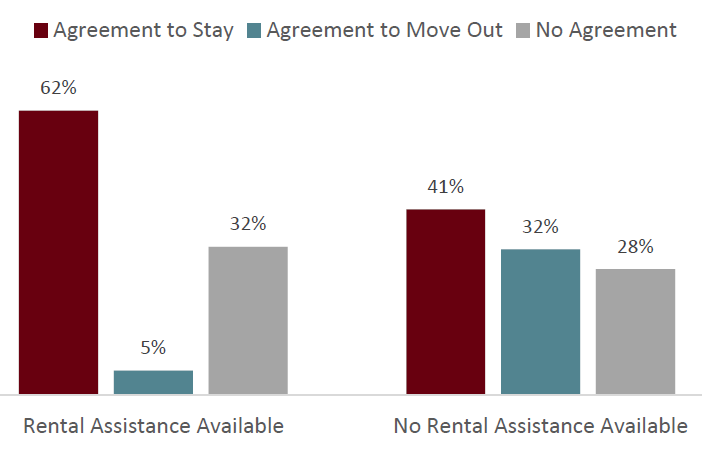
Housing agencies stopped accepting rental assistance applications at the end of October 2022 and stopped processing applications at the end of 2022. Somewhat surprisingly, this did not lead to a drop in agreements. The percentage of mediations ending in agreement rose from 68% before rental assistance ended (25 of 37 mediations) to 72% (100 of 138 mediations) afterward. However, the end of rental assistance did lead to a smaller proportion of agreements allowing tenants to stay. In October and November, 21 of 23 (91%) agreements were for the tenant to stay. This dropped to 4 of 9 (44%) in December, and 52 of 91 (57%) for the first eight months of 2023. Overall, 56% of mediation agreements after the end of rental assistance allowed the tenant to stay.

Tenants were offered the option to mediate by phone or by video. They overwhelmingly chose to mediate by phone: 157 of the 162 mediations for which we had data were conducted by phone. Only five tenants selected video mediation.

Mediations in general were conducted within a month of the tenant or landlord’s initial contact with the program. Almost two-thirds were closed within two weeks and only 11% took more than 28 days to close.

Recommendations

Based on our findings, we recommended that the program continue. It is well used and effective in helping tenants and landlords reach agreement. It has also been efficient, mediating cases quickly. We also recommended the court continue to give tenants the option to mediate by phone or video. This increases self-determination, and each method offers benefits. Phone mediation, for example, reduces the risk of a power imbalance caused by one party having a better grasp of technology or access to better technology, while video mediation offers the opportunity to exchange and view documents.

RSI Mediation Program Has Helped Over 1,500 Households Avoid Eviction

Sandy Wiegand, November 21st, 2023

More than two years ago, amid the looming threat of a rush of evictions as Illinois prepared to end its pandemic-era eviction moratorium, RSI partnered with the circuit court in Kane County to create a mediation program. It was free of cost to both tenants and landlords.

The program’s impact has been impressive. Since the eviction moratorium ended in October 2021, the Kane County Eviction Mediation Program has helped over 1,500 households avoid the traumatic effects of a sheriff’s eviction. Meanwhile, the program’s connections to rental assistance and legal and financial counseling have made it far more possible for these tenants to meet their financial obligations to landlords.

RDNE Stock Project via Pexels

Judge John Dalton, the 16th Circuit’s presiding eviction judge, also credits the program with helping the court run smoothly.

“With the help of RSI, Kane County was the first in Illinois to launch an eviction mediation program, and we have been overwhelmingly pleased with the outcomes,” Judge Dalton says. “It has been successful in assisting landlords and tenants in reaching mutually beneficial agreements. Thanks to this program, the court has been able to run efficiently during an eviction surge.”

RSI regularly surveys Kane County Eviction Mediation Program participants as one way to evaluate the program’s effectiveness. And participants have told us that mediation helps them feel heard and seen — as one tenant said, “like an actual person and not just some case number.”

As the weather turns colder and the potential consequences of eviction wax even harsher, RSI’s Kane County Eviction Mediation Program continues, with the support of the Illinois Equal Justice Foundation, the 16th Circuit Court, dozens of dedicated mediators, a few hard-working RSI staff members, and generous donors such as yourself. 

Thank you for your commitment to RSI’s work. If you’d like to invest in impactful endeavors such as the Kane County Eviction Mediation Program, you can do so on our website.

Want Your Court Communications to Be Accessible? RSI Focus Groups Offer Insights

Rachel Feinstein, October 16th, 2023

RSI’s research has shown that self-represented parties in small claims cases often don’t understand what online dispute resolution (ODR) is or how to use it, even when courts require their participation. To learn what self-represented parties need when a small claims case is filed against them, RSI’s OPEN Project is going to the source —­ conducting focus groups with people similar to these parties and asking what works for them.

Participants in an RSI focus group in Texas provide feedback on sample court documents in October 2023.

Director of Research Jennifer Shack and I led two focus groups in rural New Hampshire in August, followed by two groups in Texas in early October. We will finish our data collection for the ODR Party Engagement Project in Maryland this month. In the meantime, we want to share some of the initial insights we have gained.  

Hearing from 26 participants so far, we have learned about many of the barriers people experience when faced with examples of court documents, a court website and instructional court videos. Groups also shared their recommendations for how the material could be improved and their preferences for receiving court notifications and instructions. The majority of participants have a maximum of high school education. Most, if not all, participants earn less than $50,000/year. These income and education characteristics parallel the backgrounds typical of self-represented litigants, making their insights regarding the comprehensibility and usability of court material invaluable as we aim to develop recommendations for accessible court resources.

Notification Preferences Vary Widely

We are excited to share some preliminary findings from our focus groups. First, we have learned that providing court resources in a variety of formats is essential to addressing the public’s needs and preferences. Focus group participants expressed minimal consensus about the ideal way to learn about their involvement in a lawsuit or how to proceed with online dispute resolution. For example, only half of the 26 participants said they would prefer to receive an initial notice about their lawsuit through the mail. Six people would prefer to receive notice about their case over the phone, while five would prefer text message, and only one person wants to learn of their case via email.

“There are times where the form of a video works wonders in comparison to throwing a chapter out of a book at me or something.”

— Focus group participant

Further reflecting this need for variety, participants in two of our groups were enthusiastic about using instructional videos to learn about registering for ODR. One participant in New Hampshire shared, “I think a video would be good. Where they could break it down and explain it a little bit more in depth.” Another person agreed, “Yeah, I think so. I mean, I’m a visual learner … If this was on YouTube … everything would be fine. It’d be perfect.”

A third participant added, “There are times where the form of a video works wonders in comparison to throwing a chapter out of a book at me or something.”

In contrast, most participants in the Texas focus groups did not express a need or interest in viewing videos to get this information. But several people did agree that, as one said, “options are good,” when attempting to meet the potential variety of needs, learning styles and preferences among self-represented litigants.

Participants Wary of Possible Scams

RSI focus group participants in Texas shared their recommendations for how court informational materials could be improved and their preferences for receiving court notifications and instructions.

One topic where focus group participants were largely in agreement was their concern about being scammed. During the focus groups, we asked all participants to look at one of two ODR websites on a laptop or tablet that we provided. The first step many participants took was to assess the credibility of the website. For instance, the first reactions routinely included comments about whether the site was legitimate or a scam. Some participants also expressed apprehension regarding receiving the mailed Notice to Defendants, wanting to contact the court to check that it was legitimately a lawsuit against them before following the instructions on the document.)

This initial step of assessing documents and websites for legitimacy may be crucial for courts to be aware of when developing their communications and other resources, since apprehension about whether the material is trustworthy could inhibit people from beginning the process.  

Simple, Organized Info Is Desired

One of the most consistent themes among the participants so far has been the desire for court resources to be simple and quick to use. For instance, we heard from many individuals who want courts to use simple language, concise instructions and well-organized documents or videos. Some participants specifically requested more spacing around paragraphs, and people found sections with bullet points or short fill-in-the blank questions easy to understand.

We anticipate delving more deeply into strategies for making court resources simpler to use and comprehend. Additionally, participants have been identifying key information that is missing from the material and sharing their emotional responses to the court resources. We look forward to examining these and other themes in more detail after we conclude our focus groups later this month. 

Check back soon for a summary of our findings and a guide for courts, which we will provide on a new RSI webpage this spring!

As always, RSI is grateful to the AAA-ICDR Foundation for supporting this important work.

RSI Guide Will Help Courts Make ODR Communications More Accessible

Rachel Feinstein, September 14th, 2023

In 2022, RSI and the University of California, Davis, published two evaluations of court-related online dispute resolution (ODR) programs. A main finding of those evaluations was that parties did not have sufficient information about the programs they were being required to use. We went on to look at programs in other courts and found that the information available to parties about ODR varied, and that courts, despite making significant efforts to provide this information, needed help to do so. This was especially true for communicating with self-represented litigants. Our findings have led RSI to conduct new research that will result in a guide for courts that need to communicate with parties about their ODR programs.

The Case for Accessible Court Communications

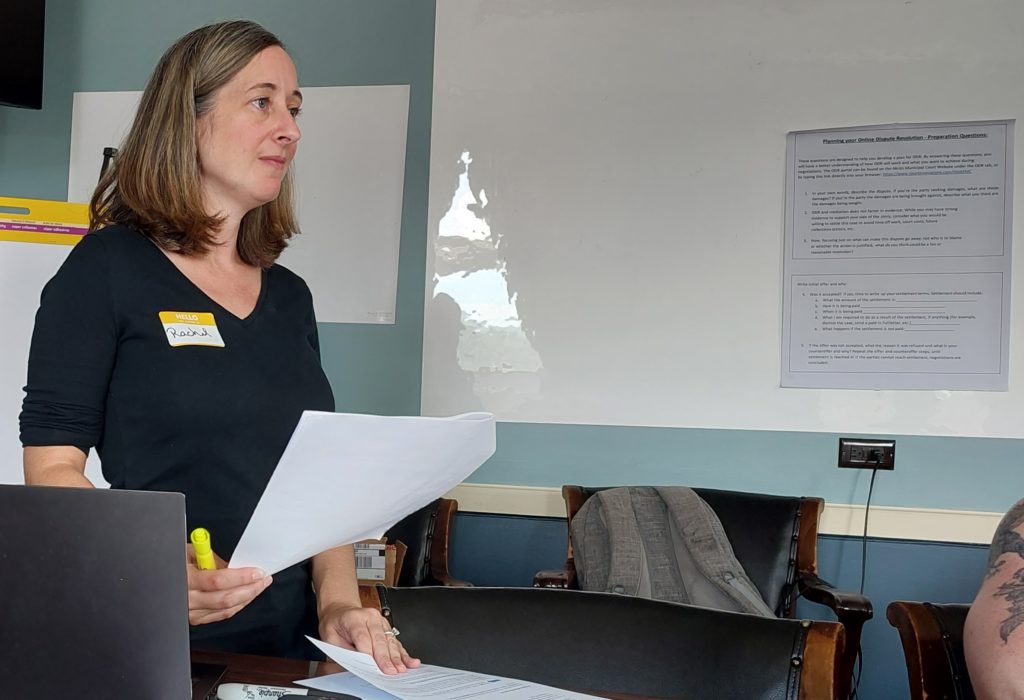
RSI Researcher Rachel Feinstein, pictured, and Director of Research Jennifer Shack facilitated focus groups for RSI’s ODR Party Engagement (OPEN) Project in Berlin, NH, in late August.

Across the US, 72% of family law cases and 76% of civil cases involve at least one self-represented litigant. As more people are handling civil cases without a lawyer, it is increasingly important that everyone can understand and use court communications, regardless of their educational background. Accessible court communications can reduce default rates and increase access to court services and programs, including ODR programs.

Half of the adult population in the US struggles to read lengthy, dense texts to complete tasks and accurately answer questions. Developing court resources with this in mind can significantly improve people’s understanding of how to access court resources, and can increase participation rates in various programs. One recent study found that simplifying the text used in court forms improved participants’ understanding of the purpose of a subpoena from 23% to 70%. Studies have also found important patterns in the reading styles and strategies of people who have low literacy, such as avoiding dense blocks of text and ignoring information on the left and right sides of the web page. Effective court communications take these types of reading patterns into account.

Digital Literacy is Another Challenge

But language and writing styles are not the only issues. Many people rely on websites and online resources provided by courts to gather the information they need, provide information to courts, and participate in online court programs. Despite widespread use of the internet, a large percentage of US adults struggle with digital literacy, or the ability to use digital technology to find information, complete tasks or communicate.

When designing websites or other digital resources, courts can benefit from recognizing common patterns among people who have low digital literacy skills. For example, people with low digital literacy will often avoid the use of search boxes, opting instead to link surf. And it is common to satisfice quickly, or give up before finding necessary information. In RSI’s forthcoming guide for courts, we will provide more information about reading patterns and strategies common among people with low literacy and low digital literacy, with the aim of supporting courts in developing ODR material everyone can use.    

Helping ODR Serve More Parties

The movement to use accessible court communications helps both parties and the courts. For example, civil courts throughout the country are investing in ODR programs. Many people can benefit from the convenience, lower cost and less intimidating process of resolving conflicts online. However, ODR participation rates remain very low, even when it is mandatory. If self-represented litigants understand the steps they need to take, more may take part in their case and do so in a more informed manner. This, in turn, will help courts by increasing participation in ODR.

The experience of the ODR programs we evaluated provides a valuable example of the need to develop effective court communications to help parties to more easily navigate court services and to improve participation in court programs. In a typical ODR process for debt and small claims cases, the court requires that defendants be given a notice of the ODR program. This notice provides written instructions to register on a third-party platform. Once they register, they can try to resolve their case with the plaintiff before their first hearing. The defendant will likely complete the entire process without interacting with court staff. Further, ODR is unfamiliar to most people, increasing the importance of courts’ efforts with written communications — and sometimes instructional videos — to provide parties adequate information to participate in their case. 

Maximizing Court Programs’ Potential

If done well, court communications can narrow the information gap and maximize the potential of a variety of court ODR programs. Enhancing access to justice requires the development of effective and accessible court communications that people from all backgrounds and education levels can easily understand and use.  RSI’s ODR Party Engagement (OPEN) Project is working to support courts in this effort by conducting focus groups in three areas of the US. Through these focus groups, we will hear from a diverse group of people who have a low income and low education, to learn what works for court notices, guides, websites and instructional videos pertaining to ODR. We will use our data, along with previous research, to develop a broadly applicable guide for civil courts to use when developing communications that reduce barriers to participation in ODR for people with low literacy.

This project is generously supported by the American Arbitration Association-International Centre for Dispute Resolution Foundation.  

Verified by ExactMetrics