
Resources / Study / Innovation for Court ADR

Just Court ADR

The blog of Resolution Systems Institute

Archive for the ‘Uncategorized’ Category

New Jersey Legislature Tackles State’s High Foreclosure Rate

Nicole Wilmet, March 21st, 2019

Despite employing a number of practices in response to the mortgage crisis in 2008, New Jersey has had one of the highest foreclosure rates among all states since 2015. In a continued effort to address this issue, New Jersey Chief Justice Stuart Rabner established a Special Committee on Residential Foreclosures in 2017 to review current practices, policies, court rules and legislation and develop suggestions for reform. Last year, the Committee released its report, which summarizes the history and current state of foreclosure in New Jersey and includes recommendations for reform. Towards the end of their report, the Committee notes that not only do unresolved foreclosures lead to thousands of cases remaining on court dockets, but they also depress property values, burden municipalities and reduce tax revenues.

Building on the recommendations from the Committee, the New Jersey legislature is currently considering a ten-bill package that would reform the residential mortgage foreclosure process. Introduced at the end of January, this package of ten bills seeks to expedite the foreclosure process, decrease the amount of time foreclosed properties remain on the market, and make the foreclosure mediation program permanent. The following chart summaries each bill being considered.

Bill Number

Summary

S3411

Recommends revising the Fair Foreclosure Act (“FFA”) to require that notices of intention to foreclose are filed at least 30 days (but no more than 180 days) before foreclosure commences. Additionally, the bill also requires that these notices also include a notice to homeowners that they are entitled to housing counseling through the Foreclosure Mediation Program.

S3412

Requires the Department of Community Affairs to create a database with an interactive map that details the foreclosed properties in the state. To fund this database, this bill also establishes a $30 fee that would be collected when deeds are recorded.

S3413

Modifies the foreclosure process to expand the definition of what constitutes a vacant and abandoned property and requires that sales of foreclosed properties occur within 60 days of a foreclosure judgment.

S3414

Allows all common interest community associations to record liens for unpaid assessments.

S3415

Requires creditors and their in-state agents to file their contact information with the Superior Court.

S3416

Clarifies that the New Jersey Residential Mortgage Lending Act also applies to any out-of-state person involved in residential mortgage lending in the state.

S3417

Requires anyone acting as a mortgage servicer to obtain a license from the state Department of Baking and Insurance.

S3418

Reduces the statute of limitations for residential mortgage foreclosure actions under the FFA from 20 years to six years from the date on which the homeowner defaulted.

S3464

Focuses on expediting residential mortgage foreclosure proceedings. Under this bill, sheriffs would be required to conduct foreclosure sales within 120 days of receiving orders to foreclose.

S1244

Codifies the Foreclosure Mediation Program and makes several adjustments to the program. These changes include notifying homeowners about the program when they receive their intent to foreclose and again when a mortgage foreclosure complaint has been filed against a property. The bill also requires that these written notices must be available in both English and Spanish.

Although these bills have several more hurdles to pass before becoming law, their introduction indicates cooperation among the executive, legislative and judicial branches during the state’s foreclosure reformation.

My Favorite Resource Featuring Sally Campbell

Nicole Wilmet, January 30th, 2019

Our series, My Favorite Resource, features interviews with our court ADR friends across the country to learn about their favorite resource. This month, Resource Center Director Nicole Wilmet spoke with Sally Campbell, Dispute Resolution Services Manager for the Supreme Court of Virginia, to learn about her favorite resource. 

NW: What is one of your favorite ADR resources? 

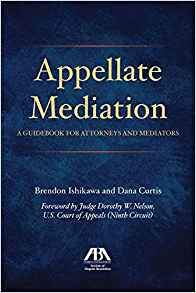
SC: Aside from RSI, always a favorite resource, my favorite ADR resource tends to be what is helping me most at the moment. Appellate Mediation: A Guidebook for Attorneys and Mediators, an ABA publication written by experienced appellate mediators Brendon Ishikawa and Dana Curtis, tops my list right now.   

NW: Why do you value this particular resource? 

SC: Appellate Mediation contains a wealth of information for any mediator, whether newly minted or appellate veteran. I still marvel at this book’s promotion of a facilitative process with a client-centered, problem-solving approach – not what I expected when I first opened it. The book divides into five sections. The first, “Fundamentals of Appeals,” tackles appellate law basics, case evaluation, and decision tree risk analysis for case evaluation. The second, “The Appellate Mediation Process,” covers each phase of the mediation, with headings varying from “Explanation of the roles of the Mediator and Participants” and “People Get Angry; It’s Okay,” to “Brainstorm for as Many Options as Possible – Especially Options with Asymmetric Gains.” The “Practice Tips for Appellate Attorneys” section focuses on preparing attorneys and clients for mediation; strategies for the sessions; and crafting an enforceable agreement. “Practice Tips for Appellate Mediators” delivers excellent, detailed guidance for mediators.   

Finally, the Appendix packs a punch with great resources for appellate mediators, like sample phone call dialogue and sample documents. Appellate Mediation is eminently accessible with a user-friendly design that makes it easy to find specific information. The authors even include a chapter on mediator professional development. That chapter’s attention to the reflective practice process generated an a-ha! moment, and facilitated our goal to design the Mediator Self-Reflection Treasury to guide and support mediators even in solitary, first-time self-reflection.  

NW: How did you first learn about this resource?  

SC: In 2018, the Supreme Court of Virginia approved appellate mediation pilot projects to run for two years in the Supreme Court and the Court of Appeals of Virginia. I found this book while looking for resources to assist in the training of appellate mediators. It fit the bill so well that the trainer used it in the basic mediation course.  

NW: For those unfamiliar with this resource, what is one part of this resource that you wouldn’t want someone to miss?  

SC: For newer, non-appellate mediators, I would recommend Chapter 14 (“Phase 2, Information Exchange, and Phase 3, Identifying and Organizing the Issues”), although there is so much to be gleaned elsewhere in the book, I wouldn’t stop there. For seasoned mediators, I’d recommend Chapters 2 and 3, that address case evaluation as in “What is my best presently available option?” and case valuation through decision tree analysis. In this well-written, accessible book, these chapter materials aren’t nearly as daunting as they sound.     

This book might top my list for a long time to come. 

If you have a favorite resource you would like to share in an upcoming edition of our newsletter and our blog, please reach out to our Resource Center Director Nicole Wilmet at nwilmet@aboutrsi.org. 

New Mediator Self-Reflection Tool

Susan M. Yates, January 9th, 2019

The Supreme Court of Virginia has developed a wonderful new self-reflection form for mediators. While the Court developed this tool for their certified mediators as part of their re-certification process, it is a valuable tool for any mediator (just ignore the instructions about continuing mediator education credits). There is a lot of content, so if you are using this on your own you will probably want to pick and choose among the questions. This new tool coordinates with Virginia’s excellent Mediator Self-Reflection Treasury.

Even though mediators work very closely with people when we mediate, typically no one else in the room shares our mediator perspective. There are exceptions, such as co-mediation or when we are observed by new mediators, but mediation can be an isolated activity (made especially so by the limits of confidentiality). This isolation makes self-reflection particularly important.

I can imagine many uses for these tools beyond self-reflection. A group of mediators could pick a few of the questions to discuss over lunch. For co-mediators, the tools could aid their debriefing. The forms might help a new court or community mediation program get clear about what they expect from mediators. The tools will probably spark other ideas when you read them.

Many thanks to the good people of the Supreme Court of Virginia for taking the time to produce and share these tools. They are a real gift to the mediation community.

A Look Back on 2018

Nicole Wilmet, December 21st, 2018

What a wonderful year 2018 has been! From court program evaluations and trainings to celebrating Resolution Systems Institute Day, we have had an exciting year and continued to great make strides in serving communities with court alternative dispute resolution! As RSI’s Resource Center Director and Court ADR Connection Editor, I have had the pleasure to share each exciting moment with you this year. To culminate 2018, I am looking back on all of RSI’s monumental moments this year.

This was a hallmark year for AboutRSI.org with several new resources added to our Resource Center. March brought the launch of Mediation Efficacy Studies, the most comprehensive collection of resources on the subject of court alternative dispute resolution effectiveness. This summer, Director of Research Jennifer Shack published her evaluation of Washington, D.C.’s Child Protection Mediation Program, and we shared our Model Tools for Mediator Peer Review.

This fall, we released two new chapters to our Guide to Program Success, a step-by step guide from Executive Director Susan Yates and Jennifer Shack that discusses how to design, manage and evaluate a successful court ADR program. We also collaborated with the National Association for Community Mediation to share a Community Mediation Special Topic that explains the basics of community mediation, explores the relationship between courts and community mediation centers, delves into the important activities of data tracking and evaluation and compiles exemplary studies on the effectiveness of community mediation.

Finally, we rounded out our year of new resources with Jennifer Shack’s program evaluation of the eight foreclosure mediation programs funded by the Illinois Attorney General and developed a digital summary of the evaluation.

In 2018, we also launched our series My Favorite Resource that collects resources from our court ADR friends across the country. I would like to thank Heather Kulp, Debora Denny, Doug Van Epps, Missy Greathouse, Rebecca Price, Raeshann Canady, Kevin Malone, Catherine Geyer, Annalise Buth, Renee Salmon, and Peter Salem for participating in our inaugural year. I have truly enjoyed learning about each of your favorite ADR resources and network groups and I look forward to connecting with more friends this year!

This year was also a milestone year for our foreclosure mediation programs here in Illinois as our five-year grant from the Illinois Attorney General ended. Under the grant, RSI developed and administered foreclosure mediation programs in Illinois’ Lake, Kane, Winnebago, and Boone counties; trained mediators for all Attorney General-funded foreclosure mediation programs throughout the state; developed an online case management and monitoring system for those programs; and conducted two statewide evaluations of the programs. We are happy to report that all three of RSI’s foreclosure mediation programs will continue to operate thanks to the support of their local courts. RSI’s Kevin Malone and Olga Kordonskaya will continue to administer our programs in Kane County and Lake County, respectively, and moving forward, the court will administer the foreclosure mediation program in Winnebago & Boone counties. We consider the continuation of the programs as evidence of their success given that the courts value these programs enough to continue to provide funding for them. We are grateful to the Attorney General for supporting these programs, to the courts for their partnership and to the skilled mediators for conducting the mediations.

Last, but certainly not least, we also celebrated several important events this year. In April, we welcomed Grace Barter as our new Administrative Assistant. On July 11, 2018, Rockford, Illinois Mayor Thomas McNamara declared that day as Resolution Systems Institute Day in honor of RSI’s work on foreclosure mediation in the Rockford community. That same month, we celebrated Kent Lawrence, founder and steadfast supporter of RSI, for receiving the Decalogue Society of Lawyer’s Hon. Gerald C. Bender Humanitarian Award. The Hon. Gerald C. Bender Humanitarian Award is presented to individuals whose excellence and dedication demonstrate commitment to justice by serving the community.

In September, we celebrated our one-year anniversary of the new AboutRSI.org, and Eric Slepak-Cherney was named RSI’s new Associate Director. In November, Jennifer Shack was appointed to the American Bar Association Section of Dispute Resolution Research Advisory Committee and this month, Olga Kordonskaya and Kevin Malone celebrated their five-year anniversary with RSI.

As December comes to a close, I know that each of us here at RSI is thankful for a wonderful 2018. We look forward to all that awaits in 2019!

Verified by ExactMetrics