Resources / Study / Innovation for Court ADR

Just Court ADR

The blog of Resolution Systems Institute

Archive for the ‘Training, Skills & Techniques’ Category

Workshops Can Help Courts, Others Better Communicate with Self-Represented Parties

Stephen Sullivan, January 14th, 2026

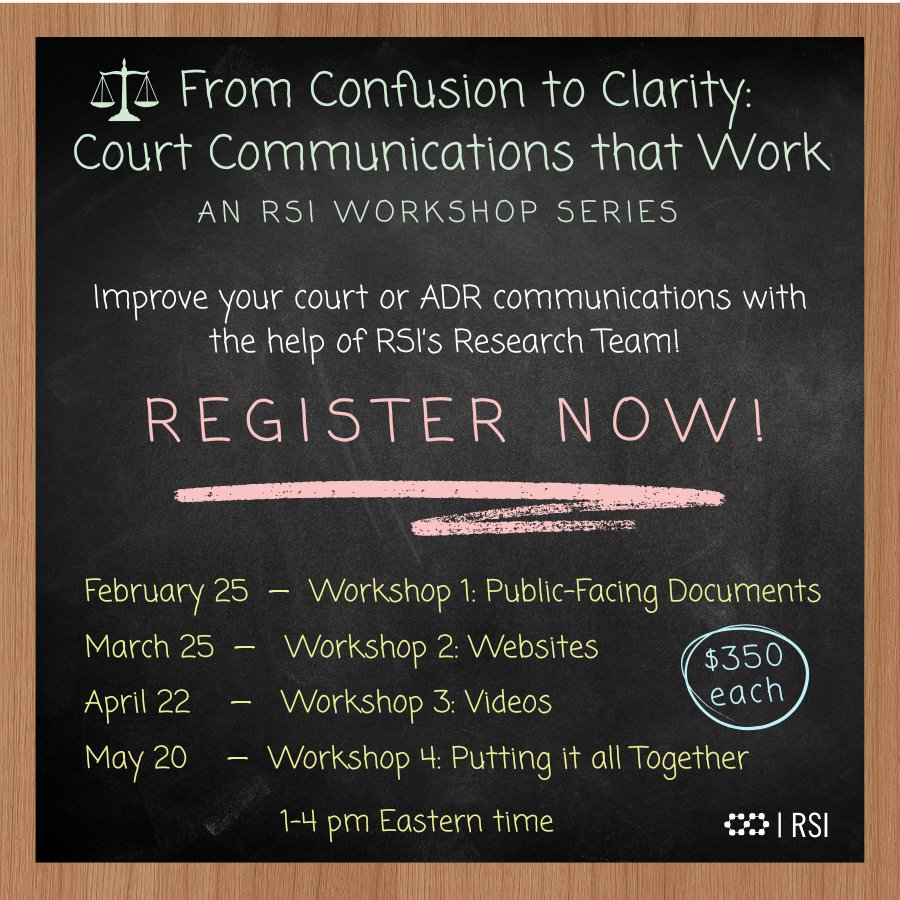
RSI is offering a series of online workshops to help courts and organizations enhance their ADR program communication materials. During these workshops — From Confusion to Clarity: Court Communications that Work — RSI’s researchers will work with participants to review and improve their communication materials, including notices, webpages and videos. Participants will walk away with new or updated materials and the strategies to ensure future communications can effectively serve their communities, including self-represented litigants (SRLs).

Improving Court Experience Remains a Priority
Courts continue to face diminished public trust and a lack of confidence among those who go through the legal system. The 2025 State of the State Courts report by the National Center for State Courts found that poor communications are a major driver of access to justice issues. People find court forms and paperwork confusing or hard to understand, and they lack information about what to expect from court processes, the report notes. In line with these findings, a recent Pew study on perceptions of state and local courts found that US adults want courts to be easier to navigate, to work for all users and to be more user-friendly.

According to the Pew study, one-third of people who have had a court experience emerged with diminished confidence in the courts. More than half of those with court experience found it difficult to understand how to fill out court forms and to understand the steps of their cases. The latter finding held true across demographic groups, including age, education level and income level, and regardless of whether the respondent was a plaintiff or defendant.

Most people also said courts should focus on making processes easier to navigate rather than making them faster. The same Pew study found that 71% of survey respondents with court experience and 68% of survey respondents without court experience said courts should make it easier for people to navigate the system rather than diverting their resources to speed up cases and reduce costs.

Why We Designed the Workshops

RSI’s OPEN research demonstrates that simple and easy-to-understand communications can meaningfully address some of the biggest challenges facing court users. Through usability testing, we found that our accessibly designed OPEN communication models boosted people’s confidence in navigating their case and enabled them to more capably follow the steps required to participate in ADR programs.

Easy-to-understand court communications are especially important for SRLs, people with low literacy and people with low digital literacy. Courts can make important inroads to improving court experience and building trust by addressing barriers in their communication materials. Our OPEN research also highlights scaffolding as an effective strategy for making the steps within court programs easy to follow.

Yet RSI recognizes that courts may not have sufficient resources for a full consultation to improve their materials. We developed these workshops to be low-cost opportunities for court staff to begin addressing these issues. By participating in our workshops, participants can take the first step to improving their existing communication materials or creating new materials that better serve their communities.

What the Workshops Will Cover

We are offering four workshops over the next few months. Each workshop will be 3 hours long and cost $350. Each will take place 12-3 pm Central/1-4 pm Eastern, via Zoom. Below are descriptions of each workshop:

Wednesday, February 25Workshop 1: Public-Facing Documents. Bring the documents you would like to modify or thoughts on what you want to create. You will leave with documents that are written and formatted so that SRLs will understand and act on any instructions. Register & pay now for Workshop 1, or Register & receive an invoice for Workshop 1. Please register by February 18. 

Wednesday, March 25 — Workshop 2: Websites. Bring your webpages or ideas. Leave with a layout and draft content you can bring to your IT department. Register & pay now for Workshop 2, or Register & receive an invoice for Workshop 2. Please register by March 18.

Wednesday, April 22 — Workshop 3: Videos. We will help you take your ideas for a video and turn them into a storyboard to provide your communications department or consultant, or ready for you to create your own video. Register & pay now for Workshop 3, or Register & receive an invoice for Workshop 3. Please register by April 15.

Wednesday, May 20 — Workshop 4: Putting it All Together. Learn how to take your different communication methods and turn them into a workflow that enhances SRL trust and confidence in navigating an unfamiliar process. Register & pay now for Workshop 4, or Register & receive an invoice for Workshop 4. Please register by May 13.

We are excited to use what we have learned through the OPEN Project to help you with your communication needs. Please reach out to research@aboutrsi.org for any questions you may have about the workshops.


After Successful Pilot, RSI Seeks Mediator Partners for Next Phase of Trust Project

Jennifer Shack, July 17th, 2024

Last year, RSI began the pilot phase of a research project to examine how mediator behaviors might affect parties’ trust during mediation. During this exploration phase, our research team has been observing small claims and eviction mediations and marking down mediators’ communication behaviors, in a process referred to as coding, for the Trust Project. We gathered pre- and post-mediation surveys from the parties, and we interviewed the mediators involved.

From left, Rackham Foundation’s Ava Abramowitz, RSI Director of Research Jennifer Shack and Behavior Analysis Trainer Kenneth Webb gave a presentation on the early findings of RSI’s Trust Project at the American Bar Association Section of Dispute Resolution 2024 Spring Conference in April 2024.

After coding 22 mediations and completing a thorough review of our piloted data collection instruments, RSI has successfully completed our pilot phase. We are excited to share that we will soon be expanding the project and are looking for mediation organizations and/or individual mediators who would like to partner with us.

Method Adapted for Mediation

The Trust Project is based on behavior analysis (BA), a research method that codes for particular communication behaviors and connects them to desired outcomes. This method has been used successfully in negotiations and sales. BA examines the particular behaviors used as well as the sequences of behaviors that occur, to determine their effects on specific desired outcomes. In this instance, RSI is interested in changes in trust between the parties and changes in trust in the mediator. We are also interested in mediation results and participant perceptions of the mediation and the other party.

Over the course of five years, Ava Abramowitz and Ken Webb worked to modify communication behaviors used in the contexts of negotiations and sales for use in mediation — with a lot of input from mediators and researchers. Ava is a former assistant U.S. attorney, longtime mediator and secretary of the Rackham Foundation. Ken is an expert in behavior analysis, coding and training negotiators to improve their practice. He trained RSI’s researchers in behavior analysis. Thanks to generous support from the Rackham Foundation, RSI has the opportunity to conduct this innovative research into the effects of mediator behaviors on party trust.

Watch Michael Lang’s 2021
In Their Voices interview with Ava Abramowitz and Ken Webb for more insight into the idea of applying behavioral analysis to mediation — the concept behind the Trust Project!

Mediator Partners Sought

For the next phase of the Trust Project, RSI will observe mediations of small claims, family and larger civil cases, both in person and online. We are looking for partners in this endeavor. Interested organizations and mediators would work with RSI to determine how to effectively recruit parties. Mediators will be asked to complete an initial survey about their background and approach to mediation, to facilitate observations of their mediations, and to complete a survey after each observed mediation. We will preserve confidentiality of the mediations, the mediators and the parties by removing any identifying information from the data.

If you are interested in participating in this impactful research, please contact RSI Director of Research Jennifer Shack at jshack@aboutrsi.org.

8 Tips for Assisting Self-Represented Litigants

Christina Wright, June 24th, 2024

Working in the Kane County Eviction Mediation Program for the past three years, I have seen firsthand the challenges self-represented litigants may face. I have also learned a lot by reading RSI’s research on related topics, such as the ODR Party Engagement (OPEN) Project. Recently, I had a chance to speak to members of the Illinois Supreme Court Access to Justice Court Navigator Network at the Kane County Law Library in Geneva, Illinois, about tips I’ve found useful in supporting these litigants. I am sharing them below with the hope that they will be useful to others.

Photo by Edmond Dantes via Pexels

1. Speak and write in plain English.

For native speakers as well as those for whom it is a second language, English can be a difficult language to master. Many self-represented litigants don’t have the language skills to understand the legalese that is often used in the courtroom. Thus, it is important that all court-related communications be written in plain English. Additionally, court-connected mediation programs and other settings involving self-represented litigants should have a staff member accessible to answer questions regarding court/program handouts and policies.

2. Provide translation.

Any paperwork should be readily available in commonly used languages other than English. In Kane County, our primary need is Spanish, but that will vary by jurisdiction. Translation services should also be provided as needed.

3. Be clear that outcomes are not predictable.

To avoid making promises you can’t keep, be sure to use language that does not promise a particular outcome. For instance, one could say “You may apply for a court fee waiver,” rather than “You can get your court fees waived.” This important distinction can prevent confusion down the line as the individual continues to navigate the court/program.

4. Be flexible with scheduling.

Courts/programs can be difficult to access for those who live near or below the poverty line and/or who have inflexible work schedules. For self-represented litigants with little or no income, it may be impossible to physically attend court or afford the devices necessary to attend court virtually. Buses, ride-hailing services and even bicycles cost money and can be time-consuming to use. Being flexible with scheduling allows participants a greater chance of attending, and without the extra burden of costs associated with travel, childcare, calling off work, etc.

5. Be knowledgeable about available resources.

Inability to use technology is another hurdle. Whether it be because the individual lacks the skills or the finances to utilize technology, online dispute resolution (ODR) programs and virtual court may only be an option with extra assistance from the court/program. Extra assistance may come in the form of lending a device, walking the self-represented litigant through connection issues, or referring them to another agency that can help get them connected. Libraries are a great resource for technology assistance and connection.

6. Keep an open mind.

Don’t assume you know anything about any particular self-represented litigant’s life, capabilities, technology access, education, finances, etc. What may seem simple or common to you may not even be an option for them. With that said, self-represented litigants come from all different walks of life, so it is even more important not to assume they are all alike and thus all have the same needs.

7. Be persistent when reaching out to parties.

How do you reach a self-represented litigant? Keep trying! The Kane County Eviction Mediation Program uses phone, text, email and in-person conversations to gather information and assist self-represented litigants face their legal challenges. Everyone has their own preferred communication method, so it takes different forms of communication to reach different people. Attempt contact frequently and through a variety of methods if you really want to reach the individual.

8. Be trustworthy.

Finally, the OPEN Project found that trust can be a big obstacle for courts. OPEN focus group participants were wary of the communications they reviewed. Thus, it is important that all court communications look official and provide solid contact information in case the self-represented litigant needs to ask questions or contact the court/program for other reasons.

Although there can be challenges when working with self-represented litigants, the individual parties can benefit greatly from the support. Mediation and similar programs can provide clarity, control, support, legal assistance, financial resources, housing counseling and other resources to self-represented litigants. They can decrease the amount of time a case remains in court (a benefit to everyone involved) and prevent unnecessary wage losses. Self-represented litigants may need regular reinforcement and assurance, but by providing this service we increase their access to justice.

New, Free IPV Screening Tool Can Help Ensure that Mediation is Safe and Fair

Rachel Feinstein, June 14th, 2023

Screening for interpersonal violence and abuse (IPV/A) is an essential step for making family mediation safer and more fair for all parties. Unfortunately, in “Joint Session or Caucus? Factors Related to How the Initial Mediation Session Begins,” Roselle Wissler and Art Hinshaw found that only 11% of surveyed family mediators screened for IPV, or had access to the screening results, prior to mediation (see footnote 85). A new tool, the MASIC-S, might change that. The MASIC-S is available free at ODR.com for all mediators. It is an abbreviated version of the Mediator’s Assessment of Safety Issues and Concerns (MASIC), which was developed in 2010 and is widely referenced for use in family mediation.

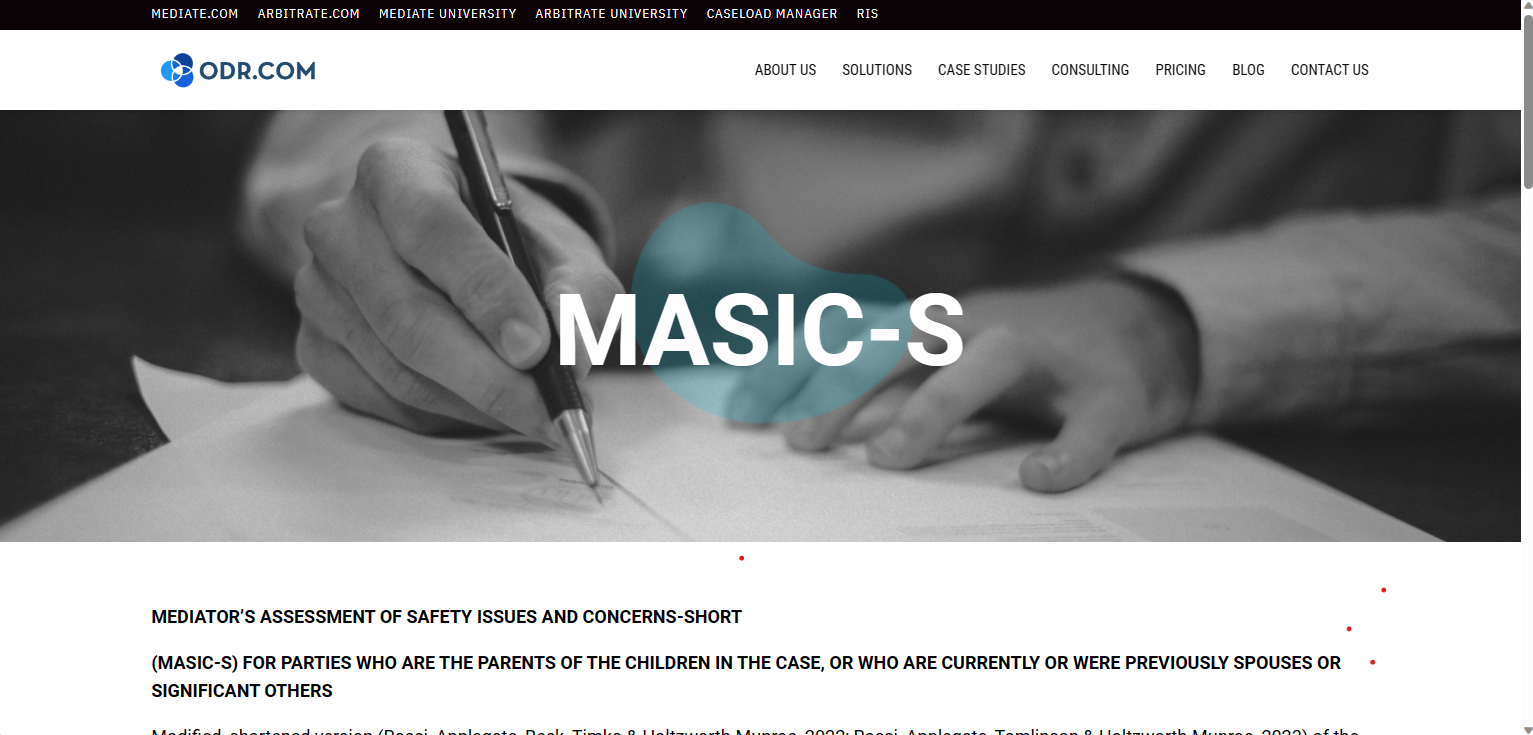
Screenshot of the webpage for MASIC-S, a new tool to screen for interpersonal violence and abuse.
MASIC-S is an abbreviated version of the Mediator’s Assessment of Safety Issues and Concerns (MASIC). It is available for free at ODR.com (screenshot from website above) for all mediators.

RSI is particularly interested in this new tool in light of our 2018 project, supported by the Family and Interpersonal Resilience and Safety Transformation Fund, that studied IPV screening tools, surveyed experts in IPV dynamics (as well as lawyers, judges and mediators) on best and actual practices, and convened those experts to explore how to close that gap. The research led to an extensive report outlining RSI’s proposed solution and the steps to actualize it.

The questions in the MASIC-S focus on abuse in past or current relationships. Many of the questions have been validated, meaning that they accurately identify severe and concerning degrees of abuse, which the screening tool aims to assess. Mediators can screen parties during intake by privately administering the MASIC-S questionnaire in person or through videoconferencing. After each party has completed the questionnaire, the mediator will be prompted to consider specific questions regarding whether or not mediation is appropriate for the case, and if so, what accommodations might be necessary for a safe and voluntary process.

The Comprehensive Guidance provides detailed instructions for administering the MASIC-S, as well as directions to follow based on a party’s score. For example, if a party receives a score of 3 or higher, the guide recommends refraining from mediating jointly in-person; however, online mediation may still be a reasonable option. The Comprehensive Guidance even provides scripts to follow, such as what a mediator can say to safely terminate mediation without blaming either party or endangering a survivor.

The MASIC-S is also designed to protect confidentiality of the parties. For example, mediators do not record any identifying information that could connect responses to a particular person, and the results are not shared with the other party. Additionally, the responses are not stored online; mediators can instead download a PDF of the responses if they want a record of them. Using this abbreviated screening tool at intake can help to ensure mediation is appropriate for the parties and necessary accommodations are made for a safe and just process.

Verified by ExactMetrics