
Resources / Study / Innovation for Court ADR

Just Court ADR

The blog of Resolution Systems Institute

Archive for the ‘RSI News’ Category

A Q&A with RSI’s Virtual Eviction Mediation Programs Manager Chris Riehlmann

Eric Slepak Cherney, October 13th, 2022

This article is part of a series of perspectives on eviction mediation program development that is being supported by the American Arbitration Association-International Centre for Dispute Resolution Foundation. The AAA-ICDR’s grant is enabling RSI to expand our outreach to court ADR colleagues working in the fast-evolving eviction field, and we are tremendously grateful to the Foundation for their support.

RSI conducts three virtual mediation programs in northern Illinois. The programs are supervised by Eviction Mediation Programs Manager Chris Riehlmann. In this role, Chris oversees the administration, data collection and reporting, and ongoing development of the programs. He recently took some time to answer some of Court ADR Connection’s questions about the programs and his experience.

Chris, can you start by sharing a little about your background prior to joining RSI?

Chris Riehlmann

Education-wise, I received my B.A. and J.D. from Loyola University Chicago. During law school, I focused mainly on learning all aspects of litigation and criminal law. Following law school, I pursued my interest in civil rights by working with the Greater New Orleans Fair Housing Action Center, the Orleans Parish Public Defenders Office, and private civil rights attorneys in the Chicago area. My first real attorney job was for a high-volume personal injury law firm representing plaintiffs injured by car accidents, medical malpractice, slip and falls, defective products and more. This position gave me real experience handling cases from beginning to end while interacting with judges, opposing counsel and clients. 

My most meaningful foray into the housing legal realm was working for Open Communities, a fair housing non-profit in Evanston, IL. While at O.C., I led a team that investigated allegations of housing discrimination, took legal action against bad actors and educated the public on their housing rights. I also learned how eviction litigation worked and defended individuals who couldn’t afford an attorney. It was eye opening how quick evictions worked, with tenants showing up in court for their first appearance and leaving with an eviction order that same day. There was no chance for tenants to meaningfully participate in the process that was removing them from their homes.

After fighting for housing justice in the northern suburbs of Chicago with Open Communities for four years, I decided to expand my understanding of dispute resolution methods and joined RSI’s eviction mediation team. 

In general, what do you see as the benefits of mediating eviction cases?

There are plenty of benefits for everyone involved with the program, such as improving access to justice, legal cost reduction, promotion of judicial efficiency and more. However, the greatest benefit for mediating evictions is that the parties get a chance to breathe and discuss the issues that brought them to the point of legal action on a level field.

In my experience with eviction litigation pre-COVID, cases were decided incredibly quickly, with tenants either being evicted on their first appearance or agreeing to settlements under duress with no clue of the ramifications of their actions. On the other hand, if a tenant knew how the process worked, and had an attorney or faced a landlord who was unrepresented, evictions could potentially take months! Landlords could wait forever and a day for a judgment only to wait even longer for an overbooked sheriff to effectuate the order of possession.

Overall, mediation positively affects the timeline of an eviction by giving both parties an opportunity to efficiently have their needs met. Tenants can slow the warp speed nature of some cases so they can have a voice in the process and potentially avoid the most traumatic aspects of eviction. Landlords can speed up some cases to get a resolution in a few weeks instead of a few months.

Can you give us a broad overview of how the programs operate?

RSI has an eviction mediation program in three counties in northern Illinois: Kane, Winnebago and Kankakee. Each county works in its own nuanced way, but each program starts when the judge presiding over evictions refers a case into the program.

Once the program coordinator is assigned a case, they make contact with both parties to schedule a mediation. Before the mediation occurs, the tenant is connected to resources to help them in the eviction, including rental assistance, housing counseling and legal representation. The idea is to set the tenants up in the best position possible going into the mediation.

On mediation day, the tenant, the landlord and any attorneys sit down with a trained third-party mediator via Zoom to present their case. The mediator gives both parties an opportunity to voice their needs, to discuss what brought them to this point and to discover avenues of resolution. Any agreements reached are memorialized in the appropriate court order form and submitted to the judge for approval. Depending on the terms of the agreement, the case is dismissed or a compliance date is set in the future.

Can you tell us how the programs operate in a hybrid space? Which aspects still occur in the courthouse, and which are conducted online? Has any of that evolved in the nine months you’ve been with RSI?

The majority of all program activities take place virtually. The program coordinators in all three counties attend the court calls remotely, and the vast majority of cases are mediated remotely. The only physical presence we have is in the Kane County courthouse so we can interact with those parties face-to-face if necessary. In Kankakee and Winnebago counties, we are entirely remote, handling referrals and conducting mediations over Zoom. These programs were developed with this level of remote participation in mind, but we still have backup methods to interact with people who need more support.

What challenges do you see when it comes to participating virtually? What benefits?

At the risk of sounding incredibly contradictory, virtual participation both increases and decreases party participation. Holding mediations over Zoom offers flexibility for the majority of parties. People can hop on to a Zoom call while on break at work or any time that is convenient. In a situation where making money to pay off a debt is vital, this flexibility helps keep people on track with payment plans.  

On the other hand, some individuals are not very tech savvy and have trouble accessing Zoom through their phone. These are often some of the most vulnerable populations. To address this, we try to have a physical attendance option available. When we don’t have a physical presence at the courthouse, we rely on our social service partners to help people in person access the mediation either over the phone or Zoom.  

What have been some of the biggest successes you and your team have had operating these programs? Conversely, what sorts of challenges have you faced, and what have you learned from them?

The programs have had an impressively high agreement rate. Through all three programs, we are reliably assisting around 65% of cases come to a resolution. When the stakes are as high as losing your home or not getting months of rent, consistently setting parties on the path toward mutual success makes us proud.

It seems like contradiction is becoming a theme here, but challenge-wise we’ve seen both the high and low ends of caseloads depending on the county served. In Kane County, we have impressive judicial buy-in and nearly every eviction case is referred into the program. While we are happy about the enthusiasm and know we are helping many residents of Kane County, the constant high volume can be challenging for staff. Once you complete one demanding week of mediations, there is little rest as the next week’s cases are ready to be handled. To address this high volume, we have supplemented staffing to support this program and are exploring adding further personnel.

Conversely, the two other programs are less active and receive fewer referrals. This is due to a variety of issues including getting new judges up to speed, local rental assistance programs being highly effective (thus obviating some of the need for mediation), and different philosophies regarding when mediation is appropriate. We have learned that maintaining good communication with the presiding judge and court administrative staff is integral to promoting program buy-in.

As these programs have now been established for about a year, and the broader eviction landscape continues to evolve, are you anticipating any changes to the programs?

The approaching unknown in the eviction field is the end of rental assistance programs. Since the mediation programs’ inceptions, there have been federal, state and local programs that provide financial support to tenants who are behind on rent. Some of these smaller programs are wrapping up, and the large state program will end in July 2023. Once these resources are no longer available to tenants, the terms of agreements will likely change. We will most likely see less “pay and stay” agreements and more “graceful exits” with an agreed move-out date. I also anticipate providing training to our mediators on how to handle that new state of affairs.

Rental Relief and Eviction Mediation Work Hand in Hand to Make Housing More Stable

Eric Slepak Cherney, August 19th, 2022

This article is part of a series of perspectives on eviction mediation program development that is being supported by the American Arbitration Association-International Centre for Dispute Resolution Foundation. The AAA-ICDR’s grant is enabling RSI to expand our outreach to court ADR colleagues working in the fast-evolving eviction field, and we are tremendously grateful to the Foundation for their support.

Photo by Kostiantyn Li, via Unsplash

Rental assistance has been a critical component of eviction mediation programs over the past two years. With tenants unable to work for months on end and moratoria on evictions in place, past due rent amounts soared. Conducting mediations in which tenants could not pay landlords much, if any, accumulated rent would not have been fruitful. While mediation in landlord-tenant cases has a long pre-COVID history of success, the sheer number of impacted households and amount of past-due rent threatened to destabilize housing markets and leave millions without a home in the midst of a global health emergency.

The key was rental assistance: Landlords and tenants applied to government programs, which would then make payments to landlords for past-due rent and, in some instances, for a few months in the future.

Across two separate rounds of relief, Congress appropriated over $46 billion in emergency rental assistance. Through June 30, 2022, some $32 billion of that funding had been expended. The relief was allocated to individual states, under the assumption that each state would be best situated to decide how to distribute its allocated funds most effectively. Generally speaking, the states designed their rental assistance programs along a continuum, with one end being central administration by statewide agencies, and the other being delegation of administration to individual municipalities such as cities and counties. Many fell somewhere along the continuum in a hybrid approach.

Timely Processing of Applications a Challenge

The coordination among federal, state and local governments to deliver these services has been a massive undertaking, and certainly not without challenge. An analogous challenge in coordination has arisen between the executive branches of states that are charged with distributing these funds, and the judiciaries that are charged with adjudicating the eviction cases filed in their courts. The interplay between these two, particularly around the speed at which each operates, often determines the reality of whether a tenant can successfully stay in their home.

Using Illinois, where RSI operates several eviction mediation programs, as an example, we saw early on how gaps in coordination were impacting applicants. As cases began to be filed in the wake of our state’s eviction moratorium being lifted in October 2021, the processing time for rental assistance applications was significant. Anecdotally, we heard stories from tenants, landlords and legal aid providers that it wasn’t unusual for applications to take two or three months to be approved. 

Even with many jurisdictions in Illinois electing to continue their eviction cases, some for up to 28 days, the rental application process simply wasn’t going to move fast enough in many cases to change case outcomes. While judges could potentially continue cases to allow for a decision on rental assistance, they also had to balance the needs of the landlord, some of whom had already gone 18 months or longer without collecting rent.

Expediting the Resolution Process

Commendably, our state agencies responded by developing a dedicated Court-Based Rental Assistance Program (CBRAP). This rental relief program is solely for parties to an active eviction court case, and its resolution process has been expedited to stay within the timelines of most courts in the state. The program has been effective at resolving rental assistance applications in a period of three weeks or sooner, meaning that many parties know whether they’ve been approved by the time their case comes back up for their continuance date.

RSI and our fellow mediation centers in Illinois have assisted CBRAP in expediting cases by accepting referrals from the Illinois Housing Development Authority to mediate certain pending rental assistance applications. Typically, these cases are ones in which a rental assistance application has been conditionally approved but the landlord has also secured an eviction order, often from a default judgment. Because the rental assistance terms stipulate that a landlord agrees to not evict for an additional 90 days (the rent is prepaid by the award), the primary focus of these mediations has been to help the parties make sure they both understand the terms of the agreement, including that the landlord will need to vacate the eviction order to receive rental assistance.

Complementary Programs

Our work on CBRAP complements our eviction mediation programs operating in Illinois’ circuit courts. When tenants are evicted and taken to court, our mediation programs are often the first touchpoint for many parties, and thus we make a lot of referrals to rental assistance as part of our intake and triage process.

Illinois’ CBRAP is just one example of many that demonstrate how eviction diversion programs complement and intersect with rental assistance efforts. We’ve previously showcased the Philadelphia eviction diversion program, which innovatively integrated rental assistance directly into the program model itself, and also allowed for pre-filing cases to give parties more time to explore the rental assistance. A recent webinar jointly hosted by the White House and Treasury Department highlighted the significant role eviction diversion programs have played in improving rental assistance delivery. And a forthcoming post on this blog will take a look at the unique and effective approach that was taken in Hawaii on Oahu.

A Look at RSI’s Extraordinary Past Two Years

Sandy Wiegand, August 1st, 2022

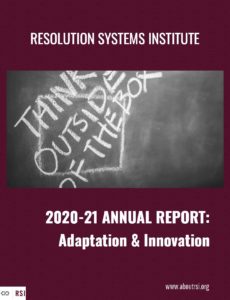
Adaptation and Innovation. Those are the themes of the new Resolution Systems Institute annual report. Like many organizations, RSI has opted to sum up 2020 and 2021 together – a reflection of the degree to which we have been consumed by the urgent demands of these extraordinary times.

As we lift our heads from our work for a moment, we’re proud to review all that our efforts have helped accomplish over the past couple years.

From designing and operating three new eviction mediation programs in Illinois, to convening experts from across the US to explore the potential of online dispute resolution for family court, to curating resources for a special topic on eviction mediation, to providing evaluation of both our own and others’ alternative dispute resolution programs, RSI has been busy adapting and innovating in an effort to mitigate some of the devastation of the COVID-19 pandemic.

This work is improving outcomes. To take just one local example, our Kane County, Illinois, Eviction Mediation Program served over 100 households in the final few months of 2021, after Illinois ended its eviction moratorium on October 3. Mediators handled 66 cases, providing a vital forum for parties to hear and be heard, and leading to 45 agreements. Afterward, 89% of parties responding to surveys expressed satisfaction with the mediation experience. In addition, RSI helped navigate hundreds of community members to housing counseling, rental assistance and legal aid services.

Of course, everything RSI has accomplished in our 27 years of operation has been made possible by our dedicated program partners, generous funders, and everyone who joins us in working to increase access to justice through court alternative dispute resolution. 

We invite you to review the Resolution Systems Institute 2020-2021 Annual Report and learn more about what we’ve accomplished together. We hope you will continue to support our work and be a part of finding creative solutions that improve outcomes for disputing parties, while reducing the strain on our nation’s court systems.

Spring 2022: How RSI’s Work Has Expanded and Evolved During the COVID-19 Pandemic

Just Court ADR, May 18th, 2022

As the COVID-19 pandemic has strained finances, families and the social fabric in general, the need for and potential of well-designed alternative dispute resolution (ADR) to stitch together solutions has become increasingly apparent. Throughout this challenging time, Resolution Systems Institute (RSI) has continued to monitor and evaluate new dispute resolution initiatives and developed new court mediation programs of our own. Below is a description of some of our work during the pandemic.

In 2020, as a potential pandemic-driven eviction wave loomed, RSI began to design our first eviction mediation program. In the course of about nine months, we developed the court rules, procedures and forms the program would need to operate. We also recruited a cadre of mediators and provided them with specialized eviction mediation training through our friends at the Center for Conflict Resolution. The Kane County (Illinois) Eviction Mediation Program launched in spring 2021. Later that fall, RSI launched similar programs in Illinois’ Kankakee and Winnebago counties. Overall, our programs operate in judicial districts that serve over 920,000 Illinois residents.

To learn more about RSI’s work over the last two years in the eviction arena, we recommend you check out our blog entries on the topic, as well as our Eviction Mediation Special Topics resource. RSI is now working with Kane and Winnebago counties to bolster their longstanding foreclosure mediation programs as homeowners now begin to feel the squeeze that renters started experiencing last year.

While RSI is spearheading these new program development and administration initiatives, evaluation remains the central pillar of upholding RSI’s mission of improving access to justice. RSI Director of Research Jennifer Shack recently published two reports evaluating the program development experience in Kane County: Eviction Mediation Design and Implementation in Illinois’ 16th Judicial Circuit: Challenges and Keys to Success and Participant Experience in Eviction Mediation: Summary Of Early Survey Responses in the 16th Judicial Circuit of Illinois’ Video Mediation Program.

In partnership with the University of California, Davis, RSI has also evaluated online dispute resolution (ODR) pilot programs in Texas and Michigan. The pandemic generated greater interest among courts for ADR processes that parties could access remotely. The evaluations, which will be released soon, will provide courts with a better understanding of what ODR adoption requires and what possible benefits it can provide.

The last two years have provided many of us, RSI included, with a complex mix of setbacks and new opportunities. RSI is committed to innovating and adapting to meet the challenges that courts, and the litigants they serve, encounter in this ever-changing world. We are grateful to our program partners, our funders and each of you who come to RSI in search of expertise and guidance. We hope you will continue to take this journey with us as we work towards our mission of expanding access to justice through court alternative dispute resolution.

Verified by ExactMetrics