
Resources / Study / Innovation for Court ADR

Just Court ADR

The blog of Resolution Systems Institute

Archive for the ‘ADR Resources’ Category

New, Free IPV Screening Tool Can Help Ensure that Mediation is Safe and Fair

Rachel Feinstein, June 14th, 2023

Screening for interpersonal violence and abuse (IPV/A) is an essential step for making family mediation safer and more fair for all parties. Unfortunately, in “Joint Session or Caucus? Factors Related to How the Initial Mediation Session Begins,” Roselle Wissler and Art Hinshaw found that only 11% of surveyed family mediators screened for IPV, or had access to the screening results, prior to mediation (see footnote 85). A new tool, the MASIC-S, might change that. The MASIC-S is available free at ODR.com for all mediators. It is an abbreviated version of the Mediator’s Assessment of Safety Issues and Concerns (MASIC), which was developed in 2010 and is widely referenced for use in family mediation.
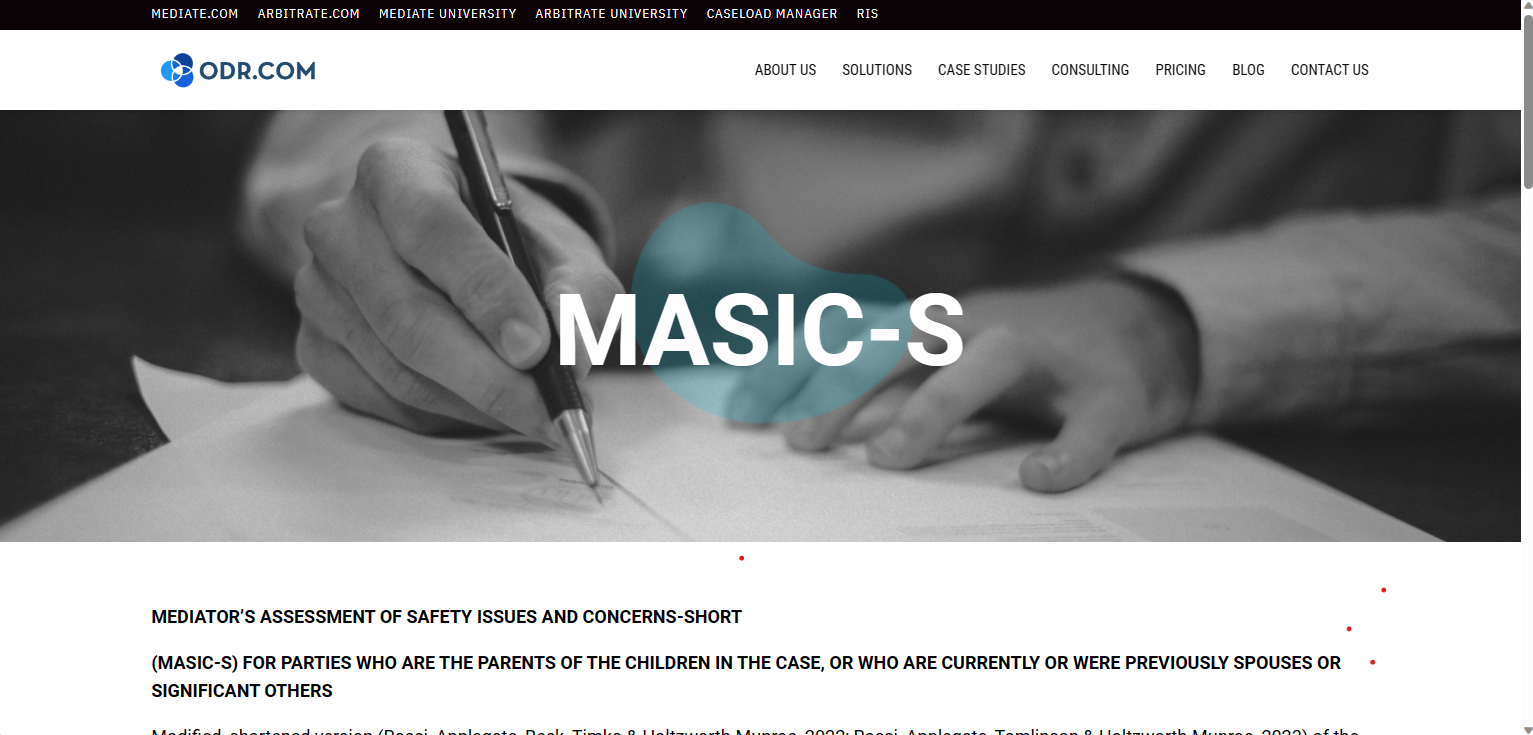
Screenshot of the webpage for MASIC-S, a new tool to screen for interpersonal violence and abuse.
MASIC-S is an abbreviated version of the Mediator’s Assessment of Safety Issues and Concerns (MASIC). It is available for free at ODR.com (screenshot from website above) for all mediators.

RSI is particularly interested in this new tool in light of our 2018 project, supported by the Family and Interpersonal Resilience and Safety Transformation Fund, that studied IPV screening tools, surveyed experts in IPV dynamics (as well as lawyers, judges and mediators) on best and actual practices, and convened those experts to explore how to close that gap. The research led to an extensive report outlining RSI’s proposed solution and the steps to actualize it.

The questions in the MASIC-S focus on abuse in past or current relationships. Many of the questions have been validated, meaning that they accurately identify severe and concerning degrees of abuse, which the screening tool aims to assess. Mediators can screen parties during intake by privately administering the MASIC-S questionnaire in person or through videoconferencing. After each party has completed the questionnaire, the mediator will be prompted to consider specific questions regarding whether or not mediation is appropriate for the case, and if so, what accommodations might be necessary for a safe and voluntary process.

The Comprehensive Guidance provides detailed instructions for administering the MASIC-S, as well as directions to follow based on a party’s score. For example, if a party receives a score of 3 or higher, the guide recommends refraining from mediating jointly in-person; however, online mediation may still be a reasonable option. The Comprehensive Guidance even provides scripts to follow, such as what a mediator can say to safely terminate mediation without blaming either party or endangering a survivor.

The MASIC-S is also designed to protect confidentiality of the parties. For example, mediators do not record any identifying information that could connect responses to a particular person, and the results are not shared with the other party. Additionally, the responses are not stored online; mediators can instead download a PDF of the responses if they want a record of them. Using this abbreviated screening tool at intake can help to ensure mediation is appropriate for the parties and necessary accommodations are made for a safe and just process.

New Eviction Mediation Special Topic Offers Courts Guidance in Midst of Housing Crisis

Just Court ADR, June 25th, 2021

This article is part of a series of perspectives on eviction mediation program development that is being supported by the American Arbitration Association-International Centre of Dispute Resolution Foundation. The AAA-ICDR’s grant is enabling RSI to expand our outreach to other court ADR colleagues working in the fast-evolving eviction field, and we are tremendously grateful to the Foundation for their support.

Those of you familiar with Resolution Systems Institute will know that over the past year, we have been heavily focused on the rise in eviction cases in the aftermath of COVID-19. This evolving eviction crisis has begun to, and will continue to, test the capacity of our court systems in a way likely not seen since the foreclosure wave of the last decade.  RSI’s mission is to strengthen access to justice through court ADR, and with many courts looking at diversion efforts to address a surge in eviction cases, we see both significant opportunities and challenges ahead to ensure that participants receive due process.

We are thus very proud to share with you our new Eviction Mediation Special Topic. In the past, we have shared with you our Special Topics collections on subjects such as Child Protection Mediation, Community Mediation and Online Dispute Resolution, to name a few. These resources provide background on how court ADR programs address these cases, share insight into how to evaluate such programs and share relevant resources such as articles, evaluations and sample materials.

The Eviction Mediation Special Topic contains all of this information, with a slight twist. Due to the topical nature of this subject, we have prepared this resource in the context of the current crisis. Background information and certain resources are therefore presented with current events in mind, and we also have a section about key considerations we have learned thus far into the eviction crisis. Additionally, we have done our best to collect information on active court ADR eviction programs, captured in our Eviction ADR Across the Country database. We plan to update the Special Topic regularly as developments unfold, and new collective knowledge becomes available to the field.

We are sincerely grateful to the American Arbitration Association-International Centre for Dispute Resolution Foundation, whose generous funding has enabled us to create and share this resource.

Recently Added Resources to RSI’s Resource Center

Nicole Wilmet, June 23rd, 2021

Did you know that RSI’s Resource Center is the most comprehensive and respected source of information on court ADR anywhere? Housed within the Resource Center is the Research Library, which has an extensive annotated collection of court ADR resources such as articles, studies, court rules, statutes and court forms.


As RSI’s Resource Center Director, I regularly adds new resources to the Research Library. The following list highlights a few of the resources that have recently been added.

I hope these resources are helpful to you in your work!

RSI’s Board Member Alyson Carrel Co-Authors New Negotiation Textbook

Just Court ADR, May 6th, 2021

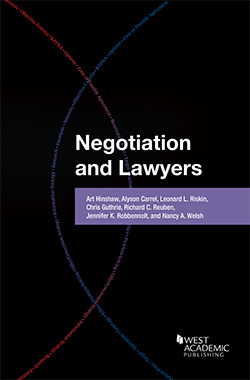
Congratulations to RSI’s Board Member Alyson Carrel for co-authoring a new negotiation textbook entitled Negotiation and Lawyers. Joining Alyson as co-authors are Art Hinshaw, Leonard L. Riskin, Chris P. Guthrie, Richard C. Reuben, Jennifer K. Robbennolt and Nancy Welsh. The textbook is responsive to the increased role technology plays in the negotiation practice and presents the core concepts, skills and strategies lawyers need to be successful in negotiation both online and offline. In particular, Alyson crafted a chapter on technology and negotiation.

Congratulations to Alyson and the entire team of authors on this terrific new resource!

Verified by ExactMetrics