
Resources / Study / Innovation for Court ADR

Just Court ADR

The blog of Resolution Systems Institute

Archive for the ‘RSI News’ Category

Jennifer Shack Talks about Inspirations, Dream Projects and the Future of ADR

Just Court ADR, July 19th, 2023

RSI Director of Research Jennifer Shack often uses this space to tell us about a new research project or share findings from her latest ADR program evaluation. Today, we asked her to take a step back and answer a few questions about what drives her work, as well as share her thoughts on a few “big questions” in our field.

What drew you to studying alternative dispute resolution (ADR) as a career?
When I was a Peace Corps volunteer in Benin, West Africa, I observed how the village chiefs resolved conflicts through what I was to discover was mediation. I thought it would be great to have something similar here in the States – a way to resolve conflicts without court intervention and in a way in which both parties felt was fair. I was surprised to learn about mediation when I returned home, and excited when I saw an ad for a job opening that started with the words “Interested in mediation?” I applied, and 24 years later I’m still enjoying my work at RSI.

What is your favorite part of your work?

So much! I really enjoy designing evaluations and research projects. I love interviewing program participants and conducting focus groups because I get to learn on a much deeper level how mediation programs affect the participants – and because I get to meet so many interesting people. I also have a lot of fun digging into data to find out what story they tell about a program or an issue and then writing that story.

Do you have a long-term wish list in terms of aspects of court-based ADR that you’d like to study?

I have a lot of items on my wish list. I’ll just talk about my top three. As you know, Donna Shestowsky and I evaluated two text-based ODR programs. I have also evaluated programs that involved in-person and video mediation. I would love to delve further into how these three different processes affect participant experience, particularly in what and how they communicate with each other and the mediator, and whether agreement terms differ. The more we know about how these processes are experienced by parties, the better we can become at determining which method best fits with different case types and situations, and the more we can improve the participant experience.

I would also love to do longitudinal research on child protection mediation. Having conducted a couple of evaluations on child protection mediation programs and interviewed parents after they participated in mediation, I think this is one of the best uses of mediation. But I’d like to know more about its long-term impact on families.

My third item on my wish list is already starting to become true. For decades, I and so many others have wanted to look inside the black box of mediation and find out what works and what doesn’t. We’re starting to do this with the Mediator Trust Project, but that’s only the first step. There are many aspects that can be examined. For example, in family mediation we can examine mediation’s effect on co-parenting and family dynamics. Another possibility is researching whether there are certain things mediators do that increase the probability of impasse.

RSI’s research team has recently expanded to include two additional full-time employees. How has this affected your day-to-day work or RSI’s project work?

RSI’s Research and Evaluation team recently expanded to include Rachel Feinstein, left, and Jasmine Henry.

Having Rachel and Jasmine join us has been wonderful. It’s really helpful to be able to talk through ideas and issues with other research-minded colleagues. I also am happy to have Jas do research on an idea that I otherwise wouldn’t have time to explore. But most of all having Rachel take leadership on our OPEN Project has allowed me to focus on our Mediator Trust Project while Jasmine continues to monitor and report on the participant surveys from the eviction mediation program RSI administers.

What trends do you see in court-based ADR that you think are likely to persist?

I think remote dispute resolution is here to stay, whether it’s video mediation or text-based ODR. Video mediation will continue to be prevalent, and I’m seeing signs that text-based ODR is going to become much more common in the near future. Artificial intelligence (AI) will make inroads in dispute resolution, particularly in helping parties to negotiate and write agreements. AI may also one day mediate between parties as well.

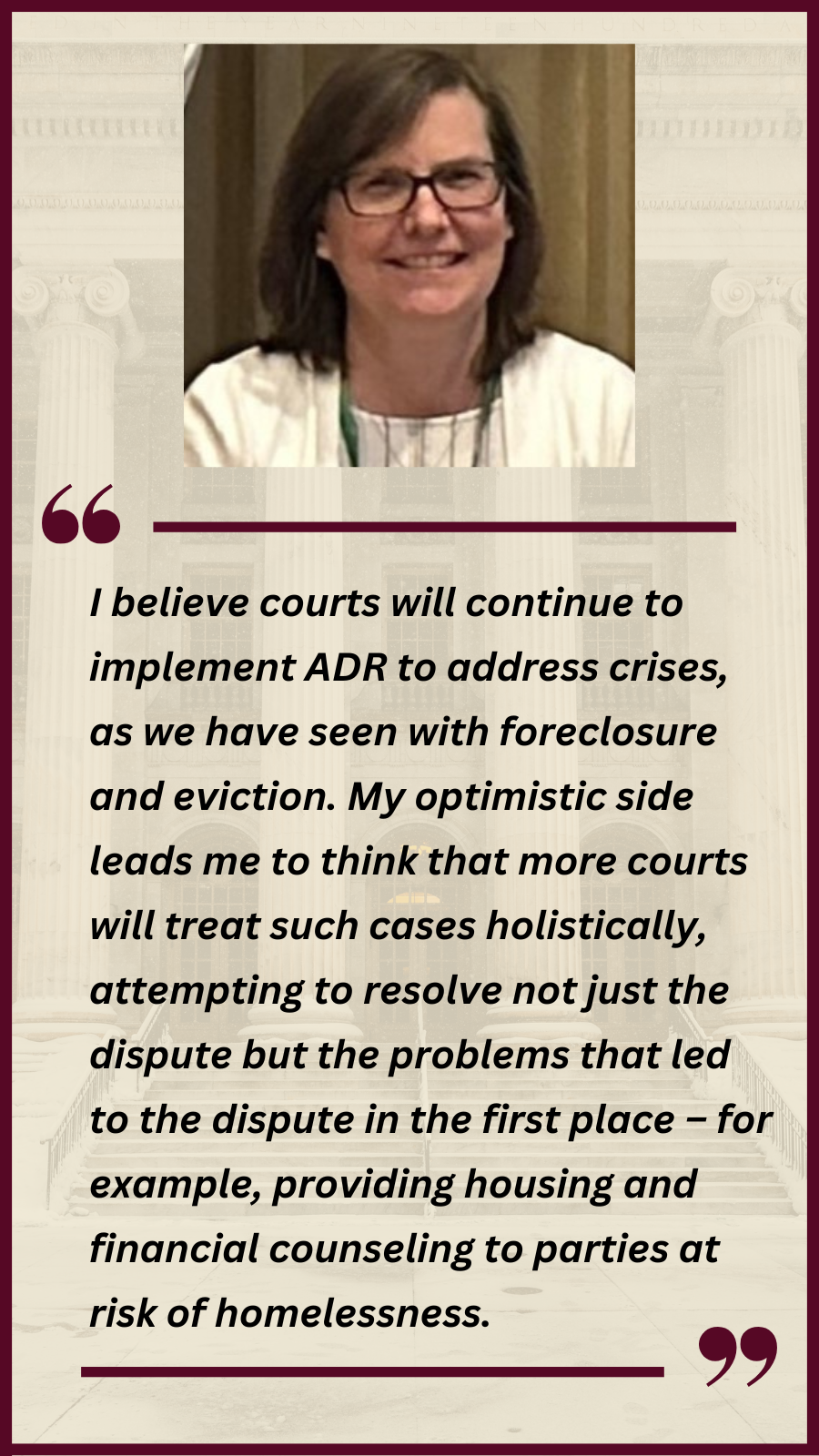
Outside of technology, I believe courts will continue to implement ADR to address crises, as we have seen with foreclosure and eviction. My optimistic side leads me to think that more courts will treat such cases holistically, attempting to resolve not just the dispute but the problems that led to the dispute in the first place – for example, providing housing and financial counseling to parties at risk of homelessness.

What is your least favorite part of your work?

Probably not having the time or money to pursue all the projects I’d like to do.

What do you see as keys to making court-based ADR more accessible?

The main thing is to break down barriers to participation. This means making the ADR process easier to navigate and use. It also means communicating with parties using multiple methods and keeping in mind best practices for individuals with low literacy. Courts need to ensure that parties know about the existence of ADR options. Donna Shestowsky’s research on civil court ADR and our evaluations of court ODR programs have shown that too many parties don’t know that ADR programs exist. Courts should also educate parties about the benefits and risks of their options if they have them, so they can make informed decisions about those options.
Does ADR + Tech = Better Access to Justice? RSI Spent Much of 2022 Trying to Find Out

Sandy Wiegand, May 2nd, 2023

RSI spends a lot of time and energy studying the conditions under which court-based alternative dispute resolution (ADR) can best improve access to justice. In recent years, that has often meant using new technologies and/or assessing their impact.

As is often the case with innovations, ADR options that employ new technology are sometimes hailed as the solution to longstanding challenges. For example, online dispute resolution (ODR) is celebrated for its potential to increase access to justice by allowing parties to engage on their own schedules, in their own spaces. Unfortunately, however, technological innovations can also bring challenges and create their own barriers to justice.

RSI’s 2022 annual report asks the question: Does ADR + Tech = Better Access to Justice? Our staff spent much of last year examining that premise. We published two landmark evaluations of court programs that used ODR-specific platforms; completed an in-depth report on the potential for ODR to serve thinly resourced parents, courts and communities; and used video mediation to serve hundreds of clients in northern Illinois. We also evaluated how those programs were operating and how participants viewed them.

Our annual report outlines these efforts and summarizes some of our findings. Not surprisingly, we found both promising signs and causes for concern when it came to technology’s impact on access to justice. We also discovered a lot more questions that need to be answered and problems that need to be addressed.

We hope you will take the time to read the Resolution Systems Institute 2022 Annual Report and review what we have learned so far. The role of technology is, of course, just one of many aspects of court-based ADR that RSI is examining. Please join us as we continue exploring what technology can and can’t solve, as well as other keys to providing cost-effective, timely and fair conflict resolution.

Could RSI’s Latest Research Project ‘OPEN’ Door to ODR for Parties with Low Literacy?

Jennifer Shack, April 13th, 2023

Text-based online dispute resolution (ODR) programs are often touted as a way to increase access to justice. They are seen as more convenient, less costly to parties, and less intimidating, and thus as having the potential to reduce the default rate, particularly for debt cases. Yet early evaluations of ODR programs have found that they suffer from low participation. An information gap, worsened by the prevalence of low literacy, contributes to this low participation.

Through a generous grant from the AAA-ICDR Foundation, RSI’s ODR Party Engagement (OPEN) Project hopes to address this problem by gaining insights from impacted populations and using those insights to develop guidance on communication materials for small claims courts that use ODR.

Through a generous grant from the AAA-ICDR Foundation, RSI’s ODR Party Engagement (OPEN) Project hopes to address this problem by gaining insights from impacted populations and using those insights to develop guidance on communication materials for small claims courts that use ODR.

The Information Gap

RSI’s ODR evaluations found that parties were often unaware of their court’s ODR program or did not understand what ODR was and how it worked. We identified deficiencies in the language the courts used to inform and educate parties, and in how the information was provided. In Utah, a usability study found that parties did not always understand the information provided and wanted more information than was offered.

These evaluations point to a need for better information to apprise parties that an ODR program exists and educate them about the program. Then they could knowledgeably decide whether the program might benefit them, understand what the risks may be, and learn how to use the ODR platform.

Need for Digital Hand-holding

Informing parties properly has become more important with the increase in self-represented litigants. According to the Program for the International Assessment of Adult Competencies, 48% of US adults struggle to perform tasks with text-based information, such as reading directions, with 19% only capable of performing short tasks.

Some courts have changed their approach to helping parties, with varying success. But even those that recognize the need to serve their constituents better may not realize they have a communication problem. Recently, the Colorado Supreme Court conducted a listening tour throughout the state to find out how it might better serve the state courts’ constituents. The main takeaway was that people with low literacy could not understand the courts’ communications to them.

Some courts have instituted alternative dispute resolution (ADR) programs, such as RSI’s virtual eviction mediation programs, that involve access to a program administrator to help parties navigate the program. Small claims ODR programs are different. These programs require parties to use ODR before their first hearing, and they often do not have a designated staff person to help those who have the wherewithal to reach out to the court on their own. Without a person to “hold their hand” through the process, parties need digital hand-holding.

RSI’s Project Goals

To engage and educate parties, courts should offer ODR participants materials that are easy to understand and to access via multiple methods (e.g., mailed notices, videos, text guides). A recent readability study of court forms found that simplifying the text used in the forms increased participants’ understanding of the purpose of a subpoena from 29% to 70%.

Courts generally do not have the knowledge or capacity to develop materials that can be readily understood by people with low literacy. For the OPEN Project, RSI will conduct a series of focus groups and apply their findings, along with best practices developed from prior research, to develop guidance on communication materials for small claims courts using ODR. Cases such as debt, landlord-tenant, eviction and consumer-merchant cases are likely to benefit.

OPEN aims to make access to justice more equitable for self-represented, diverse populations who are either required or offered the opportunity to use text-based court ODR for debt and small claims cases.

Watch this space for updates on our findings.

RSI Board Secretary Marinello on the Role of Arbitration and How It Has Changed

Sandy Wiegand, February 16th, 2023

Welcome to RSI’s Board Member Profile series! Each profile will feature a different member of RSI’s talented and dedicated Board of Directors. This month we focus on Board Secretary Mitchell L. Marinello.

RSI Board Secretary Mitchell L. Marinello

Mitchell L. Marinello has been a member of RSI’s Board of Directors since 2013 and has been Board Secretary since 2015. He is a partner at Novack and Macey, where he handles complex commercial cases through litigation, arbitration and mediation. Mitch also serves as a commercial arbitrator for numerous organizations including the American Arbitration Association, the International Center for Dispute Resolution, the International Institute for Conflict Prevention & Resolution (CPR), and others. We asked him to tell us about how alternative dispute resolution fits into his work, what he likes about the RSI Board, and more.

Can you share a little about your law practice and how you use ADR in your practice?

My practice is complex commercial arbitration. It involves contracts, real estate, employment, some intellectual property, and partnership law including break-ups in law firms and other businesses. Over the years, I have gotten a wide variety of cases. It’s fun in that you often learn about types of business or industries that are new to you, you litigate the issues involving those matters and then, when the case is over, you go on to something else. Of course, I also do counseling.

These days, ADR is an integral part of a commercial litigation practice, and I often represent clients in ADR settings. Arbitrations are a forum where trials are much more common than they are in court and you get to the merits of the case much faster. That has advantages for clients and for lawyers who usually find trials to be one of the most enjoyable aspects of litigation. I also serve as a mediator and arbitrator myself. To date, I have served as a mediator in about 20 cases and as an arbitrator in more than 240. As a mediator, I have had good success in settling cases, and my mediation practice has been picking up.

Mediations generally don’t work unless both sides are genuinely interested in them and enough information has been shared so that both sides can calculate the benefits and risks of going to a judgment on the merits. An extremely high percentage of commercial lawsuits eventually settle, so once enough information is on the table, there is a reasonably good chance of settling the case. I recommend mediation in appropriate settings. There are several factors to consider.

What led you to join the RSI Board?

I met (RSI Board member) Hon. Morton Denlow (ret.) years ago through the Chicago Bar Association and knew him from his time on the bench. He also knew other people in my firm very well. And then I had a mediation in front of him that was settled as a result of his efforts. He knew that I was interested in ADR, and some time after that he asked if I would be interested in joining the RSI Board. He gave a positive review of the organization, and I thought it would be interesting to learn about the organization and get to know the other Board members who at that time were mostly retired judges. I was and still am primarily focused on arbitration, while RSI is focused exclusively on mediation, but I thought RSI’s mediation programs would be interesting to learn about.

What’s your favorite thing about being on the RSI Board?

The people who work at RSI are very good at the services they provide. They are intelligent, dedicated and easy to get along with; getting to work with them is one benefit of being on the Board. Another benefit is that the Board members are a varied and interesting group of people.

When/where were you first introduced to alternative dispute resolution?

I started off as an attorney in New York City. We had some clients in the textile business, a client in the steel business, and a client in the paint supply business. They all had arbitration clauses in their agreements, and they ended up filing arbitrations involving breach of contract claims against companies they had supplied products to. The firm let me handle those arbitrations as a young lawyer, and I enjoyed them. I also started to think about how the arbitration process could be improved.

One thing people don’t necessarily know is how much arbitration has changed since the early 1980s. Then, like now, you would get a list of potential arbitrators and each side would get to strike and rank them. Well, I would try to find out information about the panel members, and it was very hard to do. There was no internet, of course, and the information in lawyer listings was pretty minimal, and it all sounded the same. I also discovered that some of the people on the arbitration panels were completely retired and that others had passed away! Also there wasn’t much arbitration in those days. People volunteered to be on the panels, but even if they were senior attorneys, that didn’t mean they had any significant experience as arbitrators.

In the early ’90s, things really started to change. The panels were updated, and a more rigorous process was put in place before you could become an arbitrator. Gradually, that also corresponded with an increasing number of arbitrations and with larger cases. I got really interested in arbitration and applied to be on the AAA panel. I got on the AAA panel in the early ’90s, and I started off getting small cases to arbitrate. And over time it just gradually grew. So now I get some very large and complex cases.

The increasing popularity of arbitration coincides with Supreme Court decisions that have given the Federal Arbitration Act new life and with the crowding of the courts, the high cost of litigation, and the long time it takes in court to get to trial. Arbitration and mediation benefit clients, but they also are in a very major sense relief valves for the court system. And, as RSI has shown, mediation also can help people who cannot afford the high cost of litigation resolve their disputes and get a chance to be heard.

Verified by ExactMetrics