Resources / Study / Innovation for Court ADR

Just Court ADR

The blog of Resolution Systems Institute

Archive for the ‘RSI News’ Category

Want Your Court Communications to Be Accessible? RSI Focus Groups Offer Insights

Rachel Feinstein, October 16th, 2023

RSI’s research has shown that self-represented parties in small claims cases often don’t understand what online dispute resolution (ODR) is or how to use it, even when courts require their participation. To learn what self-represented parties need when a small claims case is filed against them, RSI’s OPEN Project is going to the source —­ conducting focus groups with people similar to these parties and asking what works for them.

Participants in an RSI focus group in Texas provide feedback on sample court documents in October 2023.

Director of Research Jennifer Shack and I led two focus groups in rural New Hampshire in August, followed by two groups in Texas in early October. We will finish our data collection for the ODR Party Engagement Project in Maryland this month. In the meantime, we want to share some of the initial insights we have gained.  

Hearing from 26 participants so far, we have learned about many of the barriers people experience when faced with examples of court documents, a court website and instructional court videos. Groups also shared their recommendations for how the material could be improved and their preferences for receiving court notifications and instructions. The majority of participants have a maximum of high school education. Most, if not all, participants earn less than $50,000/year. These income and education characteristics parallel the backgrounds typical of self-represented litigants, making their insights regarding the comprehensibility and usability of court material invaluable as we aim to develop recommendations for accessible court resources.

Notification Preferences Vary Widely

We are excited to share some preliminary findings from our focus groups. First, we have learned that providing court resources in a variety of formats is essential to addressing the public’s needs and preferences. Focus group participants expressed minimal consensus about the ideal way to learn about their involvement in a lawsuit or how to proceed with online dispute resolution. For example, only half of the 26 participants said they would prefer to receive an initial notice about their lawsuit through the mail. Six people would prefer to receive notice about their case over the phone, while five would prefer text message, and only one person wants to learn of their case via email.

“There are times where the form of a video works wonders in comparison to throwing a chapter out of a book at me or something.”

— Focus group participant

Further reflecting this need for variety, participants in two of our groups were enthusiastic about using instructional videos to learn about registering for ODR. One participant in New Hampshire shared, “I think a video would be good. Where they could break it down and explain it a little bit more in depth.” Another person agreed, “Yeah, I think so. I mean, I’m a visual learner … If this was on YouTube … everything would be fine. It’d be perfect.”

A third participant added, “There are times where the form of a video works wonders in comparison to throwing a chapter out of a book at me or something.”

In contrast, most participants in the Texas focus groups did not express a need or interest in viewing videos to get this information. But several people did agree that, as one said, “options are good,” when attempting to meet the potential variety of needs, learning styles and preferences among self-represented litigants.

Participants Wary of Possible Scams

RSI focus group participants in Texas shared their recommendations for how court informational materials could be improved and their preferences for receiving court notifications and instructions.

One topic where focus group participants were largely in agreement was their concern about being scammed. During the focus groups, we asked all participants to look at one of two ODR websites on a laptop or tablet that we provided. The first step many participants took was to assess the credibility of the website. For instance, the first reactions routinely included comments about whether the site was legitimate or a scam. Some participants also expressed apprehension regarding receiving the mailed Notice to Defendants, wanting to contact the court to check that it was legitimately a lawsuit against them before following the instructions on the document.)

This initial step of assessing documents and websites for legitimacy may be crucial for courts to be aware of when developing their communications and other resources, since apprehension about whether the material is trustworthy could inhibit people from beginning the process.  

Simple, Organized Info Is Desired

One of the most consistent themes among the participants so far has been the desire for court resources to be simple and quick to use. For instance, we heard from many individuals who want courts to use simple language, concise instructions and well-organized documents or videos. Some participants specifically requested more spacing around paragraphs, and people found sections with bullet points or short fill-in-the blank questions easy to understand.

We anticipate delving more deeply into strategies for making court resources simpler to use and comprehend. Additionally, participants have been identifying key information that is missing from the material and sharing their emotional responses to the court resources. We look forward to examining these and other themes in more detail after we conclude our focus groups later this month. 

Check back soon for a summary of our findings and a guide for courts, which we will provide on a new RSI webpage this spring!

As always, RSI is grateful to the AAA-ICDR Foundation for supporting this important work.
RSI Guide Will Help Courts Make ODR Communications More Accessible

Rachel Feinstein, September 14th, 2023

In 2022, RSI and the University of California, Davis, published two evaluations of court-related online dispute resolution (ODR) programs. A main finding of those evaluations was that parties did not have sufficient information about the programs they were being required to use. We went on to look at programs in other courts and found that the information available to parties about ODR varied, and that courts, despite making significant efforts to provide this information, needed help to do so. This was especially true for communicating with self-represented litigants. Our findings have led RSI to conduct new research that will result in a guide for courts that need to communicate with parties about their ODR programs.

The Case for Accessible Court Communications

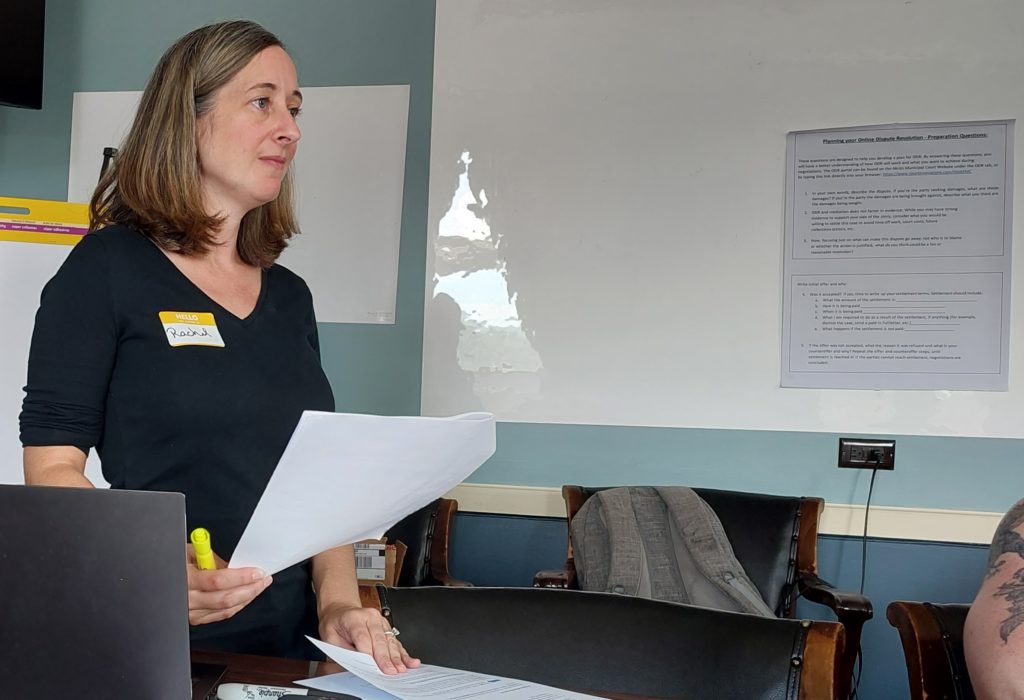
RSI Researcher Rachel Feinstein, pictured, and Director of Research Jennifer Shack facilitated focus groups for RSI’s ODR Party Engagement (OPEN) Project in Berlin, NH, in late August.

Across the US, 72% of family law cases and 76% of civil cases involve at least one self-represented litigant. As more people are handling civil cases without a lawyer, it is increasingly important that everyone can understand and use court communications, regardless of their educational background. Accessible court communications can reduce default rates and increase access to court services and programs, including ODR programs.

Half of the adult population in the US struggles to read lengthy, dense texts to complete tasks and accurately answer questions. Developing court resources with this in mind can significantly improve people’s understanding of how to access court resources, and can increase participation rates in various programs. One recent study found that simplifying the text used in court forms improved participants’ understanding of the purpose of a subpoena from 23% to 70%. Studies have also found important patterns in the reading styles and strategies of people who have low literacy, such as avoiding dense blocks of text and ignoring information on the left and right sides of the web page. Effective court communications take these types of reading patterns into account.

Digital Literacy is Another Challenge

But language and writing styles are not the only issues. Many people rely on websites and online resources provided by courts to gather the information they need, provide information to courts, and participate in online court programs. Despite widespread use of the internet, a large percentage of US adults struggle with digital literacy, or the ability to use digital technology to find information, complete tasks or communicate.

When designing websites or other digital resources, courts can benefit from recognizing common patterns among people who have low digital literacy skills. For example, people with low digital literacy will often avoid the use of search boxes, opting instead to link surf. And it is common to satisfice quickly, or give up before finding necessary information. In RSI’s forthcoming guide for courts, we will provide more information about reading patterns and strategies common among people with low literacy and low digital literacy, with the aim of supporting courts in developing ODR material everyone can use.    

Helping ODR Serve More Parties

The movement to use accessible court communications helps both parties and the courts. For example, civil courts throughout the country are investing in ODR programs. Many people can benefit from the convenience, lower cost and less intimidating process of resolving conflicts online. However, ODR participation rates remain very low, even when it is mandatory. If self-represented litigants understand the steps they need to take, more may take part in their case and do so in a more informed manner. This, in turn, will help courts by increasing participation in ODR.

The experience of the ODR programs we evaluated provides a valuable example of the need to develop effective court communications to help parties to more easily navigate court services and to improve participation in court programs. In a typical ODR process for debt and small claims cases, the court requires that defendants be given a notice of the ODR program. This notice provides written instructions to register on a third-party platform. Once they register, they can try to resolve their case with the plaintiff before their first hearing. The defendant will likely complete the entire process without interacting with court staff. Further, ODR is unfamiliar to most people, increasing the importance of courts’ efforts with written communications — and sometimes instructional videos — to provide parties adequate information to participate in their case. 

Maximizing Court Programs’ Potential

If done well, court communications can narrow the information gap and maximize the potential of a variety of court ODR programs. Enhancing access to justice requires the development of effective and accessible court communications that people from all backgrounds and education levels can easily understand and use.  RSI’s ODR Party Engagement (OPEN) Project is working to support courts in this effort by conducting focus groups in three areas of the US. Through these focus groups, we will hear from a diverse group of people who have a low income and low education, to learn what works for court notices, guides, websites and instructional videos pertaining to ODR. We will use our data, along with previous research, to develop a broadly applicable guide for civil courts to use when developing communications that reduce barriers to participation in ODR for people with low literacy.

This project is generously supported by the American Arbitration Association-International Centre for Dispute Resolution Foundation.  

81% Rate Fairness of Mediator Highly in Survey of RSI’s Eviction Mediation Program

Jasmine Henry, August 21st, 2023

Participants in RSI’s Kane County, Illinois, Eviction Mediation Program continue to have an overall positive experience, recent surveys suggest, though tenants responding to the survey tended to rate the fairness of their mediator more highly than they rated the fairness of the process itself.

RSI implemented the mediation program in 2021 to mitigate the eviction surge precipitated by the COVID-19 pandemic. Thanks to ongoing grant funding from the Illinois Equal Justice Foundation, RSI continues to administer and monitor the program.

The Survey and Respondents

RSI’s most recent survey report examines responses from participants in the 264 eviction mediations held in Kane County from March 1–June 30, 2023. After every mediation, participants were invited via email or text to complete an online survey about their experience. In all, 62 participants responded to the survey — 31 tenants, four landlords and 27 attorneys. A full report on the survey findings is available here.

The survey sought participant opinions regarding fairness, trust and satisfaction. Participants were asked to respond to the questions using a seven-point scale, which we consolidated into three categories: low (1-2), medium (3-5), and high (6-7). In addition, participants were sometimes invited to add comments to their responses.

We asked participants: How fairly did the mediator treat you? Their responses were largely positive, with 81% of respondents rating the fairness of the mediator highly. To explore more of their perceptions about the mediator, we also asked: How much did you trust the mediator? Their responses to this question also were positive overall, with 79% of respondents rating their trust of the mediator highly.

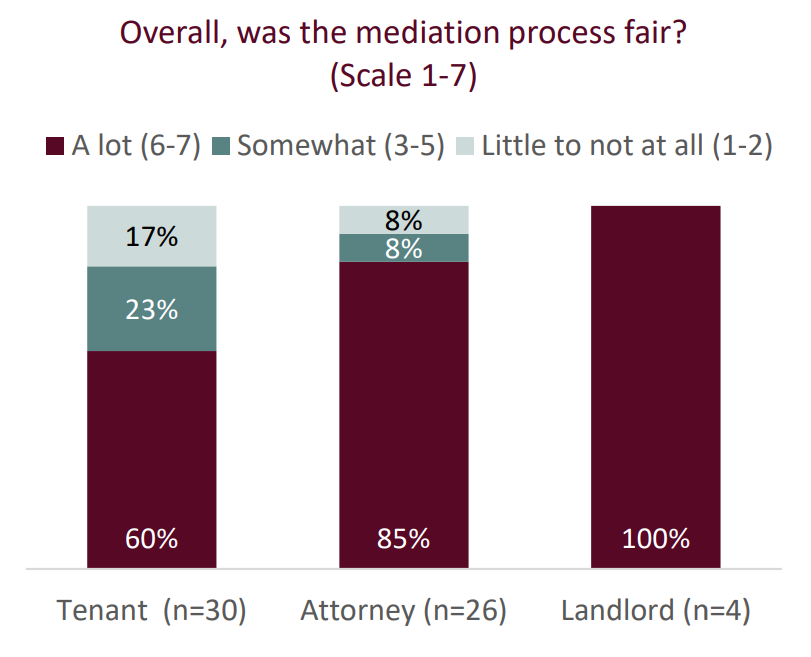
Turning more broadly to participants’ experience of the mediation process as a whole, we asked: Overall, how fair was the mediation process? Most of the participants who responded felt that the mediation was fair overall, with 73% saying it was highly fair.

Tenants on Mediator, Process Fairness

Interestingly, however, tenants tended to give the mediator higher ratings for fairness than they gave the overall process. For example, only 60% of tenants found the overall process fair, while 78% of tenants felt the mediator treated their side fairly. There was a similar, albeit smaller, shift observed in attorneys’ ratings, with 85% rating the mediation process as fair, compared with 89% who felt the mediator treated them fairly. We did not observe a similar trend in landlords’ responses.

We asked tenants to explain their overall fairness ratings. Their comments may shed some light on why some tenants rated the fairness of the mediation process lower than they rated how fairly the mediator treated them. Tenants who rated overall fairness highly focused on the clarity mediators provided them, describing mediators as “helpful,” “nice,” and going “above and beyond in making sure that I understood [and] felt comfortable.” Several tenants also appreciated having a voice and feeling respected, with comments mentioning being able to “tell [their] story of how [they] got to where [they were]” and saying that mediators “made [them] feel like an actual person and not just some case number.” In contrast, tenants that gave medium and low ratings on overall fairness tended to focus their frustrated comments on landlords, rather than the mediator or the program; for example, some tenants who gave medium ratings on overall fairness still referred to the mediator as “gracious” and “fantastic” in their additional comments.

Landlord, Attorney Perspectives

All four landlords gave a high rating for process fairness. The two who explained their answers praised the rental assistance program that RSI regularly refers tenants to and acknowledged the benefit of an objective mediator’s “fresh perspective.”

Attorneys who rated the overall fairness highly described the benefits of having a facilitated dialogue so that both parties can speak their minds and consider their options. The few attorneys who rated the process as medium or low on fairness were frustrated with specific mediator actions; one comment stated that the mediator was “disrespectful to the plaintiff in many ways,” including because of their “lack of knowledge and deference to the defendant.”

Likelihood of Recommending Mediation

In order to further explore participant satisfaction, we asked participants: If a friend or colleague had a dispute like yours, how likely are you to recommend eviction mediation? Most of the participants who responded were likely to recommend mediation to a friend or colleague, with 70% saying they were highly likely to recommend it. One tenant commented that “It would be an absolute mistake no[t] going through mediation. It is the best decision when going through this type of process.” Only four tenants were unlikely to recommend mediation.

Attorneys who were highly satisfied with the mediation process commented on the benefit of, as one said, “a solution that both sides had some part in reaching.” Meanwhile, an attorney who was less satisfied with the mediation process cited “partial” mediators as a negative.

Conclusion

Overall, the survey responses indicate that the program continues to provide a positive experience to participants. Those who completed the survey generally had very positive perceptions of the mediators and the program, with most giving high ratings on fairness, trust and satisfaction. Some participants’ comments point to a possible topics for ongoing mediator education.

For more background on RSI’s 16th Judicial Circuit of Illinois Eviction Mediation Program, serving Kane County, read our evaluation of the first full year of the program, Addressing Eviction Holistically, published in late 2022, or RSI Director of Research Jennifer Shack’s blog summarizing its findings.

Jennifer Shack Talks about Inspirations, Dream Projects and the Future of ADR

Just Court ADR, July 19th, 2023

RSI Director of Research Jennifer Shack often uses this space to tell us about a new research project or share findings from her latest ADR program evaluation. Today, we asked her to take a step back and answer a few questions about what drives her work, as well as share her thoughts on a few “big questions” in our field.

What drew you to studying alternative dispute resolution (ADR) as a career?

When I was a Peace Corps volunteer in Benin, West Africa, I observed how the village chiefs resolved conflicts through what I was to discover was mediation. I thought it would be great to have something similar here in the States – a way to resolve conflicts without court intervention and in a way in which both parties felt was fair. I was surprised to learn about mediation when I returned home, and excited when I saw an ad for a job opening that started with the words “Interested in mediation?” I applied, and 24 years later I’m still enjoying my work at RSI.

What is your favorite part of your work?

So much! I really enjoy designing evaluations and research projects. I love interviewing program participants and conducting focus groups because I get to learn on a much deeper level how mediation programs affect the participants – and because I get to meet so many interesting people. I also have a lot of fun digging into data to find out what story they tell about a program or an issue and then writing that story.

Do you have a long-term wish list in terms of aspects of court-based ADR that you’d like to study?

I have a lot of items on my wish list. I’ll just talk about my top three. As you know, Donna Shestowsky and I evaluated two text-based ODR programs. I have also evaluated programs that involved in-person and video mediation. I would love to delve further into how these three different processes affect participant experience, particularly in what and how they communicate with each other and the mediator, and whether agreement terms differ. The more we know about how these processes are experienced by parties, the better we can become at determining which method best fits with different case types and situations, and the more we can improve the participant experience.

I would also love to do longitudinal research on child protection mediation. Having conducted a couple of evaluations on child protection mediation programs and interviewed parents after they participated in mediation, I think this is one of the best uses of mediation. But I’d like to know more about its long-term impact on families.

My third item on my wish list is already starting to become true. For decades, I and so many others have wanted to look inside the black box of mediation and find out what works and what doesn’t. We’re starting to do this with the Mediator Trust Project, but that’s only the first step. There are many aspects that can be examined. For example, in family mediation we can examine mediation’s effect on co-parenting and family dynamics. Another possibility is researching whether there are certain things mediators do that increase the probability of impasse.

RSI’s research team has recently expanded to include two additional full-time employees. How has this affected your day-to-day work or RSI’s project work?

RSI’s Research and Evaluation team recently expanded to include Rachel Feinstein, left, and Jasmine Henry.

Having Rachel and Jasmine join us has been wonderful. It’s really helpful to be able to talk through ideas and issues with other research-minded colleagues. I also am happy to have Jas do research on an idea that I otherwise wouldn’t have time to explore. But most of all having Rachel take leadership on our OPEN Project has allowed me to focus on our Mediator Trust Project while Jasmine continues to monitor and report on the participant surveys from the eviction mediation program RSI administers.

What trends do you see in court-based ADR that you think are likely to persist?

I think remote dispute resolution is here to stay, whether it’s video mediation or text-based ODR. Video mediation will continue to be prevalent, and I’m seeing signs that text-based ODR is going to become much more common in the near future. Artificial intelligence (AI) will make inroads in dispute resolution, particularly in helping parties to negotiate and write agreements. AI may also one day mediate between parties as well.

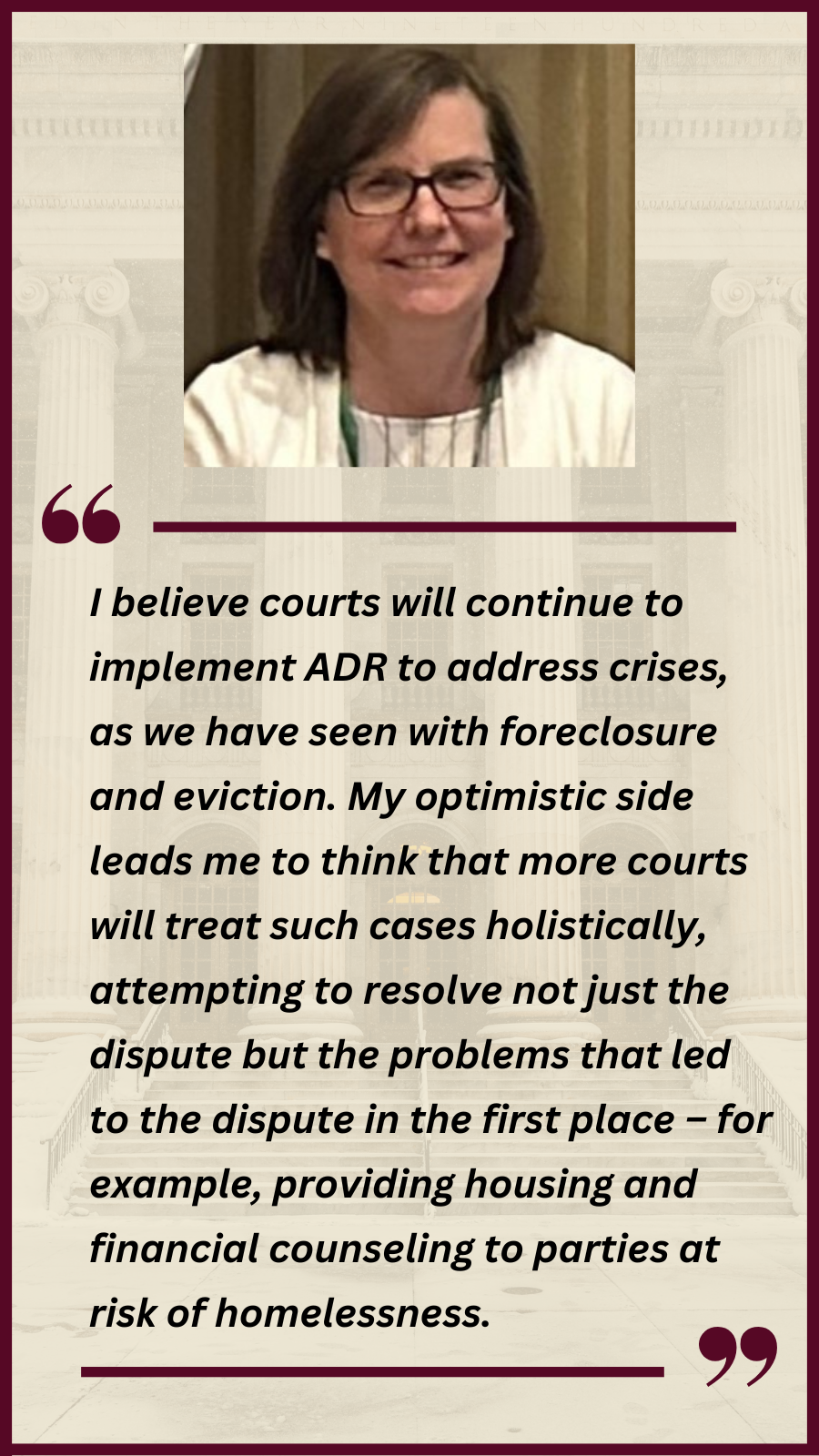
Outside of technology, I believe courts will continue to implement ADR to address crises, as we have seen with foreclosure and eviction. My optimistic side leads me to think that more courts will treat such cases holistically, attempting to resolve not just the dispute but the problems that led to the dispute in the first place – for example, providing housing and financial counseling to parties at risk of homelessness.

What is your least favorite part of your work?

Probably not having the time or money to pursue all the projects I’d like to do.

What do you see as keys to making court-based ADR more accessible?

The main thing is to break down barriers to participation. This means making the ADR process easier to navigate and use. It also means communicating with parties using multiple methods and keeping in mind best practices for individuals with low literacy. Courts need to ensure that parties know about the existence of ADR options. Donna Shestowsky’s research on civil court ADR and our evaluations of court ODR programs have shown that too many parties don’t know that ADR programs exist. Courts should also educate parties about the benefits and risks of their options if they have them, so they can make informed decisions about those options.

Verified by ExactMetrics