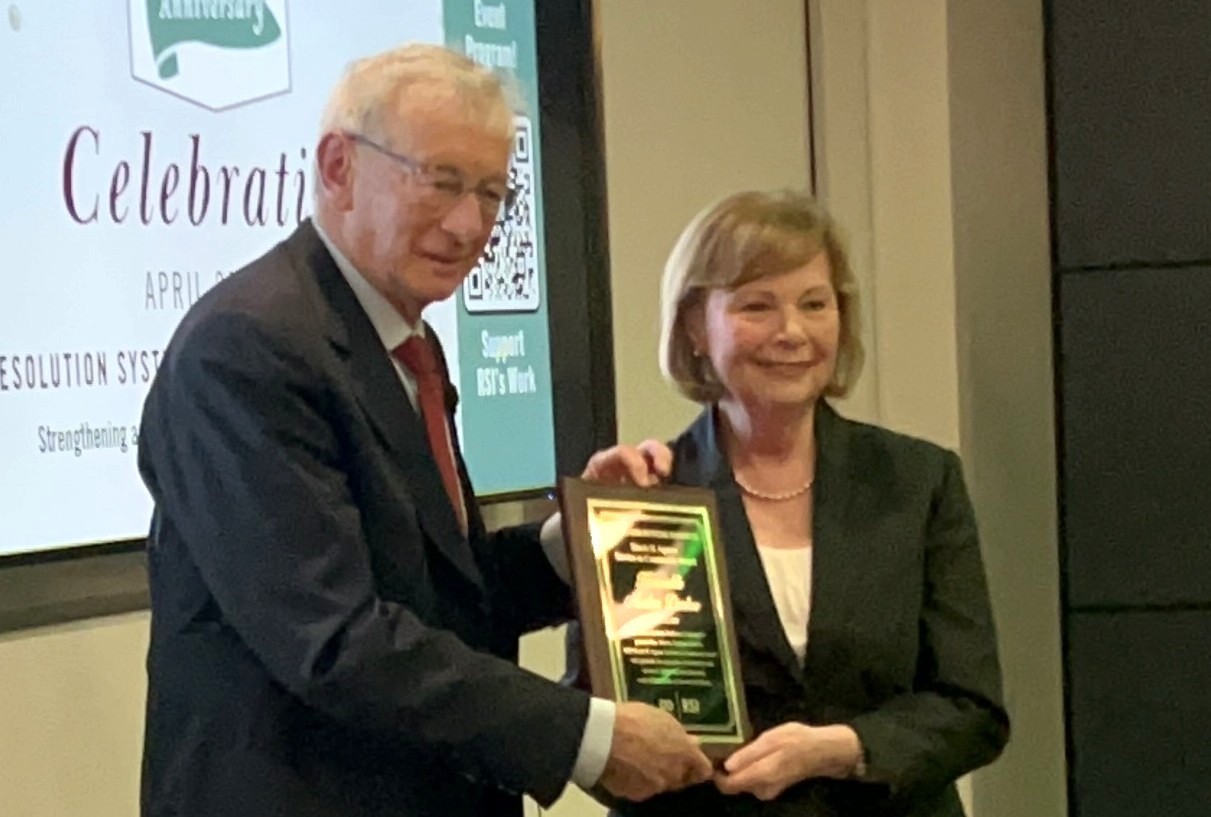
RSI had the privilege of awarding its 2025 Harris H. Agnew Service to Community Award to the Hon. Morton Denlow (Ret.) on April 25 at JAMS’ offices in downtown Chicago. The Hon. Geraldine Soat Brown (Ret.) presented the award.
Hon. Geraldine Soat Brown (Ret.) presented the Harris H. Agnew Service to Community Award to Hon. Morton Denlow (Ret.) on behalf of RSI.
RSI’s Harris H. Agnew Award recognizes individuals whose cumulative efforts have substantially and meaningfully enhanced court alternative dispute resolution systems in Illinois. Judge Denlow has provided visionary leadership over decades of service as an ADR practitioner, U.S. Magistrate Judge for the Northern District of Illinois, and attorney. He has profoundly shaped the dispute resolution field and community through work such as his groundbreaking conception of a legal settlement database and his efforts to shed light on the advantages of settlement vs. litigation.
Additionally, Judge Denlow has been a champion of RSI almost since Day 1 of our organization’s 30-year tenure. RSI has benefited greatly from his longtime dedication as an RSI Board member, including his time as Board President, when he provided pivotal support during RSI’s transition to independent nonprofit status. Judge Denlow’s strategic guidance, insightful wisdom and unwavering commitment continue to help and inspire ADR professionals far and wide, including those here at RSI.
Read more about Judge Denlow’s achievements on his RSI Board profile page, and learn more about the Harris H. Agnew Award and its recipients here.
This year marks an incredible milestone as Resolution Systems Institute (RSI) celebrates 30 years of impact! As someone who counts herself among those who have benefited from the work of RSI over the years, I am deeply grateful for the strong foundation RSI stands on today. As we reflect on three decades of service, we appreciate and consider ourselves fortunate to recall the countless lives touched, the ADR programs improved, the knowledge gained and the amazing partners who have walked beside us throughout this journey.
Our “Pearl” Anniversary: The 30th anniversary has been described as the pearl anniversary, in part because pearls have come to symbolize wisdom gained through experience, growth through change, resilience and honesty. The development of a pearl can also be a metaphor for what ADR can accomplish: Sometimes, the things that cause irritation and friction ultimately become something beautiful, such as a pearl — or a better grasp of a former adversary’s shared humanity.
My colleagues and fellow alternative dispute resolution (ADR) researchers introduced me to RSI while we worked on similarly ambitious projects for evaluating statewide efforts to implement ADR and program-specific survey evaluations of court ADR programs. I learned of the foreclosure and eviction mediation programs through our common court ADR panel presentations at national conferences. I quickly came to rely on RSI as a resource that included the most current innovations, advances and findings in the field of ADR. RSI has always been on the forefront and continues to shape the field by improving our understanding of court ADR.
From RSI’s humble beginnings as a big idea shared among colleagues in a casual conversation, we set out to impact court ADR by growing and sharing knowledge. What began as a small group of passionate individuals dedicated to court ADR has now grown into a well-established force for change, strengthening access to justice by enhancing court alternative dispute resolution systems.
A Journey Through Time: 30 Years of Progress
Over the years, RSI has experienced both challenges and triumphs, and each step along the way has renewed our commitment to court ADR. When we look back at the moments and events that have shaped us, we can’t help but feel immense pride in what we’ve accomplished:
Guiding Program Design: In the late 1990s, RSI helped get civil case mediation off the ground in Illinois by providing expert guidance to Illinois state courts and federal courts as they established civil case ADR programs. Over time, we worked on programs with a broader array of case types and parties, and helped programs nationally; and in 2007, informed by our own research, RSI created the Statewide Mediation Access Project to develop programs to improve access to justice through mediation for low-income disputants. As our mission statement affirms, guiding and supporting court efforts to strengthen access to justice through court ADR has been a throughline in RSI’s work ever since.
Studying What Works, and Creating Tools to Support It: In 2003, RSI Director of Research Jennifer Shack’s article “Mediation Can Bring Gains, But Under What Conditions?” summarized a survey of the findings of 62 studies of court-related mediation. The article posited that the ADR field must focus less on whether mediation is effective, and more on the circumstances under which it is most effective. To a large degree, RSI’s research over the years has continued to examine the article’s overarching question by evaluating the program design and impacts of court ADR in child protection, foreclosure and eviction cases, as well as more recent advancements of online dispute resolution. This research has also informed our development of tools to assist programs in conducting accessible, effective ADR. Examples include RSI’s recent studies of text-based online dispute resolution programs; our ODR Party Engagement (OPEN) study, guides and models; and our ongoing research on what leads to trust during mediation.
Responding to Immediate Needs: In 2013, RSI responded to the foreclosure crisis by providing courts throughout the U.S. resources and technical assistance, offering mediator training, and designing and administering foreclosure mediation programs in three Illinois counties. In 2016, we expanded our mediation services, developing and administering a child protection mediation program in Kane County, Illinois. And in 2021, responding to the pandemic-induced eviction crisis, we launched eviction mediation programs in three Illinois counties. RSI’s mediation programs have provided direct services to thousands of people over the years. But they also serve as an active knowledge base, enabling us to learn more about that question raised by Jen Shack’s 2003 article; in short, what works?
Each of these pivotal moments in our history is a testament to the hard work of our dedicated staff, Board, donors, funding partners and supporters.
Looking Ahead: The Next 30 Years
While we celebrate our past, we’re also looking toward the future. The world continues to change, and so do the challenges we face. Through it all, our mission remains as important and relevant as ever. In the coming years, we are committed to:
Join Us in Celebrating! We’ll be celebrating all year long! Please stay tuned here for more ways to connect and join us in celebration as we share details of programs and events to come!
Eliminating Barriers: We believe that strengthening access to justice by enhancing court ADR gives more people an array of options for resolving conflict in ways that feel fair and facilitate mutual understanding.
Innovating: We will continue to explore new projects to explore the use of technological advancements in ADR while addressing the pressing issues of reducing barriers to access to justice for everyone.
Expanding our Reach: As a convener, we plan to extend our impact even further by bringing together court administrators and ADR program directors to share insights, successes and challenges.
A Heartfelt Thank You
None of this would have been possible without the support of our incredible ADR community. To our Board members, donors, roster mediators, partners, funders, collaborators, staff and all of those who have stood with us over the years, thank you. Your unwavering belief in our mission has been a driving force behind every success.
As we mark our 30th anniversary, we are excited to celebrate not just what we have achieved, but also the promise of what’s yet to come. The future is bright, and we are so grateful to have you by our side as we continue this journey together.
Here’s to 30 years of impact — and to the many more years ahead!
RSI Director of Research Jennifer Shack joined ODR.com CEO Colin Rule and Redek founder Nicolas Lozada this month for an ODR Cyberweek 2024 webinar on the topic of online dispute resolution to settle family law cases, focusing on a report Shack co-authored in 2021.
ODR Cyberweek is a free, virtual conference hosted annually by the National Center for Technology and Dispute Resolution (NCTDR).
Shack answered questions about the 2021 evaluation of a Michigan ODR program she conducted with University of California Davis law professor Donna Shestowsky, which was the first third-party evaluation of a family law ODR program in the United States.
The program, in Ottawa County, Michigan, was launched by the 20th Circuit of Michigan’s Friend of the Court in August 2020 with the goal of providing parties with post-judgment family law disputes a simpler, more convenient and cost-effective way to reach agreements related to child custody, parenting time and child support. It also aimed to increase efficiency in the disposition of these matters.
Among the topics that came up in the ODR Cyberweek discussion were the varying levels of interest by caseworkers and others in participating in ODR; the likelihood that cultural and demographic differences might impact openness to ODR, as well as ways of dealing with conflict in general; and the potential for and possible hurdles to using ODR to mediate cases where intimate partner violence is a factor.
Shack also offered insight on how to improve communications with parties about ODR as a means to improve understanding of the process and increase participation, based on findings from RSI’s ODR Party Engagement (OPEN) Project.
Lozada, who founded the Colombian ODR startup Redek, noted the challenges of advocating for ODR in Colombia when consistent internet access and use remains out of reach for much of the population. In addition to the access problems this presents, it can also mean that those who do have access remain wary of the legitimacy of online programs, Rule suggested.
NCTDR’s ODR Cyberweek serves an international audience, is open to the public, and includes panels in English, Chinese, Spanish and Portuguese. Additional topics this year included AI integration in courts, mediation and arbitration, recent innovations and research findings. The event also included tech demos and a student panel. Recordings of many of the ODR Cyberweek sessions from this and previous years can be found in the NCTDR’s ODR Cyberweek Archive.
RSI recently completed user testing research for the ODR Party Engagement (OPEN) Project! We are excited to share insights from our experience conducting the testing and what we learned from participants about our model court communication materials.
User Test Study
As part of the OPEN Project Phase 2, RSI developed prototype materials — a webpage, a notice document, an informational video and an interactive guide — to help courts communicate more effectively about online dispute resolution (ODR). We worked with an inclusive designer to create materials that exemplify best practices based on designer expertise, OPEN Phase 1 findings and previous research. To ensure these materials were accessible and user-friendly, we planned a series of user tests to obtain feedback from actual users whose backgrounds resemble those of self-represented litigants.
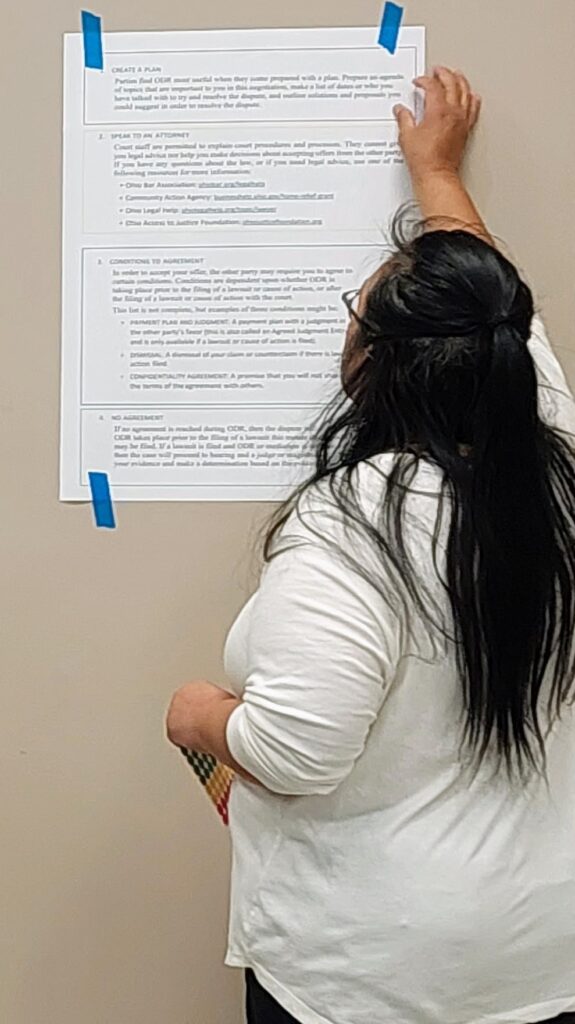
Over the past two months, the RSI research team conducted user tests across the country. We recruited a total of 15 demographically diverse participants from distinct areas: a rural town in New Hampshire; Baltimore, MD; and the Santa Fe-Española area of New Mexico. Participants were instructed to use the materials to complete relevant tasks: read about ODR, watch the informational video, prepare for ODR as a defendant, and sign up for an account. While they tested the materials, RSI researchers observed and took notes on their behavior, listened to their thought process, and asked follow-up questions. We also disseminated post-test surveys and conducted semi-structured interviews about their experience with the materials.
Read more background on the ODR Party Engagement (OPEN) Project, from concept, to focus group feedback, to creation of tools for courts, in RSI’s earlier blog posts.
Real World Feedback
Feedback from the user tests helped us to identify strengths and weaknesses in each of the materials. Users overwhelmingly praised our video for its clarity, engaging visuals, concise discussion about ODR and appropriate length; the video averaged a 4.73/5 rating for how easily it was understood.
The sessions highlighted the importance of accessible visual design. Participants missed some of the information on our webpages because they lacked sufficiently visible indicators for clickable or interactive content. Higher saturated colors, consistent blue hyperlinked text and plus signs are some of the fixes we will implement in new versions of the webpages.
Participants were excited about the prospect of ODR being available to them. The relative ease of their testing experience only amplified this excitement; participants shared frustration with previous instances trying to navigate difficult-to-use court materials. In contrast, they found our materials to be simple to follow and understand.
User testing also provides a beneficial opportunity for users to share their own creative ideas for improving the materials. During the sessions, these ideas encompassed: making the account login interface more accessible, identifying when repetitive information was useful or distracting, and enhancing the perceived trustworthiness of our notice document.
Participants were excited about the prospect of ODR being available to them. The relative ease of their testing experience only amplified this excitement; participants shared frustration with previous instances trying to navigate difficult-to-use court materials. In contrast, they found our materials to be simple to follow and understand, a sentiment shared even among those who were hesitant to use digital technologies generally. Describing the account creation pages, one participant in New Hampshire noted, “Yes, [I would feel confident helping a friend sign up for ODR using this system]. It’s really easy to use. I think my 10-year-old can do this.”
We will next return to our design partners to implement the feedback we received from user testers. RSI is grateful for the participants’ generosity and excitement for the project. We are planning to conduct one more round of user testing once the revised materials are completed to ensure any lingering issues are addressed before making the final models available for courts. RSI is also grateful to the American Arbitration Association-International Centre for Dispute Resolution (AAA-ICDR) Foundation for its funding of the OPEN Project.