Resources / Study / Innovation for Court ADR

Just Court ADR

The blog of Resolution Systems Institute

Archive for the ‘Court Mediation Program’ Category

RSI Mediation Program Has Helped Over 1,500 Households Avoid Eviction

Sandy Wiegand, November 21st, 2023

More than two years ago, amid the looming threat of a rush of evictions as Illinois prepared to end its pandemic-era eviction moratorium, RSI partnered with the circuit court in Kane County to create a mediation program. It was free of cost to both tenants and landlords.

The program’s impact has been impressive. Since the eviction moratorium ended in October 2021, the Kane County Eviction Mediation Program has helped over 1,500 households avoid the traumatic effects of a sheriff’s eviction. Meanwhile, the program’s connections to rental assistance and legal and financial counseling have made it far more possible for these tenants to meet their financial obligations to landlords.

RDNE Stock Project via Pexels

Judge John Dalton, the 16th Circuit’s presiding eviction judge, also credits the program with helping the court run smoothly.

“With the help of RSI, Kane County was the first in Illinois to launch an eviction mediation program, and we have been overwhelmingly pleased with the outcomes,” Judge Dalton says. “It has been successful in assisting landlords and tenants in reaching mutually beneficial agreements. Thanks to this program, the court has been able to run efficiently during an eviction surge.”

RSI regularly surveys Kane County Eviction Mediation Program participants as one way to evaluate the program’s effectiveness. And participants have told us that mediation helps them feel heard and seen — as one tenant said, “like an actual person and not just some case number.”

As the weather turns colder and the potential consequences of eviction wax even harsher, RSI’s Kane County Eviction Mediation Program continues, with the support of the Illinois Equal Justice Foundation, the 16th Circuit Court, dozens of dedicated mediators, a few hard-working RSI staff members, and generous donors such as yourself. 

Thank you for your commitment to RSI’s work. If you’d like to invest in impactful endeavors such as the Kane County Eviction Mediation Program, you can do so on our website.

81% Rate Fairness of Mediator Highly in Survey of RSI’s Eviction Mediation Program

Jasmine Henry, August 21st, 2023

Participants in RSI’s Kane County, Illinois, Eviction Mediation Program continue to have an overall positive experience, recent surveys suggest, though tenants responding to the survey tended to rate the fairness of their mediator more highly than they rated the fairness of the process itself.

RSI implemented the mediation program in 2021 to mitigate the eviction surge precipitated by the COVID-19 pandemic. Thanks to ongoing grant funding from the Illinois Equal Justice Foundation, RSI continues to administer and monitor the program.

The Survey and Respondents

RSI’s most recent survey report examines responses from participants in the 264 eviction mediations held in Kane County from March 1–June 30, 2023. After every mediation, participants were invited via email or text to complete an online survey about their experience. In all, 62 participants responded to the survey — 31 tenants, four landlords and 27 attorneys. A full report on the survey findings is available here.

The survey sought participant opinions regarding fairness, trust and satisfaction. Participants were asked to respond to the questions using a seven-point scale, which we consolidated into three categories: low (1-2), medium (3-5), and high (6-7). In addition, participants were sometimes invited to add comments to their responses.

We asked participants: How fairly did the mediator treat you? Their responses were largely positive, with 81% of respondents rating the fairness of the mediator highly. To explore more of their perceptions about the mediator, we also asked: How much did you trust the mediator? Their responses to this question also were positive overall, with 79% of respondents rating their trust of the mediator highly.

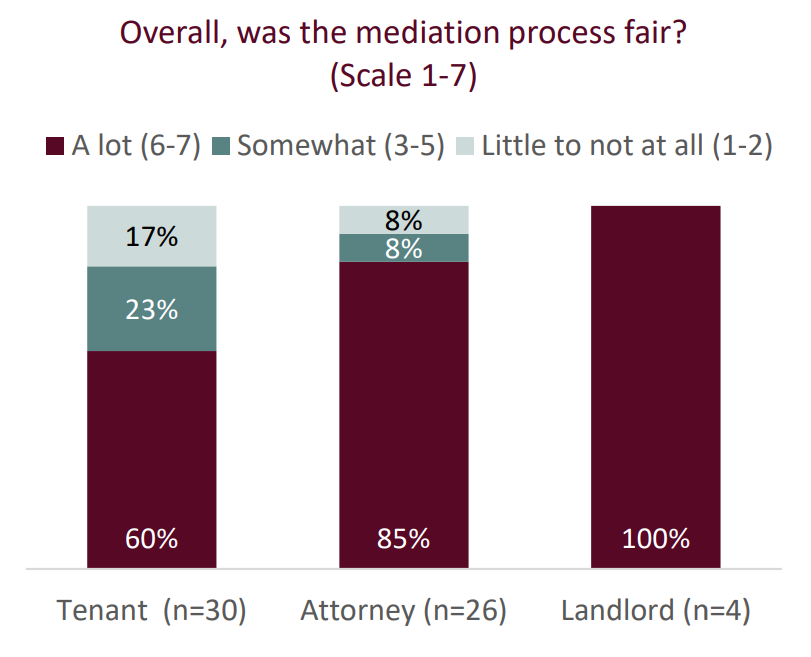
Turning more broadly to participants’ experience of the mediation process as a whole, we asked: Overall, how fair was the mediation process? Most of the participants who responded felt that the mediation was fair overall, with 73% saying it was highly fair.

Tenants on Mediator, Process Fairness

Interestingly, however, tenants tended to give the mediator higher ratings for fairness than they gave the overall process. For example, only 60% of tenants found the overall process fair, while 78% of tenants felt the mediator treated their side fairly. There was a similar, albeit smaller, shift observed in attorneys’ ratings, with 85% rating the mediation process as fair, compared with 89% who felt the mediator treated them fairly. We did not observe a similar trend in landlords’ responses.

We asked tenants to explain their overall fairness ratings. Their comments may shed some light on why some tenants rated the fairness of the mediation process lower than they rated how fairly the mediator treated them. Tenants who rated overall fairness highly focused on the clarity mediators provided them, describing mediators as “helpful,” “nice,” and going “above and beyond in making sure that I understood [and] felt comfortable.” Several tenants also appreciated having a voice and feeling respected, with comments mentioning being able to “tell [their] story of how [they] got to where [they were]” and saying that mediators “made [them] feel like an actual person and not just some case number.” In contrast, tenants that gave medium and low ratings on overall fairness tended to focus their frustrated comments on landlords, rather than the mediator or the program; for example, some tenants who gave medium ratings on overall fairness still referred to the mediator as “gracious” and “fantastic” in their additional comments.

Landlord, Attorney Perspectives

All four landlords gave a high rating for process fairness. The two who explained their answers praised the rental assistance program that RSI regularly refers tenants to and acknowledged the benefit of an objective mediator’s “fresh perspective.”

Attorneys who rated the overall fairness highly described the benefits of having a facilitated dialogue so that both parties can speak their minds and consider their options. The few attorneys who rated the process as medium or low on fairness were frustrated with specific mediator actions; one comment stated that the mediator was “disrespectful to the plaintiff in many ways,” including because of their “lack of knowledge and deference to the defendant.”

Likelihood of Recommending Mediation

In order to further explore participant satisfaction, we asked participants: If a friend or colleague had a dispute like yours, how likely are you to recommend eviction mediation? Most of the participants who responded were likely to recommend mediation to a friend or colleague, with 70% saying they were highly likely to recommend it. One tenant commented that “It would be an absolute mistake no[t] going through mediation. It is the best decision when going through this type of process.” Only four tenants were unlikely to recommend mediation.

Attorneys who were highly satisfied with the mediation process commented on the benefit of, as one said, “a solution that both sides had some part in reaching.” Meanwhile, an attorney who was less satisfied with the mediation process cited “partial” mediators as a negative.

Conclusion

Overall, the survey responses indicate that the program continues to provide a positive experience to participants. Those who completed the survey generally had very positive perceptions of the mediators and the program, with most giving high ratings on fairness, trust and satisfaction. Some participants’ comments point to a possible topics for ongoing mediator education.

For more background on RSI’s 16th Judicial Circuit of Illinois Eviction Mediation Program, serving Kane County, read our evaluation of the first full year of the program, Addressing Eviction Holistically, published in late 2022, or RSI Director of Research Jennifer Shack’s blog summarizing its findings.


Does ADR + Tech = Better Access to Justice? RSI Spent Much of 2022 Trying to Find Out

Sandy Wiegand, May 2nd, 2023

RSI spends a lot of time and energy studying the conditions under which court-based alternative dispute resolution (ADR) can best improve access to justice. In recent years, that has often meant using new technologies and/or assessing their impact.

As is often the case with innovations, ADR options that employ new technology are sometimes hailed as the solution to longstanding challenges. For example, online dispute resolution (ODR) is celebrated for its potential to increase access to justice by allowing parties to engage on their own schedules, in their own spaces. Unfortunately, however, technological innovations can also bring challenges and create their own barriers to justice.

RSI’s 2022 annual report asks the question: Does ADR + Tech = Better Access to Justice? Our staff spent much of last year examining that premise. We published two landmark evaluations of court programs that used ODR-specific platforms; completed an in-depth report on the potential for ODR to serve thinly resourced parents, courts and communities; and used video mediation to serve hundreds of clients in northern Illinois. We also evaluated how those programs were operating and how participants viewed them.

Our annual report outlines these efforts and summarizes some of our findings. Not surprisingly, we found both promising signs and causes for concern when it came to technology’s impact on access to justice. We also discovered a lot more questions that need to be answered and problems that need to be addressed.

We hope you will take the time to read the Resolution Systems Institute 2022 Annual Report and review what we have learned so far. The role of technology is, of course, just one of many aspects of court-based ADR that RSI is examining. Please join us as we continue exploring what technology can and can’t solve, as well as other keys to providing cost-effective, timely and fair conflict resolution.

What Makes Parties Trust a Mediator? RSI Hopes to Find Out, With Help From Grant

Jennifer Shack, February 28th, 2023

For mediation to be successful, it is considered essential that the involved parties trust the mediator. Yet little research has been done to determine whether any particular mediator behaviors help to engender party trust. RSI intends to change that. With a generous grant from the Rackham Foundation, we are undertaking an exploration of the intersection between mediator behaviors and party trust. 

Two Potential Phases

During this exploration, we will observe mediations, code mediator behaviors, survey parties before and after mediation, interview mediators and collect outcome data. The purpose will be to test the mediator behavior codes, data collection instruments, research protocols and hypotheses to determine whether research of this type can provide useful information.

Photo by Andrea Piacquadio via Pexels
Support from the Rackham Foundation will allow RSI to examine the intersection between mediator behaviors and party trust.

If we find that our research is fruitful, RSI will undertake a full research project to determine which, if any, mediator behaviors impact party ratings of trust in the mediator and other procedural justice components, and whether mediation resulted in agreement, among other factors. Our ultimate goal is to provide mediators and trainers with concrete information about behaviors that are more likely to engender party trust in the mediator and result in a satisfying, successful mediation. This project will lay the foundation for work toward that goal.  

Seeking Site for Observation

We plan to observe a limited number of mediations at two sites with mediators with different training and backgrounds. We have identified one but are seeking another. If you are interested, please contact RSI Director of Research Jennifer Shack.

We are grateful to the Rackham Foundation and to Ava Abramowitz, who has championed this research, for this opportunity. She and her research partner Ken Webb have developed and tested the coding scheme we will be using. Stay tuned!

Verified by ExactMetrics