Resources / Study / Innovation for Court ADR

Just Court ADR

The blog of Resolution Systems Institute

How Well Can an AI Facilitator Recognize Emotions During Dispute Resolution?

Jennifer Shack, December 1st, 2025

Recent research suggests that large-language models (LLMs) acting as facilitators in text-based dispute resolution can be trained to accurately identify human emotions and to intervene to change the trajectory of a dispute when the emotions might otherwise lead to an impasse.

The authors[1] of the August 2025 paper “Emotionally-Aware Agents for Dispute Resolution” recruited students to act as disputants regarding the sale of a basketball jersey. The ultimate dataset included 2,025 disputes, with an average 10.7 messages per dispute.

To allow for comparison with prior research, the researchers initially categorized emotions as others had done to assess LLM capacity to identify emotions in negotiations.[2] The emotions tracked were joy, sadness, fear, love, anger and surprise. The study also used a self-measure frustration scale as an indication of “ground truth” to be used as a benchmark for comparison with the LLMs’ identification of emotions. The dispute participants assessed their level of frustration during the dispute exchange, as well as their perception of the other party’s level of frustration.

To set a baseline against prior emotion models, the researchers first ran the disputants’ text exchanges through T5-Twitter, a large fine-tuned model adapted for recognizing emotions.[3] They found that T5-Twitter (T5) failed to recognize anger in conversations that participants had reported as frustrating. The researchers hypothesized that this was because T5 was classifying each dialogue turn in isolation, rather than within the context of the entire interaction. Although they had adopted the emotions used for negotiation research, the researchers also noted that those emotions were more relevant to negotiation than to dispute resolution, which concerned them.

Testing Other LLMs

The next phase of the study was to test the researchers’ hypothesis that general LLMs could better identify emotions than T5 had. The researchers prompted a variety of LLMs to analyze the same dialogues, using different prompting strategies, but with slightly different emotions. They changed the emotion “love” to “compassion” and added a “neutral” category so the LLMs were not forced to choose an emotion when none was apparent. They also prompted the LLMs to consider each dialogue turn within the context of previous turns. Finally, they helped the LLMs to learn within context by including in the prompt several sample dialogue turns with hand-annotated emotions.

Again comparing self-reported frustration with each LLM’s classification of emotions, the researchers found that GPT-4o outperformed T5 (as well as other LLMs). T5 skewed toward annotating utterances as joy or anger, while GPT-4o was more diverse in its assessments and used “neutral” as a dampener by not assigning emotions to unemotional statements. GPT-4o also recognized compassion where T5 did not recognize love.

The researchers then used multiple linear regression[4] to predict participants’ subjective feelings about the result of the dispute resolution effort (as measured by the Subjective Value Inventory) based upon the emotions that T5 and GPT-4o assigned to each dialogue turn. They found that GPT-4o provided the biggest improvement in predicting participants’ feelings about the result, even when accounting for changes in prompts to T5. They also found that buyers were more straightforward to predict than sellers.

Preventing Impasse

The researchers then examined whether GPT-4o could determine when to intervene to de-escalate anger before it escalates into impasse. This would require GPT-4o to identify a pattern of escalation. GPT-4o’s automatic identification of emotion showed that when sellers respond to buyers’ anger with anger in these dialogues, the anger spirals, and impasse results. They found something similar with compassion. When sellers began with compassion, buyers responded with compassion, and the dialogue more often resulted in agreement.

In sum, the researchers demonstrated that properly prompted LLMs with in-context learning can accurately assign emotions to text. Additionally, they found that they could predict subjective dispute outcomes from emotional expressions alone, without knowing the actual content of a conversation.

Researchers can use GPT-4o emotion assignment to reveal how emotions can shape disputes over time: Anger spirals, but so does compassion when it comes early in the dispute. This indicates that LLMs can be trained to know when to intervene in order to change the trajectory of a dispute. Future work will look at how they can do this.


[1] The authors are Sushrita Rakshit, James Hale, Kushal Chawla, Jeanne M. Brett and Jonathan Gratch.

[2] They characterize negotiations as a coming together to create a new relationship (e.g., car salesman and customer), while disputes involve an existing relationship that has gone badly.

[3] I’m extrapolating here, based on the context and what I could find about fine-tuned LLMs.

[4] Multiple linear regression uses several independent variables to predict a specific outcome.

New Resources Help Address Barriers to Diversifying Organization’s Mediator Roster

Stephen Sullivan, October 24th, 2025

RSI recently completed our evaluation of an equity audit implementation project by the Center for Conflict Resolution (CCR) in Chicago. CCR staff, board members and volunteers worked with a consulting partner to uncover barriers preventing their volunteer mediator roster from fully reflecting the diversity of the communities CCR serves. After identifying barriers, they made major changes to how CCR recruits and screens applicants to its Mediator Mentorship Program (MMP), which onboards mediators to volunteer at CCR. RSI evaluated the efficacy of CCR’s implementation and examined initial outcomes of the revamped process. 

Stephen Sullivan
RSI Researcher Stephen Sullivan will join CCR Volunteer Director Israel Putnam and former CCR Executive Director Cassie Lively to discuss this research at a 9 a.m. session Nov. 6 at the Association for Conflict Resolution conference in Philadelphia. Get conference details and register here.

We are excited to share that our evaluation report, Fostering Equity in a Volunteer Mediator Roster: An Evaluation of the Center for Conflict Resolution’s Equity Audit Implementation, is now available on RSI’s website. The report includes our findings from surveying, interviewing and observing staff, board members and volunteers who participated in the project and facilitated CCR’s new applicant screening and recruiting processes. 

In addition to the evaluation, we created a guide for community mediation centers, to help them learn from CCR’s efforts.In A Guide for Enhancing Mediator Roster Equity from Concept to Implementation, we document the strategies CCR staff, board members and volunteers took to address barriers to equity in the MMP. We describe which approaches were most effective and which were less effective, and we provide recommendations for staff at other community mediation centers (CMCs). 

A Guide for Community Mediation Centers

The guide contains step-by-step instructions to help mediation centers adapt CCR’s approaches to addressing barriers that could keep people from a variety of backgrounds from applying and participating fully as CMC mediators. It advises CMCs on how to build alignment among staff and volunteers on a set of equity-related goals; retool application materials to collect more accurate and relevant information about applicants to their programs; and create more effective screening processes to assess applicants’ mediation-related skill sets. 

CCR staff found that their experience with the equity audit and its implementation challenged previously held assumptions about how to best enhance diversity. For example, did you know that using predominantly written application materials might hamper efforts at diversifying mediator rosters? Or that activity-based group interviews might provide more relevant and useful information about applicants’ capacities to be successful mediators than traditional one-on-one interviews? 

In the guide, we explain what CCR staff learned about these issues and describe the creative solutions they devised to address them. One major solution is the Matching Event, CCR’s innovative new format for screening applicants to the MMP.

During a Matching Event, applicants participate in a series of stations involving activities designed to assess specific skills, such as being empathetic and being comfortable with conflict. Stations are facilitated by two CCR “Station Runners” (staff or volunteer mentors), with activities that range from describing the emotions of characters in a movie clip to role playing as parties in conflict. Station Runners use CCR’s newly crafted Matching Event Scorecard to rate the extent to which applicants meet these criteria.

CCR generously permitted RSI to include its Matching Event materials in the guide, so that others can understand how they work in greater detail. We also wrote step-by-step instructions to help CMCs craft their own Matching Events, should that fit their applicant assessment needs. 

Takeaways for CMCs 

RSI had two overarching aims with the evaluation: The first was to assess the successes and challenges involved with the process of implementing the audit recommendations; the second, to evaluate the effectiveness and results of implementation activities, such as staff training sessions and the Matching Events. While the evaluation’s findings and recommendations are geared toward CCR, they have broader implications for other CMCs interested in doing similar work. 

Below is a set of key takeaways for CMCs interested in making the role of community mediator accessible to more of the people with the skills to participate. These takeaways are based on what we learned from conducting the evaluation as well as working with CCR staff, board members and volunteers to create the guide.

A successful audit and implementation project requires collaboration, time and consistent communication. CCR staff, board members and volunteers needed plenty of time to review and reflect on the findings of the audit before they could take action. Collaboration helped to make the process more effective; by bringing different stakeholders together during workshops and meetings, CCR was able to build buy-in and ensure different aspects of the program were addressed. Staff and volunteers also benefited most when they were updated on the project’s progress. 

Meaningful change requires an open mind and flexibility. CCR leadership gave staff and volunteers wide latitude to make changes to program processes. As a result, staff and volunteers felt empowered to address barriers creatively and maintained investment in the project. Many of the barriers were long standing mindsets and processes; permission to make major changes was critical to the project’s success. 

Making processes more flexible does not reduce program rigor. One of the most noteworthy learning lessons for CCR was that a one-size-fits-all approach for participation in the MMP is not a prerequisite to maintaining quality program standards. By introducing flexibility to MMP processes and expanding outreach, CCR was able to create opportunities for volunteer mediators from diverse backgrounds to contribute to the organization while keeping rigorous requirements in place. 

Enhancing pathways to program participation is an ongoing dialogue and process. From the outset, CCR recognized that any changes made to the MMP as a result of this project would need to be revisited as their outcomes became clear. Building broader access to the program is a process; CCR has planned time for staff and volunteers to further reflect and make changes as needed. 

What Can We Learn from One Short Quiz?

Jasmine Henry, September 15th, 2025

Do you know the best ways to communicate with self-represented litigants (SRLs)? That’s the question we asked our newsletter readers and social media followers over the last two months through a short (four-question) quiz. Our initial answer is in: Most quiz takers have some understanding of how best to share information with SRLs, but they also have the space to learn more.

Webinar 1: Enhancing Understanding While Reducing Stress
Wednesday, October 15, Noon-1 p.m. CT
Register for Webinar 1

Webinar 2: Creating Trust and Addressing the Tech Gap
Wednesday, November 12, Noon-1 p.m. CT
Register for Webinar 2

Our four questions — meant to be fun, engaging and educational — were based on the findings of our ODR Party Engagement (OPEN) Project. In prior research, RSI had observed the struggles SRLs can have navigating court processes, and we knew that court communications are not geared toward the 57% of the population that cannot read proficiently. So we set out to find out what SRLs need and want from court communications.  

With funding from the American Arbitration Association-International Centre for Dispute Resolution Foundation, we conducted focus groups across the U.S. to learn how to improve communications for SRLs. Using what we learned, we worked with an inclusive designer and an accessibility expert to create model communication materials. We conducted usability tests around the U.S. to get feedback on these new materials. Users gave our new Notice, website and video an average 4.8/5 rating for ease of understanding.

Now, we are committed to helping courts and other organizations better communicate with SRLs. Our quiz helps us achieve this goal by providing quiz takers with the best answers and explaining why they are the most effective options. If you would like to learn more about our findings, resources, guide and toolkit, check out the website we created (odr.aboutRSI.org) to share our knowledge with courts.

Before you continue with our article, we invite you to take our quiz and test your OPEN knowledge!

What the scores are and why they don’t matter.

As of the time of this writing, 33 people had responded to our quiz. Their average score was 42%. Though that’s a score that might feel demoralizing for some, we view it as an opportunity for quiz takers to gain essential knowledge about how to communicate with SRLs.

What we can learn from our hardest questions.

Two quiz questions stood out as particularly difficult, with less than half of the takers answering either question correctly. The questions focused on the best types of illustrations to use in documents and the best method for providing information on a webpage, respectively.

Best type of illustration to use

We asked quiz takers what type of illustration should accompany text about signing an agreement. We gave them four options, as seen in the table below. The response options included two photos and two illustrations. Despite photos making up half of the answer options, only 18% of quiz takers chose a photo as the best option. This suggests that court professionals might understand that photos are typically too complex to be used in instructive text. However, most quiz takers selected the complex illustration as the best option to accompany instructive text. Just over a quarter of quiz takers selected the correct answer: the simple illustration.

Any visuals used in communication materials for SRLs should highlight major concepts and draw the reader’s attention to them. They should not contain additional visual details that are not important to the core of your message, because excessive features can become distractions that pull your user’s focus from the relevant content.

Best method for providing information on a webpage

The question on webpage formatting got 32 responses. Quiz takers were asked if any of the following were good methods for providing information on a webpage. We gave them four options, as reflected in the table below, plus a “none of the above” option. While there was no majority agreement on this question, the largest segment of quiz takers indicated that it is a good idea to place many links on one page, and the smallest segment answered that it is best to fill both the left and right sides of the page with helpful information. A little under 20% of the quiz takers answered this question correctly, selecting “none of the above.”

While any of these answers might sound like a good tip, you will want to avoid all of them. Unfortunately, it is not helpful to provide a long list of links because that can lead to “link-surfing,” where users jump around on your webpage without actually reading and absorbing any information. It is also not recommended to have a user-entered search box because sometimes users do not know the terminology for the help they seek; or, if they do know the term, they may have difficulty spelling it accurately.

Moreover, filling the whole page with information can lead your user to feel overwhelmed; instead, it is best to create white space on your webpage and keep the most important information to one side of your screen. It is also important to remember that many users are approaching your webpage via their phone or a borrowed computer and may not have access to a PDF reader, digital storage device or free printer. Thus, it is important to embed all important information within the text of your webpage itself so it is easily accessed by all your users.

Want to learn more?

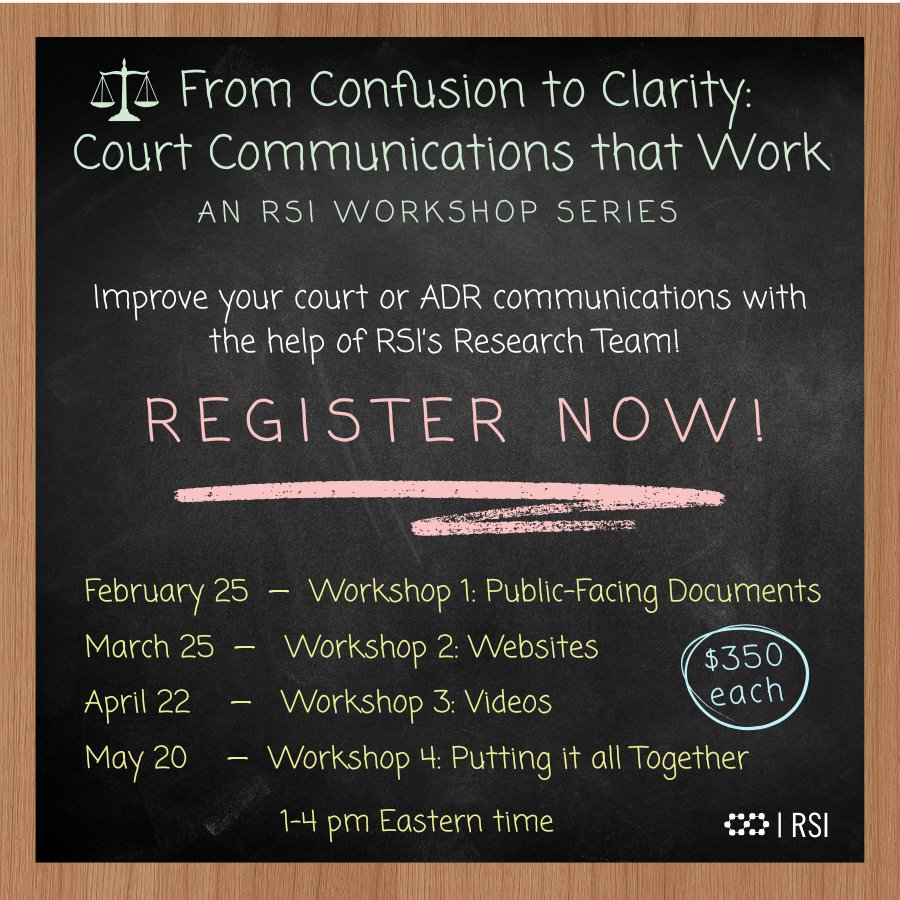
This fall, RSI will present two free webinars for courts, ADR professionals and others. In our series — From Confusion to Clarity: Court Communications that Work — we will offer insights into barriers to program communication and participation and how you can address those barriers. We will provide practicable “good” and “bad” examples and actionable tips on making court communications that your users will understand, trust and use.

So if you took our quiz and it left you wanting to learn more, click on the links to learn more and sign up for our webinars! Webinar 1: Enhancing Understanding While Reducing Stress takes place Wednesday, October 15 from Noon to 1 p.m. Central. Webinar 2: Creating Trust and Addressing the Tech Gap will be on Wednesday, November 12, from Noon to 1.pm. Central.

While participation is free, registration is required.

Grant Helps RSI’s Eviction Mediation Program Better Serve Domestic Violence Victims

Jasmine Henry, July 30th, 2025

Housing insecurity and domestic violence are deeply intertwined. In fact, according to research cited by the American Bar Association’s Commission on Domestic and Sexual Violence, 38% of domestic violence victims experience homelessness, and over 90% of homeless women have experienced severe physical or sexual abuse at some point in their lives. Recognizing this correlation, RSI sought to improve our eviction mediation program and better serve participants who have been affected by domestic violence.

Late last year, RSI applied for funding from the Illinois Equal Justice Foundation (IEJF) to support training our mediators on how domestic violence can affect victims and enable us to develop a more robust screening process to better identify any potential mediation cases involving domestic violence. Since receiving funding in January, we screened approximately 500 eviction mediation cases for instances of domestic violence. Of those cases, 13 were identified as involving domestic violence or intimate partner violence, and victims were referred to a variety of resources. Nine of those cases had mediation process adjustments as a result of domestic violence, such as only using separate Zoom breakout rooms or being assigned the specific gender of mediator requested.

What We Needed

Since the inception of the Kane County Eviction Mediation Program in 2021, RSI’s staff has been committed to creating safe mediation spaces for all parties involved. Designing respectful and responsive spaces for our program participants helps us effect our mission of strengthening access to justice by enhancing court alternative dispute resolution (ADR) systems.

Over the last few years, our program routinely noted instances of domestic violence affecting the parties in our eviction cases. While our staff and mediators tried to remain sensitive to our participants’ emotions and how their experiences might affect the mediation, none of our mediators had domestic violence training, so they were not as well prepared to adjust the mediations to ensure the safety of parties with a history of domestic violence. Additionally, it was difficult for our program and mediators to understand the scope of the issue without a proper screening process. Thus, in November 2024 when an opportunity became available, RSI’s Kane County Eviction Mediation Program applied for grant funding from IEJF to assist survivors of domestic and intimate partner violence through civil legal services and legal information. 

What We Developed

With funding secured, we designed a system to screen for domestic violence prior to eviction mediations and to modify mediations when domestic violence has been present to promote the safety of the parties involved. To screen for domestic violence, we added three questions to our intake process for all parties. These questions asked if anyone who currently lived with them, anyone they were in a relationship with, or the other party in their case had made them afraid, controlled them, hit them or contacted them in unwanted ways. We also asked if they had a current order of protection.

If warranted based on a party’s response to those questions, a staff member then went through the MASIC-S questionnaire with the party to determine what types of modifications were needed. (The MASIC-S is a research-validated screening tool to help mediators identify the types and severity of domestic violence involved. Depending on the party’s responses, it recommends modifications to the mediation process to maintain participant safety.)

While updating our intake process, we also worked to better train our staff and mediators on how to handle domestic violence issues. We held three separate trainings — hosted by the Community Crisis Center in Elgin, Illinois; RSI; and the Center for Conflict Resolution in Chicago. These domestic violence trainings focused on awareness of victim impacts and needs, how to have compassionate discussions about abuse disclosures and trauma-informed practices. Sixteen mediators on our program roster attended all three trainings and became eligible to mediate eviction cases that included a party who had experienced domestic violence.

In June, we decided to eliminate the more intensive MASIC-S step because the full screening took over an hour to complete and the advice provided after the party responded was essentially the same as what our program would have done without using the MASIC-S. There was also a sense among staff that the MASIC-S step may have been retraumatizing for the involved party, and we could not always provide immediate supportive resources to address these reopened wounds.

Who We Helped

Of the 500 defendants screened for domestic violence, 13 defendants were flagged and referred to outside services. All 13 were referred to legal advocacy, rent assistance and housing counseling services. We also gave 29 additional support service referrals to these tenants, including referrals to disability support services, immigration support services, victim support services, food assistance, utilities assistance and homelessness prevention services. Three of the defendants we referred to legal services ended up being represented by a pro bono attorney.

We held mediations for 11 of the 13 cases involving domestic violence. One was dismissed, and another has yet to take place. Based on our screening, we made safety- and security-related process adjustments for nine of the mediations. The process adjustments included keeping the parties in separate Zoom rooms in six of the mediations, holding an early caucus for one case, allowing a support person to attend with the involved party in one case, and providing a female mediator in one case. Eight mediations ended with an agreement. Seven of these agreements were for the tenant to move out; another was an agreed dismissal order, since the tenant had already moved out. These agreements gave tenants the opportunity to avoid the financial and emotional impacts of eviction while also affording them more time to move out.

While it can be difficult to understand the human impact of our program modifications purely based on the number of cases, referrals and process adjustments, the specific instances of domestic violence that participants shared with our staff left a lasting effect.

In a particularly disheartening case, a female tenant reported being sexually assaulted, verbally abused and intimidated by her male landlord over the course of about five months. As a result of her background, she was wary of the police, and she disclosed to our staff that her landlord actively worked to reinforce those fears. She was terrified that divulging his exploitations would hurt her family. Yet as a result of the abuse, she told us, she was forced to go to the hospital for prescription treatment. Shortly after getting medical care, she reported the abuse to the police but did not find their response helpful. Upon returning home, she found that her abuser had locked her out of her unit.

Soon after, the landlord filed an eviction case; he also continued to threaten and intimidate her throughout the court process, she said. When the eviction case was referred to our mediation program, RSI staff referred her to pro bono legal, immigration and victim advocacy assistance. Throughout the mediation process, our program worked with the tenant to get her into a safe living space. In the end, the woman was able to move out prior to mediation. Her landlord dismissed the eviction case without seeking money and without entering a formal eviction onto the tenant’s record.

In another case, a tenant’s past violent relationship was impacting her current livelihood. Several years ago, this tenant was locked out of her partner’s house during a domestic violence incident. This forced the tenant to get an apartment by herself for the first time. She enrolled in a housing assistance program at a nearby domestic violence support organization. After this assistance ran out, the tenant became distressed and ultimately depressed; she could not maintain employment and, by the time she came into contact with our eviction program, she was several months behind on rent. Additionally, as a result of a previous domestic violence incident with her abuser, she could not obtain free legal aid to help with her eviction case.

Our program adapted to the tenant’s unique needs and pivoted from our traditional referrals. We provided services to a different local domestic violence resource, as well as resources for a local hospital that treats depression. We also referred her to rental assistance and a homeless shelter with additional resources.

The mediation resulted in a moveout order and a payment plan. The tenant avoided eviction, had a plan to pay off her debt, and was given support in finding affordable housing. In this way, we were able to help the tenant stem the damage from her past domestic violence experiences. Moreover, the landlord was made whole financially, and the unit was ultimately returned to their possession.

In yet another instance, the program helped a defendant who was living with her abusive boyfriend during an eviction case. During the intake process, the tenant disclosed her physically and emotionally abusive living circumstances. First, our program staff worked with the tenant to create a safety plan while she was still living with her abuser. Then, we supported moving her and her ten children out of their current living situation. Additionally, our program connected the tenant to a variety of resources, including an agency that could help with both domestic violence and housing counseling, a rental assistance program and our legal aid partner.

What We Learned

In six short months, RSI’s eviction mediation team was able to improve its screening techniques and better assist domestic violence victims involved with our program. Whereas previously we only learned of domestic violence if a party happened to bring it up, we now have a clear system in place to sort the cases and help prepare mediators and parties to make appropriate adjustments. Because we are screening every case, we have the opportunity to provide parties access to support resources prior to their mediation if they seek it; in some cases, this resulted in a faster and smoother resolution for both the landlord and the tenant.

Verified by ExactMetrics