
Resources / Study / Innovation for Court ADR

Just Court ADR

The blog of Resolution Systems Institute

The Psychological Complications of Resolving Disputes Online

Jennifer Shack, October 28th, 2019

Online dispute resolution (ODR) can take many different forms, but one element is always present: the participants aren’t interacting in person. Jean Sternlight explores the possible psychological impact of this in her new article, “Pouring a Little Psychological Cold Water on ODR” (forthcoming 2020 Journal of Dispute Resolution).

It should be noted that before discussing the psychology of disputes and ODR, Sternlight opines that the term ODR is used too broadly as it’s used for any technology-assisted dispute resolution. Although she doesn’t state what she means by ODR in her article, the way in which she discusses it points to the conclusion that she is focused more on text-based and algorithmic processes rather than video-based processes.

Starting from the premise that “human disputes are intimately connected to human psychology,” Sternlight states that ODR should be designed to take into account human psychology and that requires an imaginative approach to determining whether and how to incorporate technology into dispute resolution. Even given this, however, she says that we should consider the possibility that humans are better suited than computers to resolve many disputes.

Sternlight explores the psychology of dispute resolution through four areas: the psychology of perception and memory, the psychology of human wants, the psychology of communication, and judgment and decision-making. Perception and memory often differ among those involved in a dispute. In in-person disputes, mediators and lawyers currently take on the role of overcoming parties’ beliefs that their perception is correct and the only possible version. Sternlight questions whether a computer or avatar can have the same effect, as research has found that simply receiving a message on a computer or reading a book aren’t sufficient to shake one’s belief that theirs is the only right view.

When it comes to human wants, people are complex. We don’t always know what we want, and when we do, we often have many different wants, or our wants may change over time. Further, each person may have different wants in the same circumstances. Because of this, Sternlight suggests that “computers are not likely the best tool for helping humans think through how they want to respond to a dispute, and how they might creatively work things out with a fellow disputant.” She concludes that ODR may best be used for disputes that involve wants that are simple and predictable, such as small online purchases.

Communication is another area in which computers may not provide the best forum, although Sternlight does say that computers may make communication easier by enabling fast and low-cost exchanges, and by allowing for the anonymity that some prefer. However, many ODR platforms rely on check boxes and limited exchange of textual information. This does not permit disputants to communicate fully their broad range of beliefs and concerns nor learn about those of the other party. Textual communications also make it difficult to build trust or rapport among disputants.

Sternlight also believes that human mediators, lawyers or friends are more effective than computers in helping humans deal with their emotions and other judgment and decision-making issues. She notes that a trusted person is more likely than a computer to move a disputant off an unreasonable position, even if both convey the same information.  Humans can build rapport and trust and tell persuasive stories, whereas being provided information on a chart or in text will not be as useful.

Sternlight acknowledges that online processes may have their place in dispute resolution, but to do so requires a system design that takes into account human psychology. To figure out how best to approach the resolution of disputes online, Sternlight says that empirical research is required of both online and in-person dispute resolution.

While some readers may not agree with Sternlight’s message, she does offer a thoughtful counterpoint to the current enthusiasm for ODR.

California’s Yolo Superior Court Launches New Online Dispute Resolution Program

Nicole Wilmet, October 25th, 2019

California’s Yolo County Superior Court has launched a new online dispute resolution (ODR) program to resolve debt and money due cases. The program utilizes Tyler Technologies’ Modria® software and guides parties step-by-step through the small claims process. Parties participating in the ODR program will be required to pay a fee of $25. The plaintiff will be responsible for payment, unless the parties agree to split the cost or the defendant agrees to reimburse the plaintiff.

A brochure for the program notes that the ODR process begins after a plaintiff logs in to the platform and registers their case. Then, the plaintiff will use the platform to make an initial demand to the defendant for an amount they are willing to accept to settle the case before trial. The platform then sends an email to the defendant with the demand, at which point the defendant can agree or provide a counter-offer. In the event the parties are unable to reach an agreement during these initial steps, then either party may request a mediator. If both parties agree to mediate, then a mediator will be assigned to the case and the mediator will contact the parties to initiate their confidential online mediation. If the parties reach an agreement during mediation, the agreement will be emailed to the parties for signature. After signing, the agreement is sent to the court and the case is dismissed. However, if the parties are unable to resolve their dispute within 45 days then the case will go to trial.

The court’s website for the program answers questions about the program and includes several informative videos for parties discussing the basics of mediation, how the program works and how to use the Modria® platform.

RSI Conducts Seminars on Court ADR in New Mexico

Just Court ADR, October 24th, 2019

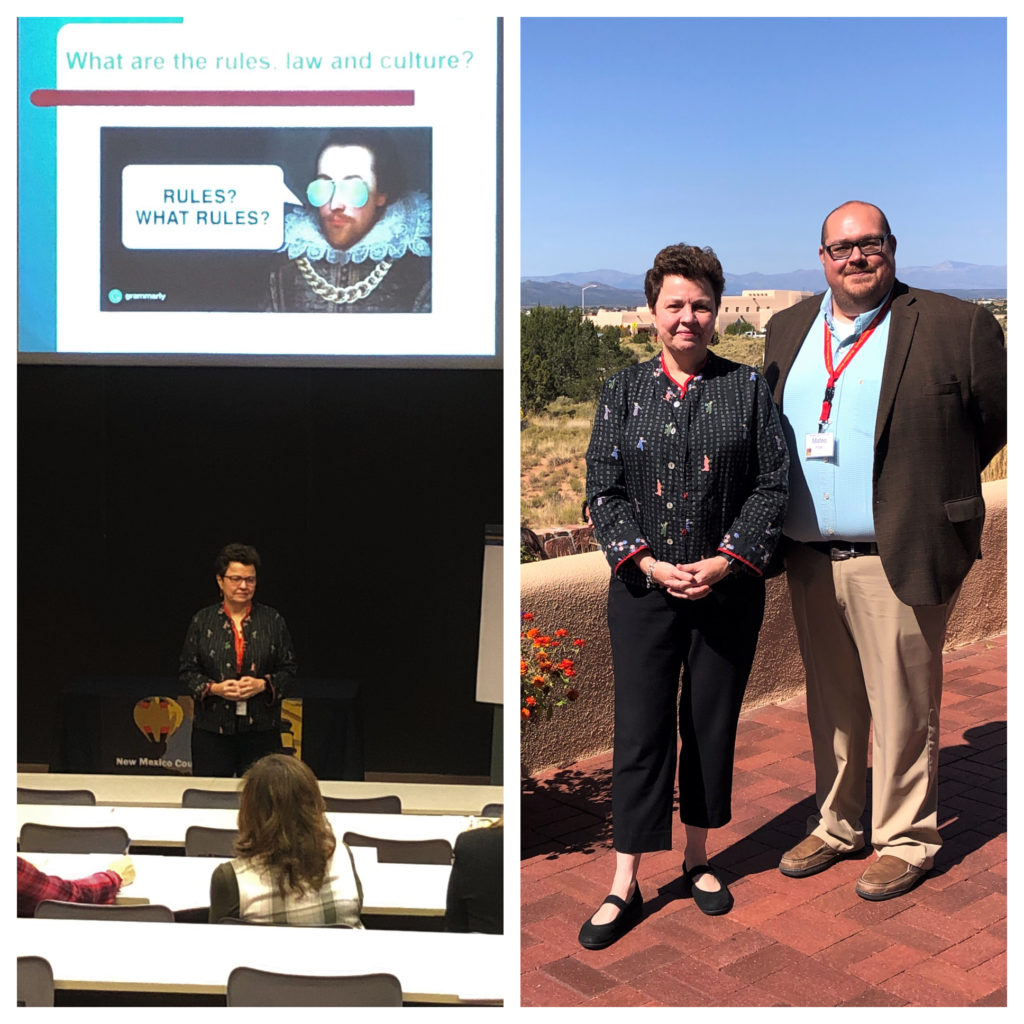
RSI Executive Director Susan Yates conducted a series of three seminars on “Building Your Court’s Civil ADR System” at New Mexico’s statewide ADR conference in Santa Fe on October 9 and 10. The court track at the conference was hosted by the New Mexico Administrative Office of the Courts and the Statewide ADR Commission. Judges, court personnel and mediators from all across the state participated.

The first of the three sessions was called “Design Your Program” and addressed issues such as goal-setting, research, determining which ADR process to use and budgeting. The second session, “Work with Neutrals,” dealt with a variety of topics from determining the criteria for mediators and other neutrals to ensuring continuing quality of services. The third session, “Manage, Track, Evaluate and Promote Your Program,” detailed the many tasks required to maintain a healthy court ADR program. During the seminars, participants had opportunities to work with others from their particular jurisdictions about how to address the issues in their local context. If you are interested in reading more about these topics, visit our Guide to Program Success. To learn about how RSI can work with or provide training for your program, send a message to a member of our staff!

Left to Right: RSI Executive Director Susan Yates during her presentation in New Mexico and Susan Yates with Mateo Page, ADR Statewide Program Manager at the New Mexico Administrative Office of the Courts.

My Favorite Resource Featuring James Alifni

Nicole Wilmet, October 1st, 2019

Our series My Favorite Resource, features interviews with ADR friends across the country to learn about their favorite resources. This month, I spoke with James Alfini, RSI Board Member and Dean Emeritus and Professor of Law at South Texas College of Law, to learn about his favorite resource.

NW: What is one of your favorite ADR resources?

JA: My favorite resource is the Center for Judicial Ethics (CJE) at the National Center for State Courts (NCSC). The Director of the CJE is Cynthia Gray who had been at the helm for well over twenty years when the CJE was located at the American Judicature Society. When AJS was dissolved a few years ago, soon after it had celebrated its 100th anniversary, Cindy Gray and the CJE moved to the NCSC.

NW: How did you first learn about the Judicial Ethics Center?

JA: I worked at the American Judicature Society (AJS) in the 1970s and 1980s and helped to organize the Center for Judicial Conduct Organizations, the predecessor of the Center for Judicial Ethics. AJS, as the premier court reform organization in the twentieth century, had been the catalyst for the establishment of state judicial conduct organizations to receive, investigate, and prosecute charges of judicial misconduct. These were viewed as necessary counterparts to judicial independence to insure that judges were not only independent but accountable to the public and would be held to high standards of conduct. The first judicial conduct organization was established in California in 1961. There are now state level judicial disciplinary organizations in every state and the District of Columbia. The CJE serves a very valuable function in reviewing and cataloging the decisions of the judicial conduct organizations and state high courts. These decisions are based on the judicial ethics rules adopted in each state, and usually referred to as the code of judicial conduct for that state.

NW: Why do you value this particular resource?

JA: The Center for Judicial Ethics is the national clearinghouse for information on judicial ethics and discipline. It is an essential resource for the state judicial conduct organizations in researching instances of judicial misconduct and applying relevant provisions of the code of judicial conduct. It is also the key resource for me and my co-authors of our treatise, Judicial Conduct and Ethics, which is currently in its 5th edition. The CJE also publishes the Judicial Conduct Reporter and other materials on judicial ethics. It responds each year to numerous inquiries from citizens, journalists, lawyers, court administrators and judges. Every other year CJE holds a national conference on judicial conduct and ethics.

NW: What interests you most about judicial ethics?

JA: In a democratic society, it is essential that we have an impartial judiciary of great integrity. That is, a judiciary that is beyond reproach and worthy of the public trust. Standards of judicial ethics permit us to hold our judges accountable and thus worthy of that public trust. It is an essential tool in holding judges accountable for their actions and is thus an important counterpart to the independent judiciary we value in a democratic society.

NW: For those unfamiliar with the Judicial Ethics Center, what’s one aspect of the Center that you wouldn’t want someone new to the resource to miss?

JA: For my colleagues in the court ADR field, I would stress that there are intersections between judicial ethics and court ADR. For example, a provision in the code of judicial conduct in most states requires judges to make appointments impartially and avoid the appearance of favoritism. This would include the appointment of mediators and other dispute resolvers. In Texas, ethical concerns about judicial selection of mediators (often turning on whether the mediator contributed to the judge’s re-election campaign) prompted the passing of a state statute, which mirrored the ethics rule (requiring fairness and transparency in the selection of mediators). The CJE thus offers the court ADR community an important resource on judicial ethics rules and cases.

Verified by ExactMetrics