Last year, a few ADR staff from courts around the US approached RSI to help with a need that was no longer being met elsewhere. Court ADR administrators needed a safe space to be honest and open when discussing the challenges they face as ADR administrators. Other options couldn’t provide a closed, confidential opportunity to learn and exchange ideas. The ADR staff asked RSI to provide that safe space for them. We agreed — who else would be better suited to take on the role of convening a network of court ADR administrators than RSI?
So, in November 2025, the Court ADR Network was launched. With dozens of members signed up, we held our first meeting to figure out what members wanted from the network. We decided to have RSI host quarterly meetings at which an expert — who could be a member — would present on a topic of interest, followed by a group discussion of that topic, or anything else. We also voted on the topics that would be the focus of each of the next three meetings.
The network is open to both state and federal court administrators, from trial to appellate level, and from single courts to statewide offices. It is also open to allied staff, such as in-house researchers and staff mediators. If you fit those categories and would like to join the Court ADR Network, please reach out to jshack@aboutrsi.org.
Our next meeting in February focused on how to work with self-represented litigants, from referral through mediation. I presented on the needs of self-represented litigants, including the importance of effective communication and issues presented by power imbalances when one side has an attorney and the other does not. That was followed by a lively discussion of the role of technology and AI as avenues for access to justice.
The topic of our third meeting, held this month, was mediator recruitment and retention. Josh Pando, the New Mexico Statewide ADR Senior Program Manager, talked about his successful recruitment and retention strategies. Discussion ranged from where to find new recruits, to ways programs engage and educate mediators, to what programs require of volunteer mediators. In August, we will be talking about the use of technology and AI.
The meetings have also provided members with an opportunity to get to network and learn about what different programs are doing. In emails, members have expressed their appreciation for the network, including a new member who recently wrote, “I absolutely loved yesterday’s meeting.” In addition to the meetings, RSI periodically lets members know about resources and learning opportunities.
The network is open to both state and federal court administrators, from trial to appellate level, and from single courts to statewide offices. It is also open to allied staff, such as in-house researchers and staff mediators. If you fit those categories and would like to join the Court ADR Network, please reach out to me at jshack@aboutrsi.org.
Recent research suggests that large-language models (LLMs) acting as facilitators in text-based dispute resolution can be trained to accurately identify human emotions and to intervene to change the trajectory of a dispute when the emotions might otherwise lead to an impasse.
The authors[1] of the August 2025 paper “Emotionally-Aware Agents for Dispute Resolution” recruited students to act as disputants regarding the sale of a basketball jersey. The ultimate dataset included 2,025 disputes, with an average 10.7 messages per dispute.
To allow for comparison with prior research, the researchers initially categorized emotions as others had done to assess LLM capacity to identify emotions in negotiations.[2] The emotions tracked were joy, sadness, fear, love, anger and surprise. The study also used a self-measure frustration scale as an indication of “ground truth” to be used as a benchmark for comparison with the LLMs’ identification of emotions. The dispute participants assessed their level of frustration during the dispute exchange, as well as their perception of the other party’s level of frustration.
GPT-4o’s automatic identification of emotion showed that when sellers respond to buyers’ anger with anger in these dialogues, the anger spirals, and impasse results. They found something similar with compassion. When sellers began with compassion, buyers responded with compassion, and the dialogue more often resulted in agreement.
To set a baseline against prior emotion models, the researchers first ran the disputants’ text exchanges through T5-Twitter, a large fine-tuned model adapted for recognizing emotions.[3] They found that T5-Twitter (T5) failed to recognize anger in conversations that participants had reported as frustrating. The researchers hypothesized that this was because T5 was classifying each dialogue turn in isolation, rather than within the context of the entire interaction. Although they had adopted the emotions used for negotiation research, the researchers also noted that those emotions were more relevant to negotiation than to dispute resolution, which concerned them.
Testing Other LLMs
The next phase of the study was to test the researchers’ hypothesis that general LLMs could better identify emotions than T5 had. The researchers prompted a variety of LLMs to analyze the same dialogues, using different prompting strategies, but with slightly different emotions. They changed the emotion “love” to “compassion” and added a “neutral” category so the LLMs were not forced to choose an emotion when none was apparent. They also prompted the LLMs to consider each dialogue turn within the context of previous turns. Finally, they helped the LLMs to learn within context by including in the prompt several sample dialogue turns with hand-annotated emotions.
Again comparing self-reported frustration with each LLM’s classification of emotions, the researchers found that GPT-4o outperformed T5 (as well as other LLMs). T5 skewed toward annotating utterances as joy or anger, while GPT-4o was more diverse in its assessments and used “neutral” as a dampener by not assigning emotions to unemotional statements. GPT-4o also recognized compassion where T5 did not recognize love.
The researchers then used multiple linear regression[4] to predict participants’ subjective feelings about the result of the dispute resolution effort (as measured by the Subjective Value Inventory) based upon the emotions that T5 and GPT-4o assigned to each dialogue turn. They found that GPT-4o provided the biggest improvement in predicting participants’ feelings about the result, even when accounting for changes in prompts to T5. They also found that buyers were more straightforward to predict than sellers.
Preventing Impasse
The researchers then examined whether GPT-4o could determine when to intervene to de-escalate anger before it escalates into impasse. This would require GPT-4o to identify a pattern of escalation. GPT-4o’s automatic identification of emotion showed that when sellers respond to buyers’ anger with anger in these dialogues, the anger spirals, and impasse results. They found something similar with compassion. When sellers began with compassion, buyers responded with compassion, and the dialogue more often resulted in agreement.
In sum, the researchers demonstrated that properly prompted LLMs with in-context learning can accurately assign emotions to text. Additionally, they found that they could predict subjective dispute outcomes from emotional expressions alone, without knowing the actual content of a conversation.
Researchers can use GPT-4o emotion assignment to reveal how emotions can shape disputes over time: Anger spirals, but so does compassion when it comes early in the dispute. This indicates that LLMs can be trained to know when to intervene in order to change the trajectory of a dispute. Future work will look at how they can do this.
[1] The authors are Sushrita Rakshit, James Hale, Kushal Chawla, Jeanne M. Brett and Jonathan Gratch.
[2] They characterize negotiations as a coming together to create a new relationship (e.g., car salesman and customer), while disputes involve an existing relationship that has gone badly.
[3] I’m extrapolating here, based on the context and what I could find about fine-tuned LLMs.
[4] Multiple linear regression uses several independent variables to predict a specific outcome.
Last year, RSI began the pilot phase of a research project to examine how mediator behaviors might affect parties’ trust during mediation. During this exploration phase, our research team has been observing small claims and eviction mediations and marking down mediators’ communication behaviors, in a process referred to as coding, for the Trust Project. We gathered pre- and post-mediation surveys from the parties, and we interviewed the mediators involved.
From left, Rackham Foundation’s Ava Abramowitz, RSI Director of Research Jennifer Shack and Behavior Analysis Trainer Kenneth Webb gave a presentation on the early findings of RSI’s Trust Project at the American Bar Association Section of Dispute Resolution 2024 Spring Conference in April 2024.
After coding 22 mediations and completing a thorough review of our piloted data collection instruments, RSI has successfully completed our pilot phase. We are excited to share that we will soon be expanding the project and are looking for mediation organizations and/or individual mediators who would like to partner with us.
Method Adapted for Mediation
The Trust Project is based on behavior analysis (BA), a research method that codes for particular communication behaviors and connects them to desired outcomes. This method has been used successfully in negotiations and sales. BA examines the particular behaviors used as well as the sequences of behaviors that occur, to determine their effects on specific desired outcomes. In this instance, RSI is interested in changes in trust between the parties and changes in trust in the mediator. We are also interested in mediation results and participant perceptions of the mediation and the other party.
Over the course of five years, Ava Abramowitz and Ken Webb worked to modify communication behaviors used in the contexts of negotiations and sales for use in mediation — with a lot of input from mediators and researchers. Ava is a former assistant U.S. attorney, longtime mediator and secretary of the Rackham Foundation. Ken is an expert in behavior analysis, coding and training negotiators to improve their practice. He trained RSI’s researchers in behavior analysis. Thanks to generous support from the Rackham Foundation, RSI has the opportunity to conduct this innovative research into the effects of mediator behaviors on party trust.
Watch Michael Lang’s 2021 In Their Voices interviewwith Ava Abramowitz and Ken Webb for more insight into the idea of applying behavioral analysis to mediation — the concept behind the Trust Project!
Mediator Partners Sought
For the next phase of the Trust Project, RSI will observe mediations of small claims, family and larger civil cases, both in person and online. We are looking for partners in this endeavor. Interested organizations and mediators would work with RSI to determine how to effectively recruit parties. Mediators will be asked to complete an initial survey about their background and approach to mediation, to facilitate observations of their mediations, and to complete a survey after each observed mediation. We will preserve confidentiality of the mediations, the mediators and the parties by removing any identifying information from the data.
If you are interested in participating in this impactful research, please contact RSI Director of Research Jennifer Shack at jshack@aboutrsi.org.
Court adoption of text-based ODR allows parties to communicate asynchronously, at their convenience, from anywhere. This suggests that ODR has the potential to increase access to justice, particularly for self-represented litigants,[i] and could lead to increased efficiency and reduced costs for parties and courts alike.[ii] Conversely, however, for parties who lack digital literacy or access to technology, mandated ODR could instead benefit already advantaged parties and leave others behind. Furthermore, in some instances, mandating ODR could reduce access to justice by overriding consent and party self-determination.[iii]
The Texas and Michigan Programs
The programs we evaluated differed in the issues involved and the platforms used. In Collin County, Texas, we assessed a debt and small claims pilot program in a busy Justice of the Peace Court (JP3-1) that used the Modria platform. In Ottawa County, Michigan, we examined a program for post-judgment family matters brought to the Friend of the Court (FOC), an agency under the aegis of the Chief Judge of the 20th Circuit Court. The FOC used the Matterhorn platform. Both programs, however, were intended to be mandatory once the program was referred. And both required that the parties register and communicate via text on the ODR platforms.
Litigant survey responses suggested that many parties were unaware of the ODR program or did not understand its main features. When asked what would make them more likely to use ODR for a similar case in the future, half said more information.
Although the programs we evaluated used different ODR platform vendors, the platforms worked similarly and had comparable limitations. The platforms provided a chat space and permitted third-party facilitation or mediation. Neither was available to those with significant visual impairments or limited English proficiency. Both allowed only one individual per side to participate. This limitation meant that in Texas if a party had a lawyer, the lawyer participated alone. In Michigan, only parties could participate, and those who had lawyers were not referred to ODR.
Possible Reasons for Not Using ODR
Although ODR was ostensibly mandatory in both programs, the majority of parties in each court did not use ODR. In Texas, both parties to a case used the platform in only 81 of 341 cases (24%) referred to ODR. In Michigan, ODR use was twice as high: For the 102 matters in which caseworkers determined ODR was appropriate, 48% used ODR. In 26 of the 53 matters in which the parties in the Michigan program opted not to use ODR, at least one party did not register on the platform.
Survey and interview data suggest a few reasons parties did not use ODR. In both programs, staff indicated they did not send parties who lacked digital literacy to ODR, and litigant survey responses suggested that many parties were unaware of the ODR program or did not understand its main features. In the Texas program, of those who did not use ODR, only one survey respondent (out of ten) indicated having received information about the program. When asked what would make them more likely to use ODR for a similar case in the future, half said more information.
In survey responses for the Michigan program, parties appeared to lack a basic understanding of how ODR worked. Half of the 50 parties surveyed near the start of their matter did not know ODR was offered free of charge.
According to Texas court staff, litigants received information about the ODR program via the notice the court sent to them (or their lawyers) about their court date, and through an email or text from the platform when the court uploaded their case to it — if the court had their email address or cellphone number. Both the notice and the email lacked information about how ODR worked. Similarly, the Michigan program’s automated email and text, platform, and FOC website missed opportunities to educate the parties.
Implications for Courts
Despite their accessibility issues, both the Texas and Michigan programs had similar access to justice benefits. Our evaluations suggest that for those parties who use ODR, the process is convenient. We found that 72% of ODR use in Texas and 52% in Michigan occurred outside of court and office hours, i.e., at times not available to them in traditional dispute resolution methods. However, in both programs, many parties simply did not register to use ODR. In addition, 50% of ODR users who responded to our survey noted that they liked that ODR was easy to use. These findings indicate that ODR can increase convenience.
Nonetheless, our finding that some parties lacked information or had nontrivial misconceptions about ODR also suggests parties did not always make informed decisions about whether to participate. To enhance access to justice and self-determination, courts should incorporate a communications plan. The plan should:
Specify how parties can learn about the program and detail what information court personnel should relay about ODR
Indicate what information about ODR to include on the court’s websites and the ODR platform to educate parties about how to use ODR and its potential risks and benefits
Outline outreach efforts to urge social services or other agencies to inform their clients about the ODR program
Additionally, courts should present information about ODR in a way that is comprehensible to individuals with low literacy. They should also explain the privacy and confidentiality implications of using ODR, especially regarding whether and how communications shared on the platform might be used in subsequent legal proceedings.
Further, ODR offerings should be accessible to all eligible parties. Courts should urge ODR providers to facilitate use by parties with visual impairments and limited English proficiency. Additionally, courts should direct parties who do not have reliable internet access to computers in the courthouse or other community locations — though as a result of limited business hours and privacy concerns, this solution is far from ideal.
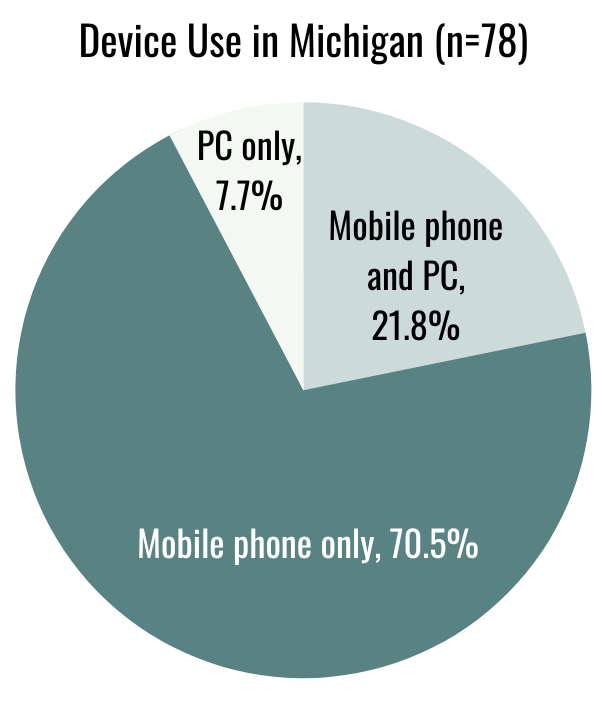
Courts should also ensure that text-based platforms are user-friendly for smartphone users. In the Michigan program, 71% of participants exclusively used a smartphone for ODR. (We did not have information on the devices Texas ODR participants used.) Yet our findings indicate that text-based ODR may be difficult for smartphone users. Courts should urge ODR providers to include in-app voice control to facilitate ODR use on smartphones generally, a change that might be especially important for individuals with disabilities that restrict their ability to type. Parties should also be able to participate in ODR with their attorneys.
Finally, courts should explore ways to maximize access to their platforms for those who lack digital literacy. Usability testing, similar to that conducted for Utah’s ODR pilot program,8 can help identify challenges and potential solutions for given platforms. Courts might also consider providing parties with links to web-based resources or trainings that could increase their comfort with technology.
Given ODR’s current technological limitations and the percentage of the population that continues to lack reliable internet access or digital literacy, ODR is not a panacea for the continued access to justice problem in the U.S. Additionally, our evaluations suggest that parties have different preferences for how to resolve their disputes. To enhance access to justice, and to advance party self-determination, ODR might best serve parties as part of a constellation of alternative dispute resolution (ADR) options rather than being the only form of court-connected ADR.
[i] Amy J. Schmitz, Measuring “Access to Justice” in the Rush to Digitize, 88 Fordham L. Rev. 2381 (2020).
[ii] Amy J. Schmitz, Measuring “Access to Justice” in the Rush to Digitize, 88 Fordham L. Rev. 2381 (2020).
[iii] Amy J. Schmitz & Leah Wing, Beneficial and Ethical ODR for Family Issues, 59 Fam. Ct. Rev. 250 (2021).